
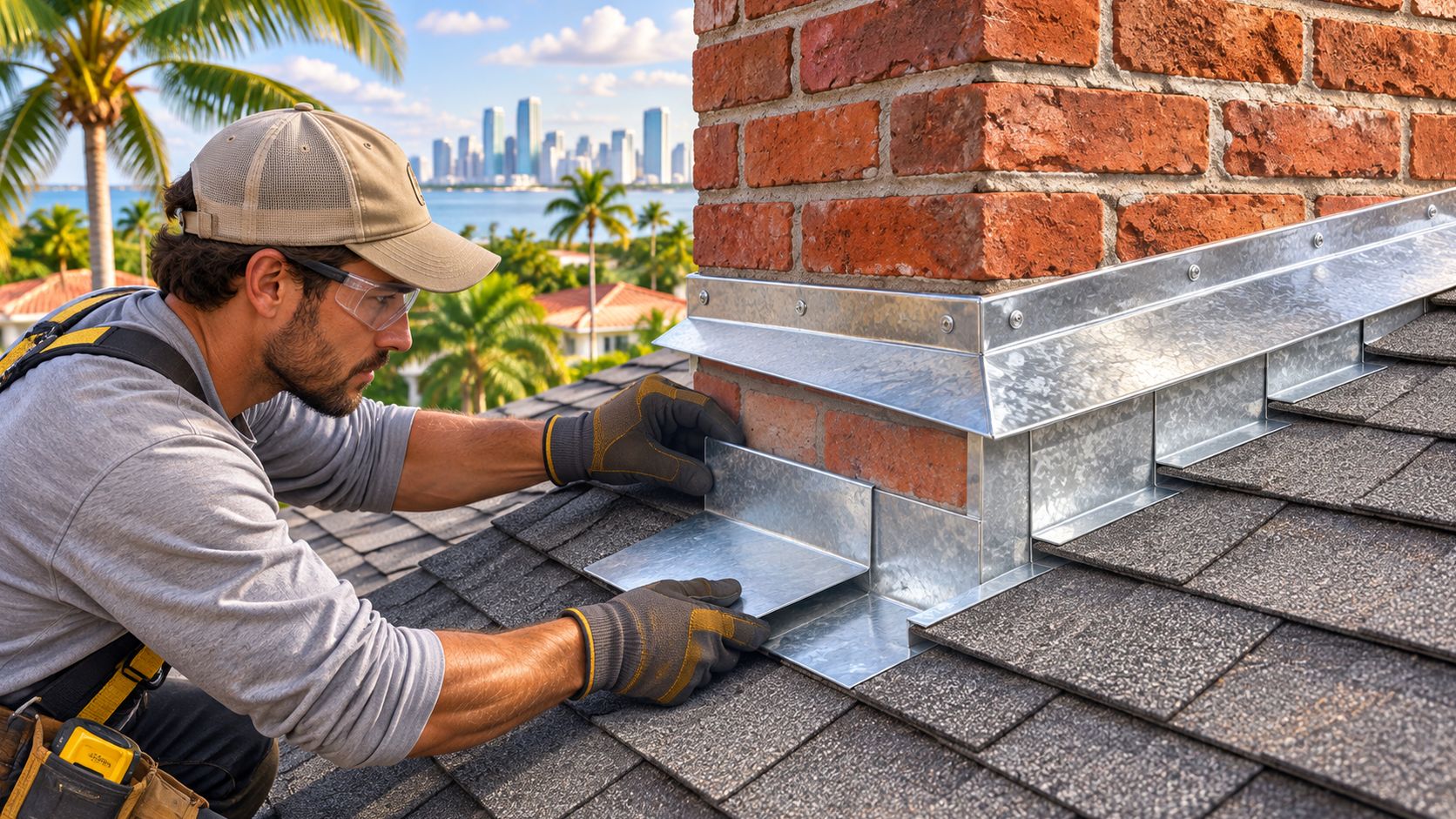
Cost to Replace Chimney Flashing: 2026 Miami Price Guide
In 2026, chimney flashing repair or replacement runs $300 to $1,800, with a common band of $400 to $1,600 and a national average near $1,000. A spot repair on one failed section costs $150 to $500.
Those numbers describe different jobs, and that's where homeowners in Hialeah, Doral and Coral Gables get burned. One published 2026 estimate from Sunflowers Energy's roof flashing cost guide puts full chimney flashing replacement at $800 to $2,500 against $400 to $1,500 for standard repair, so two contractors can both say "replacement" and mean work that differs by a thousand dollars. The price isn't the first question. The scope is.
Across Miami-Dade and Broward, from Miami Lakes and Pinecrest to Palmetto Bay, South Miami, Kendale Lakes, Pembroke Pines and Cooper City, the same leak gets quoted three ways: a bead of sealant, a partial re-flash, or a full rebuild cut into the brick. Wind-load rules, city permitting and storm-claim documentation then change what you pay out of pocket. Match the quote to its scope before you compare totals, and the number starts making sense.
Table of Contents
- Typical Cost to Replace Chimney Flashing in 2026
- How Chimney Flashing Works and Why Scope Changes the Price
- Which Factors Move the Price of Flashing Work
- How to Read a Chimney Flashing Quote Line by Line
- When Full Chimney Work Is Required Instead of a Patch
- Insurance and Permit Rules That Change Your Out-of-Pocket Cost
- Book a Free Inspection Before You Approve the Work
Typical Cost to Replace Chimney Flashing in 2026
The headline range is real, it's just wide. HomeGuide data summarized in a 2026 chimney flashing cost guide puts typical repair or replacement at approximately $300 to $1,800, while MeasureScout's 2026 summary of Angi's figures reports a national average of about $1,000 with most homeowners paying $400 to $1,600. A limited spot repair, patching or re-securing one failed section, generally costs $150 to $500, and resealing otherwise sound metal may begin near $200.
2026 chimney flashing costs by scope
| Scope | Typical cost | What the price covers |
|---|---|---|
| Sealant reseal of sound metal flashing | from about $200 | Cleaning and resealing intact metal, no new flashing |
| Spot repair of one failed section | $150 to $500 | Patching or re-securing one damaged piece |
| Full step and counter flashing replacement | $400 to $1,600 (common range) | Removing old metal, new step and counter flashing, sealant, cleanup |
| Large or stone chimney, or complex roof | $1,800 or more | Extra access equipment, masonry cutting and repointing, larger fabrication |
| Emergency service after an active leak | Labor up to $300 per hour | Temporary sealing and urgent access, billed above standard rates |
Read the rows as five different products, not five prices for one product. A reseal buys you cleaned joints and fresh sealant on metal that's still doing its job. A full replacement buys you demolition, new metal on all four faces, and integration back into the roof covering. Comparing a low quote to a high one without checking which row each sits in tells you nothing about value.
Why the same leak gets five different prices
The visible stain is rarely the full scope. Once old flashing comes off, someone has to cut mortar joints, repoint them, replace both step and counter flashing, and haul the debris away, and that labor and disposal is what separates the bottom row from the top. The same 2026 cost guide notes that excessively large or stone chimneys may exceed $2,000, because access, fabrication and masonry work all scale up together.
Emergency pricing works on a different clock. When water is actively entering the house, you're buying immediate access and temporary protection, not a finished assembly, and the hourly rate reflects that urgency.
Estimating rule: Ask which row a quote belongs to before you ask why it costs more than another one. A cheap patch and a full re-flash aren't competing bids, they're different jobs.
How Chimney Flashing Works and Why Scope Changes the Price
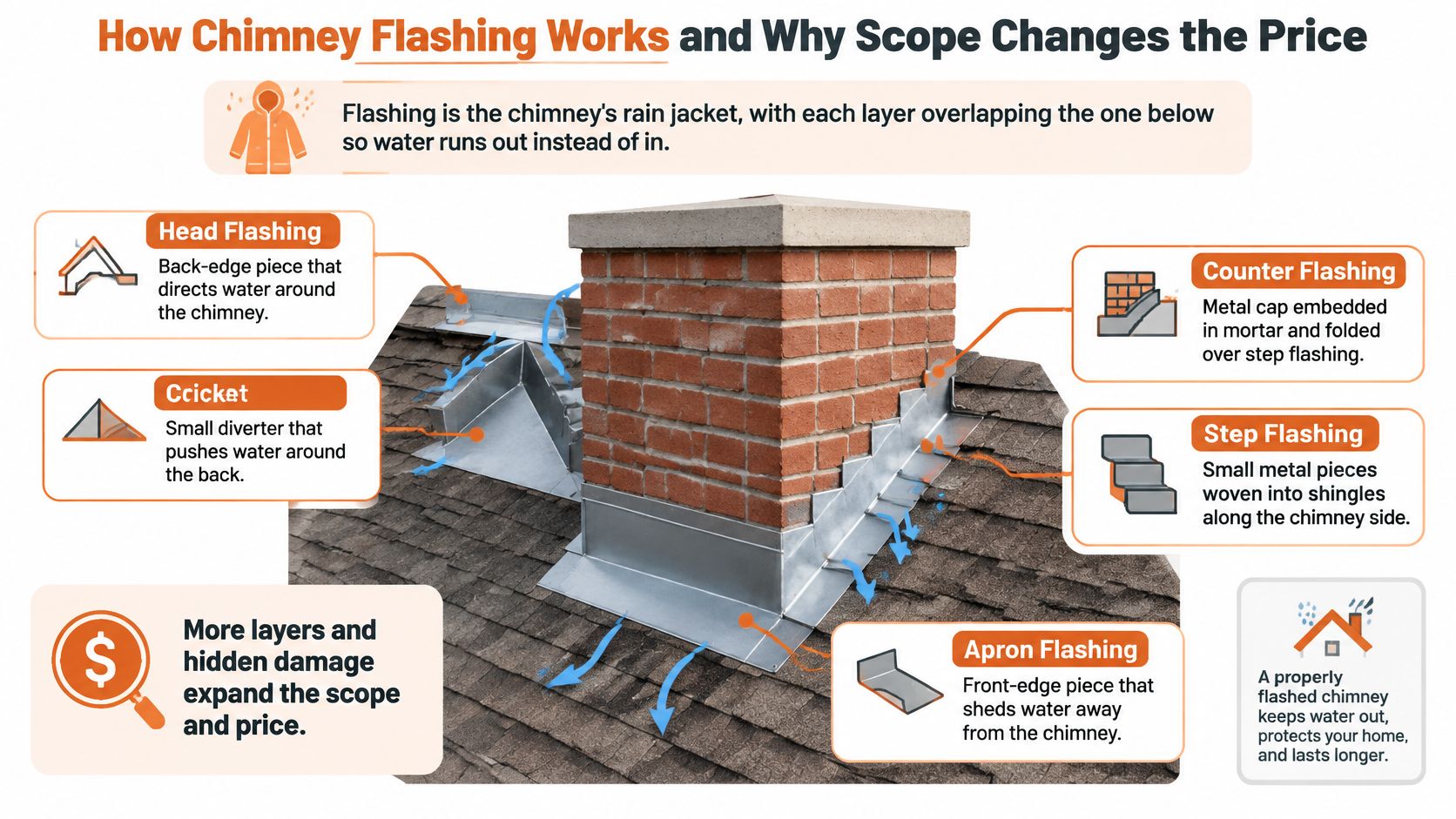
Flashing is the chimney's rain jacket. Each layer overlaps the one below it so water runs out onto the roof instead of in behind the brick, and the whole system depends on that overlap order staying intact.
The four pieces you can point to in a roof photo
- Apron flashing runs across the downhill face at the base of the chimney and carries water off the brick onto the roof below.
- Step flashing is a set of L-shaped pieces woven between shingle courses along each side, each one lapping over the piece below it.
- Counter flashing is the second layer, set into the mortar joints or a sawn reglet and folded down over the raw upturned edge of the step flashing.
- A cricket is the small peaked saddle behind a wide chimney that splits water and sends it around both sides instead of letting it pond against the back wall.
What the code minimums actually require
The 2021 International Residential Code provisions summarized in this chimney flashing installation detail guide specify step-flashing legs of at least 4 inches by 4 inches and corrosion-resistant sheet metal at least 0.019 inch thick, equivalent to No. 26 galvanized sheet. Those two numbers are the fastest way to test a vague bid. If a contractor won't state leg dimensions and metal thickness, you can't tell whether you're buying a code-compliant assembly or thin coil stock bent on site.
That's also why sealant alone isn't a repair. A bead over an exposed joint has no overlap, no mechanical attachment to the masonry, and no movement tolerance, so it hardens, cracks and opens at the same joint that leaked before. The same transition logic governs other roof penetrations, and our guide to repairing leaking skylights walks through the identical layering problem at a curb.
Rebuilding means lifting surrounding courses, pulling every old piece, cutting the mortar, setting new counter flashing into the reglet, repointing it, and re-weaving the step pieces in order. That's skilled hours, not a caulk gun, and it's the honest reason a full replacement costs multiples of a reseal.
Which Factors Move the Price of Flashing Work
Roof access can change a flashing quote substantially before the crew removes any metal. A single-story ranch with a walkable pitch offers a simpler setup than a steep roof or a two-story home in Palmetto Bay. Staging, lifts and fall protection add setup time, while difficult footing slows fitting and fastening. Compare access conditions before treating a lower total as better value.
Access, masonry and metal
Chimney size and masonry condition affect how much cutting and repointing the job needs. A small brick stack with sound joints is a different scope from a wide stone chimney with deteriorated mortar. Stonework needs careful cutting to avoid damaging the face, and crown repairs may need attention before flashing work proceeds.
The metal premium is only part of the difference.
Copper costs more than galvanized steel in both material and fabrication terms. Folded and soldered copper seams add labor compared with lapped and sealed details. On a wide chimney with extensive counter flashing, the extra material and fitting work increase together. A copper bid and a galvanized bid therefore need more comparison than their final totals.
Cost drivers, lower-cost versus higher-cost cases
| Factor | Lower-cost case | Higher-cost case |
|---|---|---|
| Chimney height and roof access | Single-story home, low-pitch roof | Two-story home or steep slope needing staging or lifts |
| Chimney size and masonry | Small brick chimney, minimal cutting | Large or stone chimney, extensive cutting and repointing |
| Flashing material | Galvanized steel | Copper, plus added fabrication labor |
| Roof planes and water diversion | Single roof plane, no cricket needed | Roof junction requiring a cricket |
| Hidden damage | Sound decking and masonry under old metal | Rotted decking or damaged masonry found after removal |
Consider a two-story Hialeah home with a wide brick chimney at a roof junction that requires a cricket. Copper, long step-flashing runs on both slopes and lift access place that job toward the higher-cost side of the comparison. A single-story Kendale Lakes home with a narrow stack, one roof plane and galvanized flashing has a simpler scope. The difference comes from the assembly and access, not from either job being exempt from applicable code requirements.
Hidden damage can turn an apparently small flashing repair into a larger roof repair. Rotted decking and crumbling mortar behind the old metal may remain concealed until removal. A cheap patch can leave that damage untouched.
The estimate should explain how concealed repairs will be priced, using an allowance or a unit rate for decking rather than assuming everything underneath is sound. Keep that potential work separate from the known flashing scope so you can compare bids fairly. Our breakdown of roof repair cost explains how those substrate repairs fit into the wider roofing expense.
How to Read a Chimney Flashing Quote Line by Line
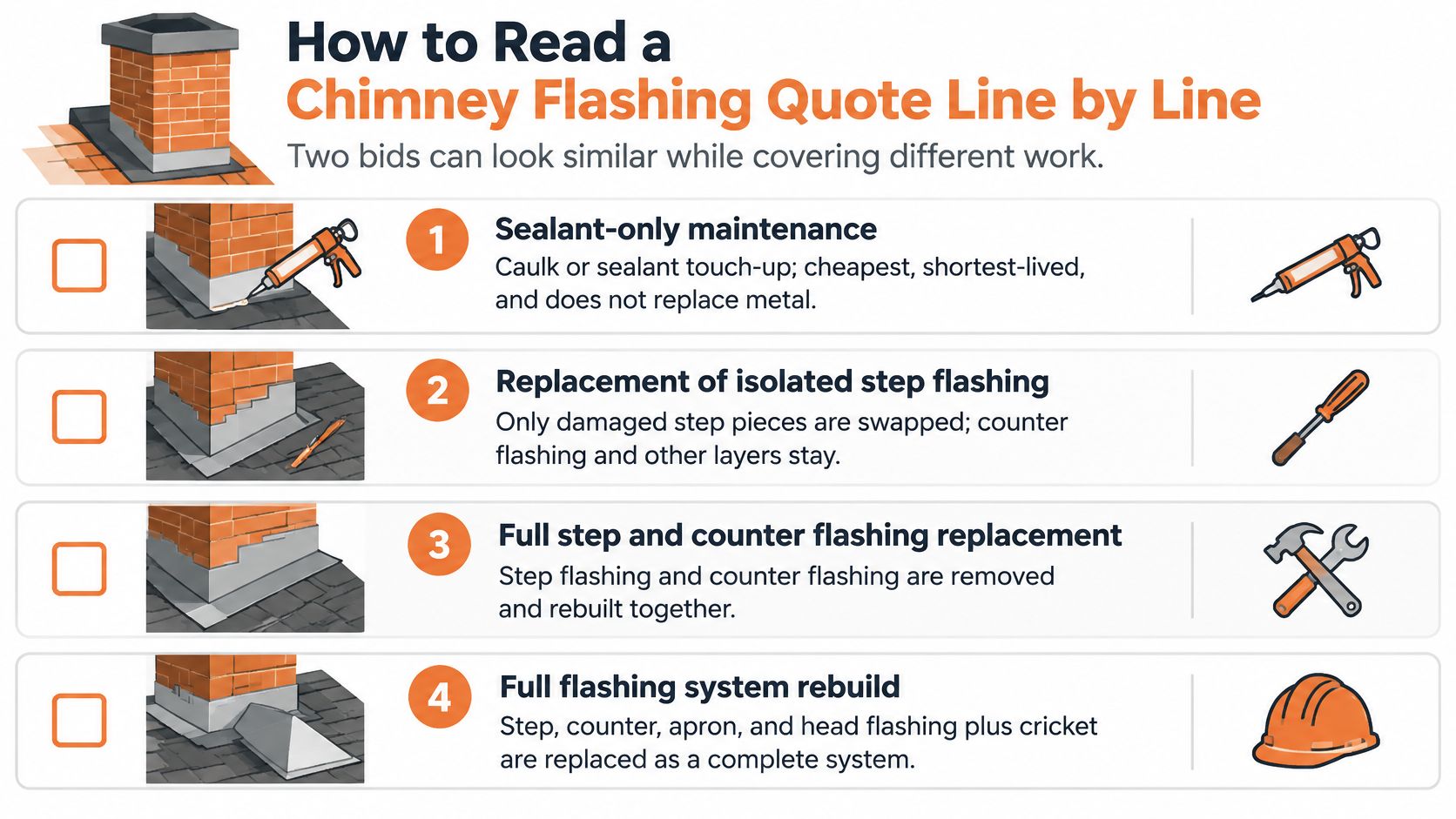
Two bids can look similar and cover entirely different work. Before you compare totals, sort each quote into one of four scenarios: sealant-only maintenance, replacement of isolated step flashing, full step and counter flashing replacement, or flashing plus damaged masonry and roof-deck repair.
The line items a real quote names
- Inspection included. Someone has to get on the roof and identify the failure point, or the price is a guess.
- Removal of existing metal. Old pieces left in place under new ones trap water and hide corrosion.
- Metal type and gauge. Galvanized, aluminum or copper, stated with thickness, so bids are technically comparable.
- Step-flashing dimensions. Leg length decides whether water lands on metal or behind it.
- Counter-flashing attachment. Mortar reglet or surface-mounted, the single biggest durability difference in the assembly.
- Cricket inclusion. If the geometry needs diversion and the quote is silent, that cost arrives later.
- Underlayment transition. The flashing has to tie into the water-shedding layer, not sit on top of it.
- Mortar cutting and repointing. This is mason's time and should be priced as such.
- Integration with shingles or tile. Tile and barrel-tile roofs need different pan and closure details than shingle courses.
- Cleanup, disposal and permits. Debris, magnet sweep and permit fees belong in the total, not in a surprise invoice.
Labor deserves its own line. Published chimney repair cost estimates place masonry and chimney labor around $50 to $150 per hour, so a quote that hides all labor inside one averaged number gives you no way to judge whether the hours match the scope.
A quote that lists sealant but never names the metal is pricing a patch, not a replacement.
Red flags and the photos to send first
Watch for three signals: one averaged price with no line items, no mention of removing old metal, and sealant specified with no metal type or gauge. Any of them means you're comparing a patch against a rebuild without knowing it.
Before you call anyone, send a short photo set: the chimney base and apron, both side walls showing step and counter flashing, the uphill face and any cricket, the mortar joints close up, the chimney crown from above, and the interior stain with its date. Add the chimney's width and height above the roof, the roof covering type, and the number of planes meeting the stack. That package lets a contractor separate a flashing failure from a roof-covering, crown or masonry problem before a truck rolls. During our free on-site inspection, the crew gets on the roof, photographs what they find, and tells you whether you need a repair or a replacement.
When Full Chimney Work Is Required Instead of a Patch
The cheapest immediate patch isn't always the lowest total cost. A bead of sealant over failing metal buys a season, moves the leak a few feet, and can leave damaged masonry and wet decking untreated behind a surface that looks finished.
Triggers that mean price the full scope
- Leaks in more than one place around the chimney, which points to a system failure rather than one bad joint.
- The same leak returning after an earlier patch, the clearest signal that the metal or the mortar underneath is done.
- Metal corroded through or pulling away from the masonry, where there's nothing left to seal against.
- Flashing held only by sealant, with no reglet and no mechanical attachment.
- Damaged masonry or decking behind the flashing, which no new metal will fix on its own.
Replacement is worth pricing when there are leaks in several places or the same leak keeps coming back. If two or more of these triggers apply, ask for the full scope priced out, then decide. Patching by default is how homeowners spend three years of small invoices and still buy the rebuild.
The code math behind repeated patching
Under the Florida Building Code, if more than 25% of a roof section is repaired or replaced within 12 months, the whole section must be brought up to current code. Several small patches around a chimney can add up to compliance work on the entire section, so confirm the current code section and how your building department applies it before you commit to a patch-first strategy.
Miami-Dade and Broward sit in Florida's High-Velocity Hurricane Zones under the state's wind-load design framework, and design speeds differ by building risk category rather than one universal number. The Florida wind speed data history published by FGDL lists the 2023 Florida Building Code three-second-gust values below.
| Risk Category | Miami-Dade design wind speed | Broward design wind speed |
|---|---|---|
| I | 165 mph | 156 mph |
| II | 175 mph | 170 mph |
| III | 186 mph | 180 mph |
| IV | 195 mph | 185 mph |
These are structural design inputs, not forecasts or hurricane categories. Risk category follows the building's importance and occupancy, so a house in Pembroke Pines, a warehouse and a multifamily building in Cooper City aren't evaluated identically. Flashing, counter flashing, fasteners and transitions have to fit the roof assembly and that code environment, which is why we install panels, ridge, drip edge and flashing to the manufacturer's spec for the High Velocity Hurricane Zone.
Smearing sealant over an exposed leak doesn't demonstrate compliance with anything.
Insurance and Permit Rules That Change Your Out-of-Pocket Cost
Insurance may cover flashing when the damage follows a covered event such as a storm or impact, but typically not deterioration or deferred maintenance, according to consumer coverage guidance on chimney flashing repair. A storm-torn flashing edge is a covered-event question. A joint cracked open by years of weathering is a maintenance cost, and no adjuster treats them the same.
Documenting a storm claim
Build the file before anyone touches the metal: dated photographs, the weather-event timing, interior water evidence, inspection notes, and an itemized estimate that separates storm damage from pre-existing corrosion or failed sealant. Emergency work carries a premium, so tarp or temporarily seal, notify the insurer, confirm permitting, then do the permanent repair once the full assembly is documented. We provide insurance claims assistance including damage documentation support, working directly with the insurer, and guidance on repair versus replace, and our Miami insurance claims support page explains how that coordination runs. Minor, cosmetic repairs are often cheaper paid out of pocket than filed as a claim, since a claim can raise your premium.
Permits depend on your city, not your county
Miami-Dade County's official municipality directory lists 34 incorporated municipalities plus unincorporated communities, so Hialeah, Doral, Coral Gables, Miami Lakes, Pinecrest, Palmetto Bay, South Miami and unincorporated Kendale Lakes can each run different procedures and inspection scheduling. Broward cities such as Pembroke Pines and Cooper City must be confirmed with their own building departments. A full roof replacement in Hialeah always needs a City of Hialeah permit, and most repairs beyond minor patching do too.
Whether your job needs one depends on the governing jurisdiction and on whether the work touches structural masonry or only roof flashing. Check the directory to identify your municipality, then ask who pulls the permit and whether it's in the quote. On replacements, we handle permits for the customer.
Book a Free Inspection Before You Approve the Work
A free roof inspection can settle most of the uncertainty around a chimney flashing quote in a single week. The useful part is not just the price. It is getting someone on the roof to confirm whether the leak is tied to failed counter flashing, a chimney base issue, or a wider roof problem that changes the scope.
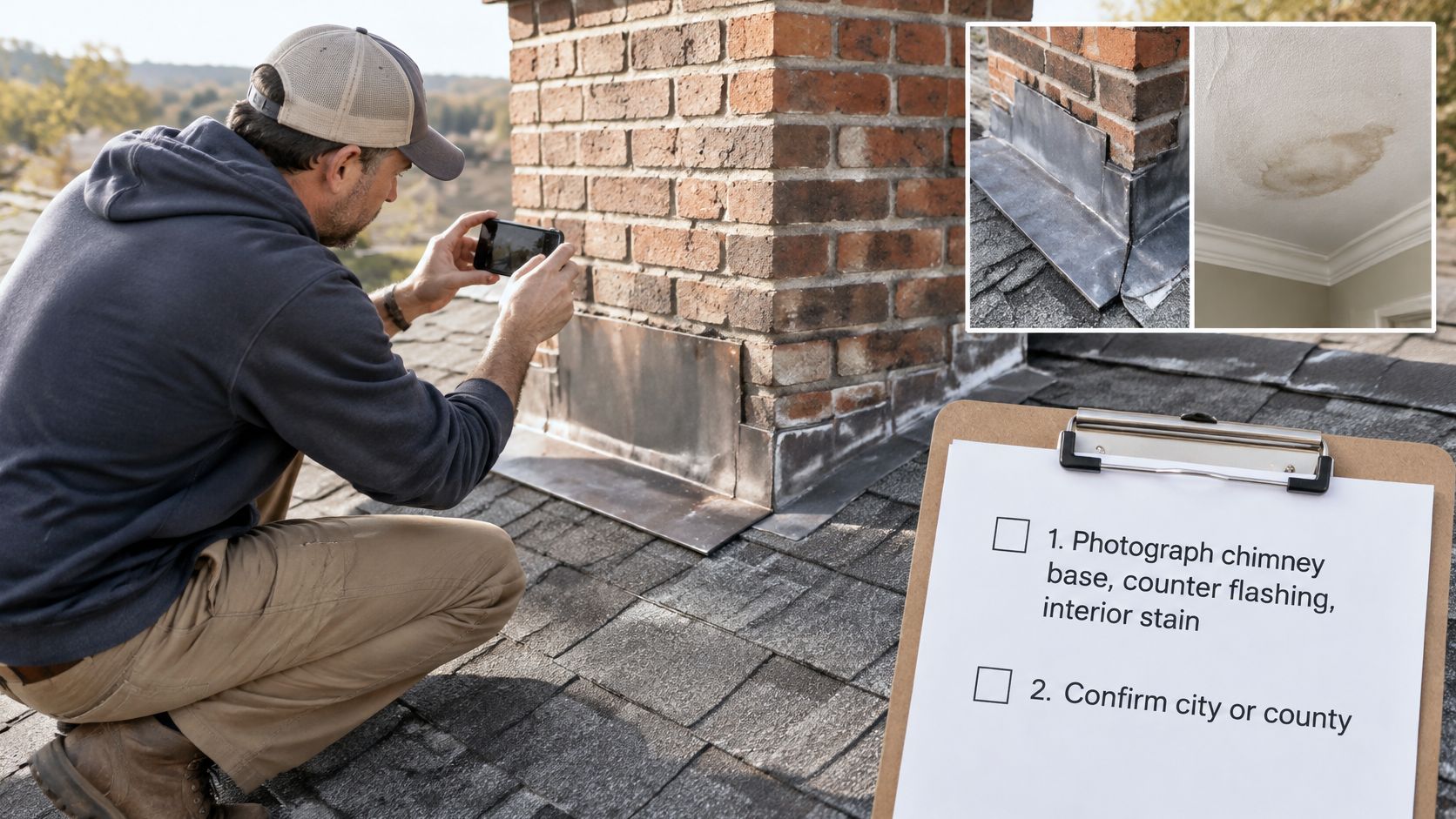
Before you approve work, use this short sequence:
- Photograph and date everything. Capture the chimney base, counter flashing, mortar joints, and the interior stain, with the date each photo was taken.
- Confirm your governing city or county for permits, since a Hialeah address and an unincorporated Kendale Lakes address don't follow the same process.
- Request an itemized quote against the line-item checklist, with labor broken out and metal type and gauge stated.
- Check the quote against the full-work triggers. If two or more apply, have the complete scope priced so you're choosing between real options.
- Book an inspection before accepting any single averaged price, because nobody can specify counter-flashing attachment from a phone call.
A cheap patch can hide the larger job. That happens when the visible seam is sealed but the step flashing, counter flashing, or surrounding roof area is still allowing water in. The point of an inspection is to make the quote match the actual assembly, then compare prices on the same scope.
Rooftop Solutions is a licensed Hialeah-based roofer with more than 20 years across Miami-Dade and Broward, and the work is done by our own trained crews rather than subcontractors. We offer a free inspection and a free estimate, same-week response on repairs, and emergency storm repair with rapid tarping when water is actively coming in. Our service coverage includes Hialeah, Doral, Miami Lakes, Coral Gables, Pinecrest, Palmetto Bay, South Miami, Kendale Lakes, Pembroke Pines and Cooper City.
For home-service teams, intake speed matters too, and never miss an emergency plumbing call is a useful example of keeping urgent calls from being lost.
Confirm the scope first, then compare prices. In that order, every time.
Rooftop Solutions sends its own crew onto your roof for a free inspection, photographs the apron, step and counter flashing and any interior staining, and gives you a straight repair-or-replace recommendation with an itemized estimate instead of one averaged number. We handle permitting on replacements and can price the full step-and-counter-flashing scope alongside a patch so you see exactly what each buys. If your chimney is leaking in Hialeah, Doral, Coral Gables, Pembroke Pines or anywhere else we serve, visit Rooftop Solutions to book your free inspection before you approve any work.
