
Roof Repair Cost in Miami-Dade and Broward
Most Miami-Dade and Broward roof repairs land between $400 and $2,000 for minor fixes, but a small leak can jump past the $4,699 national repair average once Florida wind-load corrections, decking, and permitting enter the scope. If the roof is coming apart after a storm, the actual number depends on what's broken under the stain, not the size of the stain.
A Hialeah homeowner staring at a watermark on a bedroom ceiling usually wants one thing, a straight answer. The straight answer is that roof repair cost in South Florida is a scope problem, not a stain problem, and the quote only makes sense when it matches the actual damage and the code the roof has to satisfy.
Table of Contents
- What a Roof Repair Actually Costs in South Florida
- The Six Line Items That Drive Every Roof Repair Quote
- From a Service Call to a Structural Job
- How to Read a Roof Repair Estimate the Right Way
- Hurricane Code and Why Repairs Are Not Just Patches Here
- Local Pricing Realities Across Miami-Dade and Broward
- Smart Ways to Control What You Actually Pay
- When to Call a Local Crew and What to Ask For
What a Roof Repair Actually Costs in South Florida
A Hialeah homeowner calls after a storm and says the ceiling has a brown mark near the guest room. That call can turn into a simple flashing repair, or it can uncover soft decking, failed underlayment, or water traveling farther than the stain shows. That's why the first number you hear from a contractor is only useful if you know what it's tied to.
The national benchmarks help, but they don't settle the bill. Verisk's roof-cost data puts the average residential roof repair at $4,699 and the average replacement at $17,631, while also showing roughly $31 billion in U.S. roof repair and replacement spending in 2024, nearly 30% higher than in 2022 (Verisk methodology and roof-cost data). Those figures are useful as a reality check, not as a quote for a specific house in Hialeah, Doral, or Coral Gables.
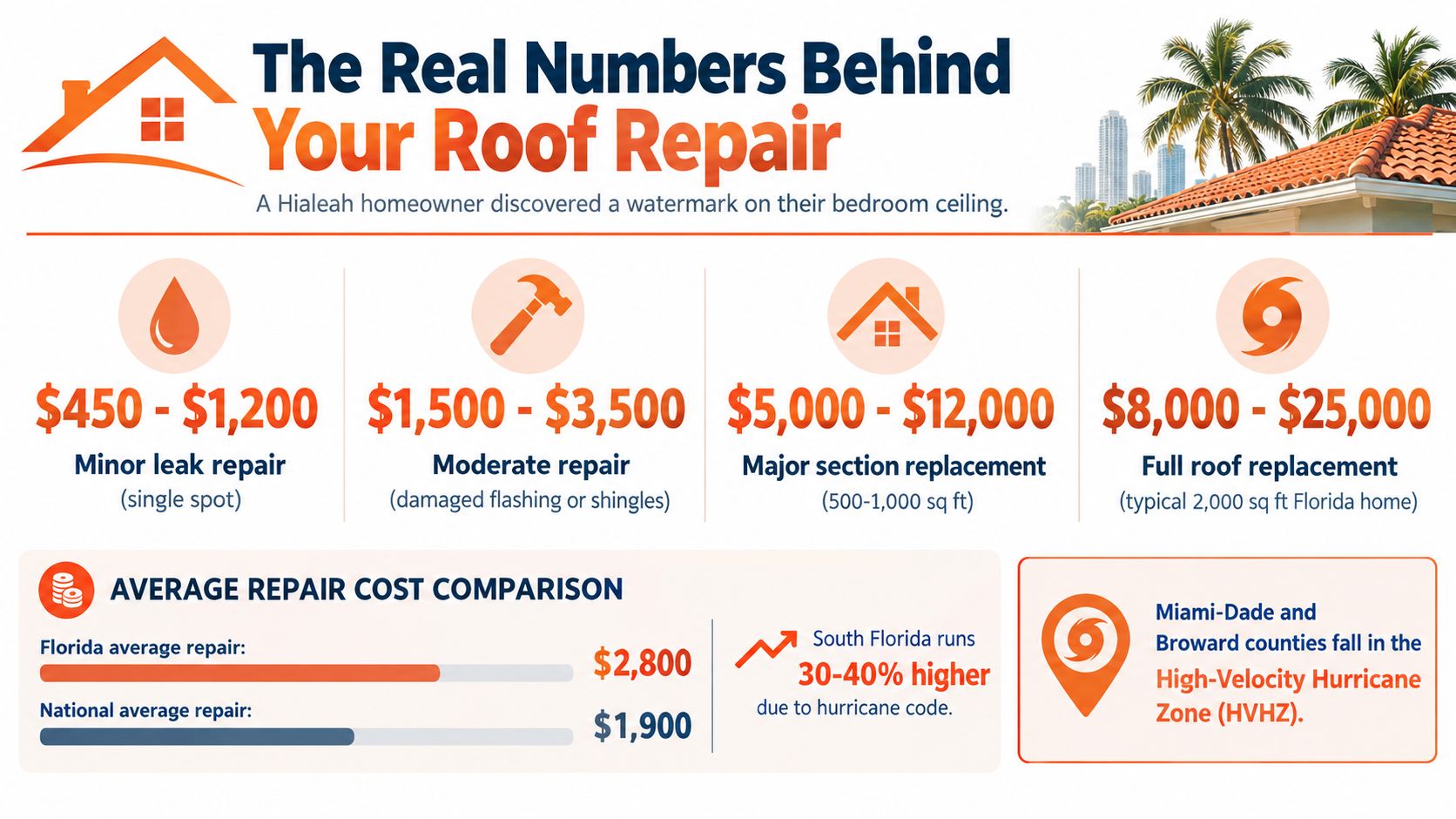
A flashing issue can stay relatively contained if the surrounding assembly is sound. A leak that reaches decking, underlayment, or interior finishes is a different animal, and that's where the invoice starts climbing fast.
Practical rule: if the contractor can't tell you what's broken, what's exposed, and what has to come off to make the roof watertight again, the price isn't defensible yet.
The way to read a roof repair cost in South Florida is simple. A small visible defect can still hide a bigger repair, and the only honest estimate is the one that starts with an on-site diagnosis and ends with a written scope.
The Six Line Items That Drive Every Roof Repair Quote
Most homeowners compare quotes as if they were comparing one number. That's the mistake. A real roof repair invoice is built from six moving parts, and each one can change even when the damaged area looks small from the ground.
Labor is usually the first place people underestimate the price. BLS-based reporting places the U.S. median roofer wage at $26.65 per hour, or $55,440 annually, for May 2025 (roofing cost report). That's not what you pay on the invoice, because the contractor still has to cover payroll taxes, workers' comp, supervision, vehicles, equipment, estimating, and warranty risk.
What belongs in a defensible estimate
A clean estimate should spell out the repair in plain English, not hide behind one blended number.
- Labor: crew size, estimated hours, and whether the job needs a foreman or specialty installer.
- Materials: shingles, tiles, flashing, underlayment, sealants, fasteners, and any matching components.
- Disposal: removal of tear-off debris and haul-away.
- Permitting: county or city paperwork, inspections, and sign-off.
- Access: ladder setup, lift rental, protection for landscaping, or steep-roof safety measures.
- Risk allowance: hidden damage, weather delays, or concealed deterioration that can't be priced without opening the roof.
That's why one roofer can say a leak is a quick fix and another can quote a much higher number. They may both be right, if one is pricing only the visible patch and the other is pricing the actual repair boundary.
The best habit is to ask for the unit of repair, not a vague total. If you want a clean example of how inspections should support that process, start with roof inspections before you compare bids.
From a Service Call to a Structural Job
A leak doesn't start out as a structural problem. It starts as a symptom, then the scope decides how far the repair has to go. In South Florida, that jump from small to serious happens fast because moisture, heat, and wind exposure punish weak points.
A service call is the lowest tier. That's the trip to locate the leak, identify the entry point, and document the damage before anyone touches the roof. Once the crew has to open surrounding materials, replace flashing, or patch a few damaged shingles, the job moves into a different price band.
Repair tiers that make sense on Miami-Dade roofs
| Repair Tier | Typical Scope | Price Range |
|---|---|---|
| Service call | Leak tracing, photos, written findings | $150 to $400 |
| Minor repair | Flashing swap, small shingle or tile replacement | $400 to $1,200 |
| Moderate repair | Underlayment, decking patch, or larger tile work | $1,200 to $3,500 |
| Structural or storm-related repair | Wider assembly repair, repeated leaks, or replacement territory | $3,500 and up |
A tiny leak can still end up in the upper tiers. If water has migrated under the visible defect, the repair boundary gets bigger, and the invoice follows the boundary, not the stain. That's especially true when the roof has brittle materials, old fasteners, or damage that only becomes obvious after the surface is opened.
A repair quote is only cheap if it actually fixes the leak the first time.
If a contractor talks like every leak is a tiny patch job, be cautious. If they open the roof, document the damage, and explain why the repair has to stop where the wet area stops, that's the kind of detail a homeowner can trust.
How to Read a Roof Repair Estimate the Right Way
A good estimate doesn't just give you a price. It tells you exactly what the company is repairing, what it's excluding, and what happens if hidden damage shows up once the roof is opened. Without that, you're buying guesswork.
Start with the repair unit. A serious quote should say things like linear feet of flashing, number of shingles or tiles, square footage of decking, or the specific section of underlayment being replaced. If the document only says “roof leak repair,” it's too thin to compare.
Red flags that should slow you down
- Square-foot pricing with no scope: that usually hides the work.
- No permit language: especially risky in municipalities where code enforcement matters.
- No photo support: if nobody documents the failure mechanism, you can't tell whether they found the source.
- No warranty detail: workmanship and material coverage are not the same thing.
- No exclusion list: if the estimate doesn't say what's not included, surprises are coming.
The biggest mistake is letting someone replace surface material without fixing the thing that made it fail. Bad flashing, loose fasteners, drainage trouble, and rotten substrate all produce repeat leaks, and repeat leaks mean a second mobilization charge.
A written scope should separate diagnosis, visible roof work, concealed damage, and compliance costs. If those four pieces aren't separate, the estimate isn't really an estimate, it's a sales number.
Hurricane Code and Why Repairs Are Not Just Patches Here
Miami-Dade and Broward are not normal roofing markets. The High-Velocity Hurricane Zone rules change what a repair has to survive, and those rules are a major reason a South Florida job costs more than the same job in a mild-weather state (Florida HVHZ and municipal code materials). In Miami-Dade, the design wind velocity is 175 miles per hour, and in Broward it's 170 miles per hour, measured as a three-second gust.
That wind exposure changes the repair itself. If you're replacing shingles, flashing, or attachment components, the contractor can't treat the job like a casual patch. Roof coverings, skylights, doors, glazing, and related envelope components all have to meet impact-test criteria or use approved protection, and fastener requirements tighten as wind exposure rises.
What code pressure does to a repair invoice
The cost rise doesn't come from bureaucracy alone. It comes from the extra labor, better materials, and compliance work needed to make the roof legal and durable in a hurricane zone.
- Fastening gets stricter: above 110 miles per hour, shingles need fastening based on qualifying ASTM D3161 testing or the Miami-Dade County PA 107-95 standard (municipality directory roofing provisions).
- Assembly details matter: flashing, penetrations, and roof covering attachments have to fit the approved system.
- Permits matter: a repair can become a permit job once the scope is big enough or structurally relevant enough to trigger inspection.
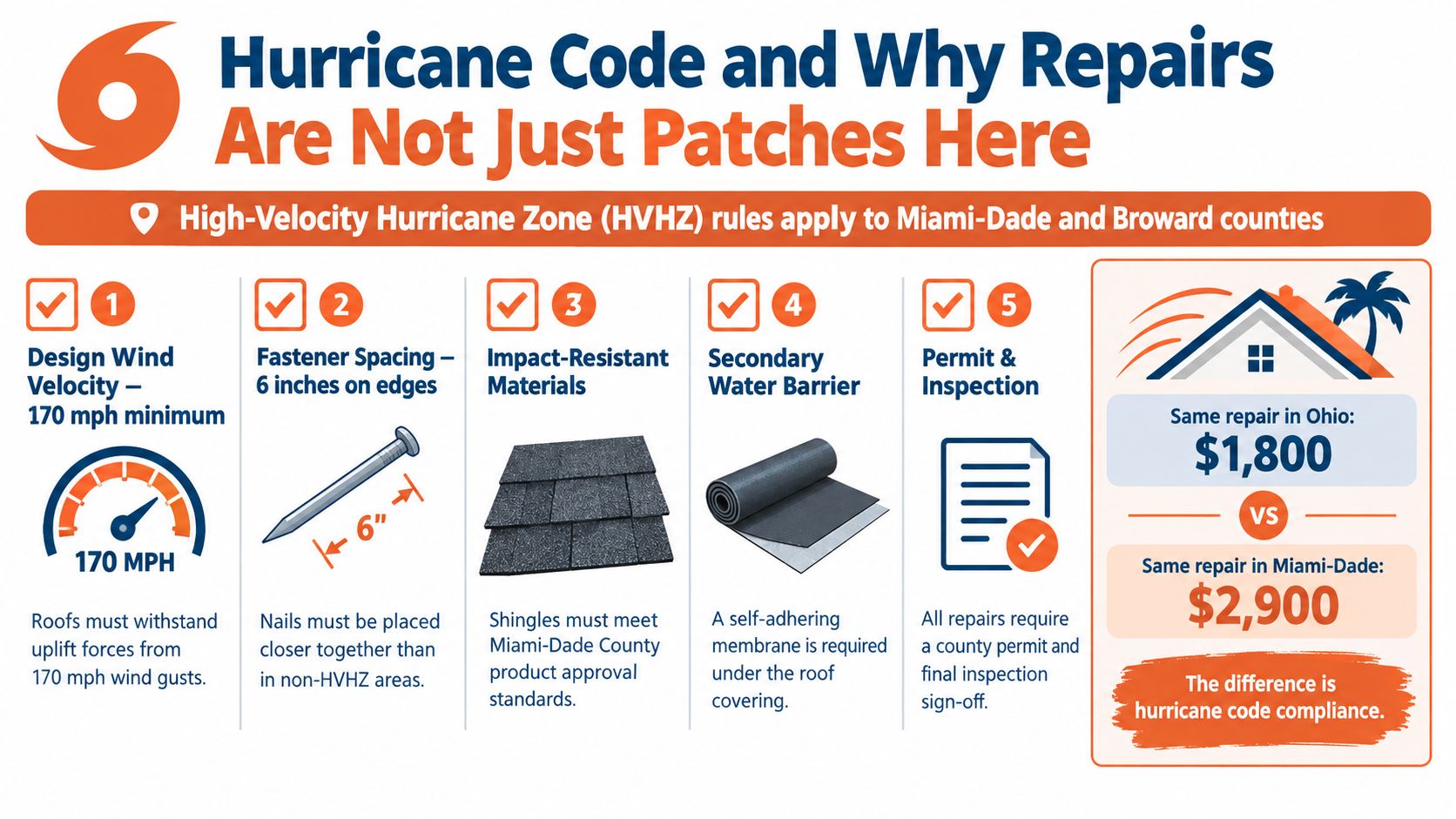
That's why an unpermitted shortcut is a bad deal. It can complicate resale, slow down an insurance file, and leave the roof weaker than it looked on day one.
If the work is tied to storm damage and the roof needs urgent attention, emergency storm repair is the right conversation, because delay usually makes the damage worse.
Local Pricing Realities Across Miami-Dade and Broward
Hialeah is the home base, and it should be the first stop on any local pricing conversation. With roughly 229,039 residents in one Miami-Dade municipal source and 223,109 residents in another official county directory, it's the biggest priority service area in the named cities, ahead of Coral Gables, Miami Lakes, Pinecrest, Palmetto Bay, South Miami, Doral, and Kendale Lakes (municipal population data, county directory).
That matters because city rules, roof styles, and access patterns change the workday. Doral and Miami Lakes often mix newer developments with HOA oversight. Coral Gables and Pinecrest lean harder toward tighter appearance standards and more exacting documentation. Palmetto Bay, South Miami, and Kendale Lakes bring their own mix of roof age, material matching, and neighborhood access issues.
Why the same repair can bill differently by city
- Hialeah: older roofs, tile matching issues, and fast response matter more than polished sales talk.
- Doral and Miami Lakes: newer construction often brings stricter HOA checks and permit sensitivity.
- Coral Gables and Pinecrest: material match and appearance standards can push a small repair into a more careful scope.
- Palmetto Bay and South Miami: localized leaks often expose aging components that need more than a surface patch.
- Kendale Lakes: access, roof style, and prior repairs can change the labor burden quickly.
- Pembroke Pines and Cooper City: treat Broward as a separate code and service market, not just an extension of Miami-Dade.
The point isn't that every city gets a different advertised price. The point is that the invoice changes because the jurisdiction, access, and roof system change. A local contractor who works these areas every week already knows that.
Service areas should always be matched with a city-specific inspection, not a one-size-fits-all phone quote.
Smart Ways to Control What You Actually Pay
The best savings happen before the crew shows up. Once water is inside the roof assembly, the bill starts climbing because the job becomes bigger, slower, and more technical. Good documentation and clean scheduling do more for your wallet than haggling over a single line item.
Take photos and video the same day you notice the leak. Save them before anyone touches the roof, because that record helps with insurance and helps the roofer trace the failure path. If the weather is calm and the leak is manageable, schedule the work before the next storm cycle instead of waiting for emergency mobilization.
What actually lowers the invoice
- Document fast: photos, short videos, and the date of the first leak sign.
- Ask for the exact repair boundary: know what part of the roof is being touched.
- Decline cosmetic upsells: don't pay for extras that don't solve the failure.
- Bundle inspection and repair decisions: one visit can settle more than one question.
- Pick a non-emergency window when you can: urgency always makes coordination harder.
- Get warranty terms in writing: if the work fails, you want a return visit without a fight.
- Ask whether hidden damage is priced separately: no one should bury that question.
- Use insurance support when storm damage is involved: the file should match the damage.
- Choose the right material match: forcing a mismatch can create extra labor.
- Avoid the cheapest unlicensed fix: a second leak costs more than a solid first repair.
Practical rule: the cheapest quote is not the cheapest repair if it leaves the original leak path untouched.
I'd rather see a homeowner spend a little more on a properly scoped repair than save a few hundred dollars and buy a second visit. The second visit almost always costs more.
When to Call a Local Crew and What to Ask For
Call a local crew as soon as the roof shows active leaking, missing materials, storm damage, or repeated staining. Don't wait for the ceiling to tell you the story a second time. In South Florida, the roof and the water line don't usually stay where you first spotted them.
Ask for a photo-documented inspection, a written scope, and a clear explanation of whether the repair or replacement path is more defensible. Ask who's doing the work, because in-house crews tend to be easier to hold accountable than a loose chain of subcontractors. Ask about financing only if the scope is large enough that you need to spread the cost sensibly.
Rooftop Solutions has been operating in Hialeah for more than 20 years, works with in-house crews, and handles inspections, storm response, and insurance-claims support for Miami-Dade and Broward homeowners. That matters when the issue is not just price, but getting the repair done once, documented properly, and built to the local code the roof lives under.
Same-week response, photo-documented reports, code-compliant scopes. That's the standard worth demanding.
If you own a home in Hialeah, Doral, Miami Lakes, Coral Gables, Pinecrest, Palmetto Bay, South Miami, Kendale Lakes, Pembroke Pines, or Cooper City, don't guess at the number from a phone call alone. Get the roof inspected, get the scope in writing, and make the contractor prove the repair fits the problem.
Rooftop Solutions handles roof repairs, storm damage, inspections, and replacement decisions with photo documentation, in-house crews, and code-aware scopes that fit Miami-Dade and Broward roofs. If you want a straight answer on your roof repair cost and a quote that reflects the job, visit Rooftop Solutions and book an inspection.
