
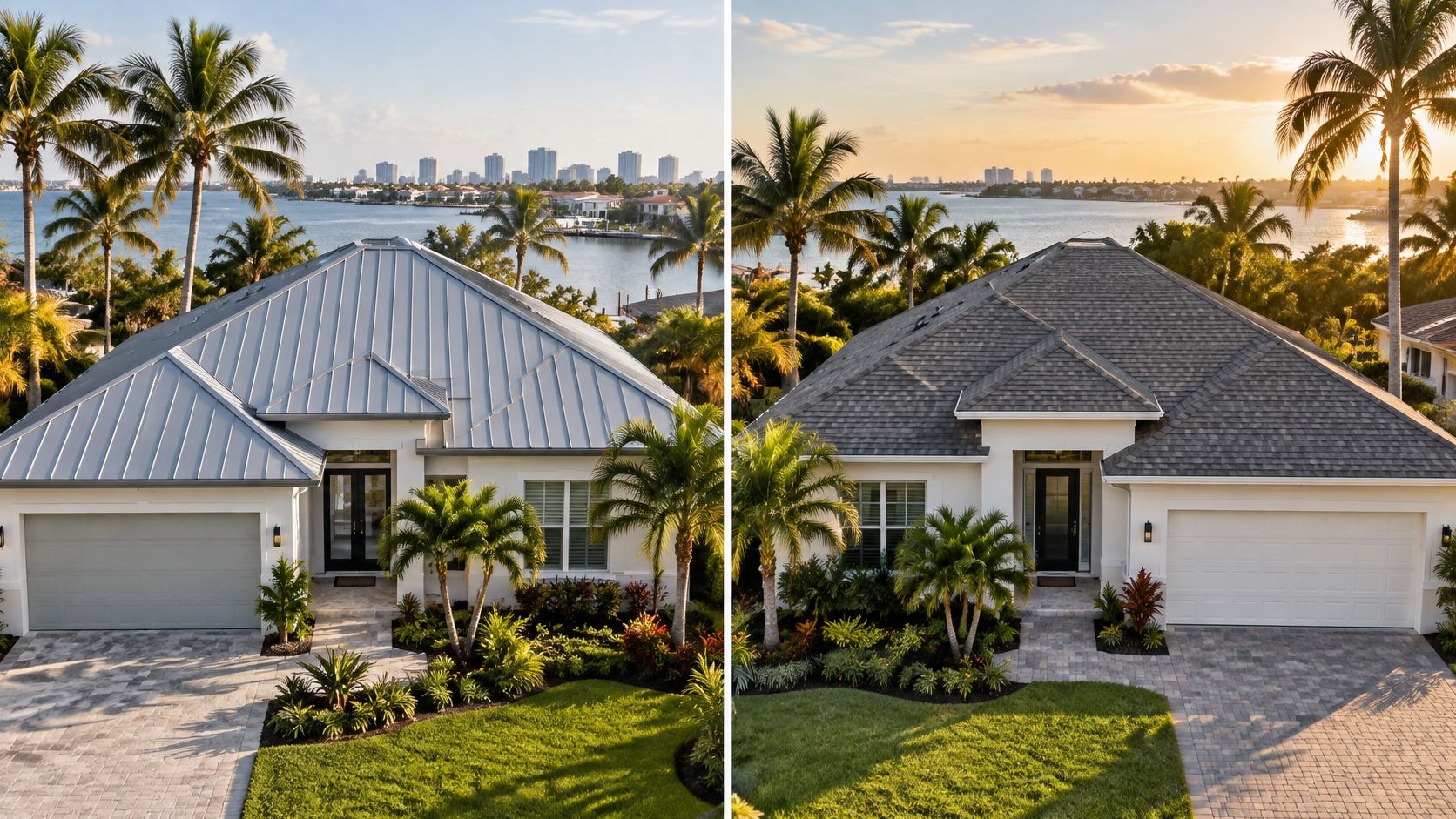
Metal Roof vs Asphalt Cost: South Florida Guide 2026
Architectural asphalt shingles generally install for about $5–$7 per square foot, while standing-seam metal runs about $18–$25 per square foot. On a 2,000-square-foot roof, that is about $10,000–$14,000 for asphalt and $36,000–$50,000 for standing seam before tear-off, permits, or unusual structural work.
The useful metal roof vs asphalt cost question is not which invoice is smaller this month. It is which roof costs less across the years you will own the house. Asphalt usually wins year one. Metal often wins a multi-decade hold, and only if a second shingle replacement would have landed inside that hold. In Miami-Dade and Broward, product approvals, wind-uplift fastening, and deck repairs move the bid as much as the panel or the shingle.
Table of Contents
- Metal Roof vs Asphalt Cost at a Glance
- Upfront Installation Costs by Roof System
- Lifespan, Replacement Cycles and Break-Even by Holding Period
- Permit and Wind-Code Costs Across South Florida Cities
- Which Roof Fits Your Property and Plans
- Lock the Quote Before You Choose a Roof
Metal Roof vs Asphalt Cost at a Glance
Hialeah is home base. From there the same comparison applies in Doral, Miami Lakes, Coral Gables, Pinecrest, Palmetto Bay, South Miami, and Kendale Lakes, then in Pembroke Pines and Cooper City in Broward. Asphalt is cheaper to install. Metal is usually cheaper to own across several decades. The gap turns on holding period, system tier, and local code, not on a single national multiple.
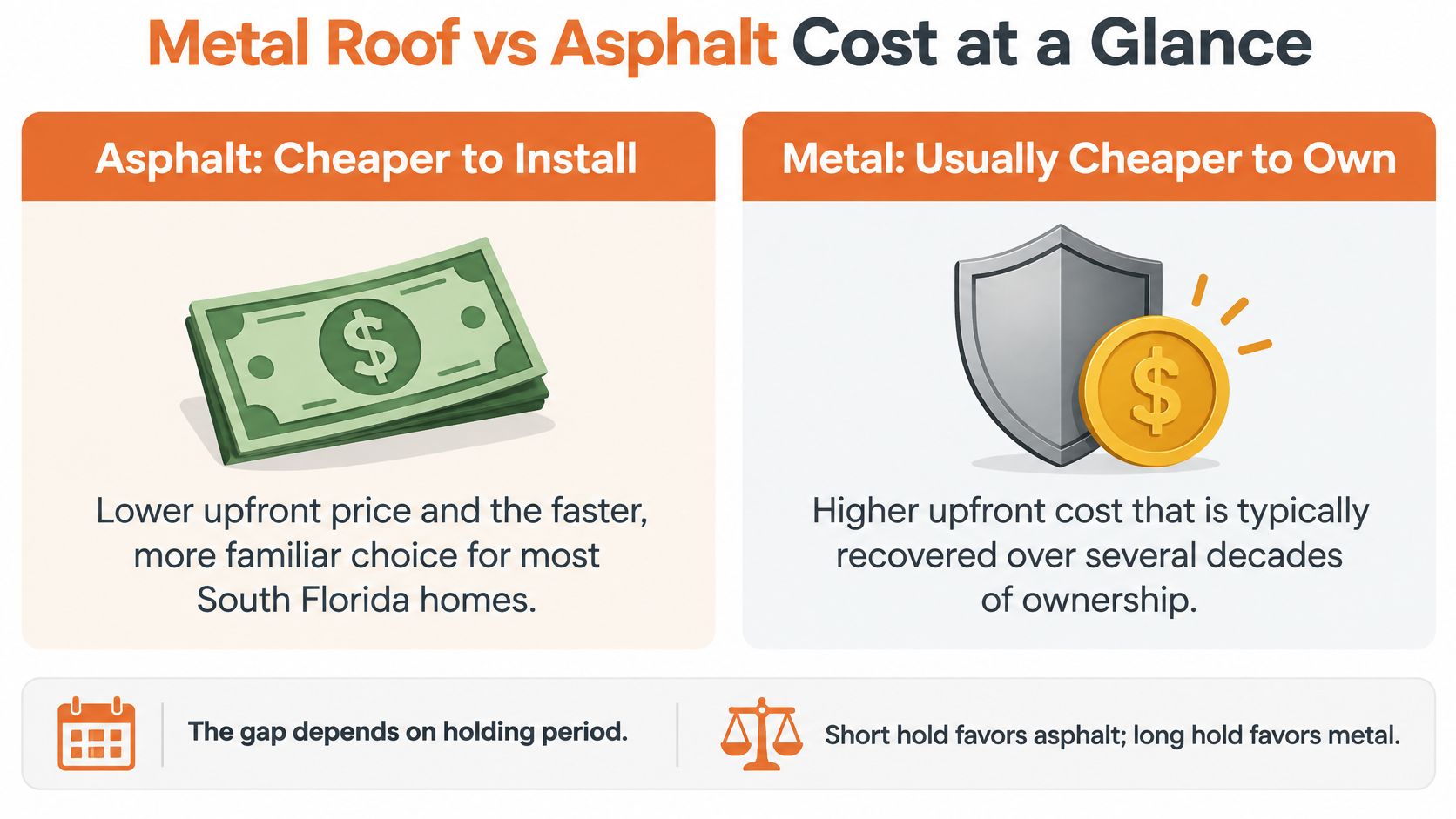
Headline metal vs asphalt cost comparison
| Factor | Asphalt shingle | Metal roof |
|---|---|---|
| Installed cost per square foot | $5–$7 (architectural) | $18–$25 (standing seam) |
| Expected service life | 20–30 years | 40–70 years |
| Maintenance over service life | About 28.5% of installed cost | About 3.5% of installed cost |
| Annualized cost per square foot | About $0.37 per year | About $0.30 per year |
| Cooling-energy effect | Set by shingle color and reflectivity | Reflective coatings; DOE cites up to 15% AC energy reduction for cool roofs |
National averages hide roof geometry, tear-off, wind-rated fastening, and permit fees. A shortcut that metal costs twice as much is unreliable. An entry metal panel can sit near a premium shingle price, while a concealed-fastener system can run several times higher before the city adds hurricane detailing.
Miami-Dade and Broward are the markets in this comparison, and both treat a reroof as a code assembly, not a commodity square. Installed price and service life do not move together. The next two parts separate system tiers, then show how many roofs you buy at 10, 25, and 50 years.
Upfront Installation Costs by Roof System
Metal and asphalt are families of products, not one price each. A 2025–2026 cost comparison places installed asphalt shingles at approximately $5–$7 per square foot and standing-seam metal at roughly $18–$25 per square foot, or about $10,000–$14,000 versus $36,000–$50,000 on a 2,000-square-foot roof before unusual structural work, permitting, removal, or regional labor. Its broader national band is about $3.50–$6.25 per square foot for asphalt and $5.75–$25.50 for metal, so basic exposed-fastener panels can overlap premium asphalt while engineered standing seam costs far more up front.
Installed cost by roof system on a 2,000 square foot roof
| Roof system | Cost per square foot | Estimated total (2,000 sq ft) | What drives the price |
|---|---|---|---|
| Three-tab asphalt shingle | $3.50–$6.25 (broader asphalt band) | $7,000–$12,500 | Lowest upfront price; shortest asphalt life |
| Architectural asphalt shingle | $5–$7 | $10,000–$14,000 | Most common residential reroof; wind-rated options raise price |
| Exposed-fastener metal panels | From $5.75, overlapping premium asphalt | From about $11,500 | Entry-level metal; can overlap premium asphalt pricing |
| Standing-seam metal | $18–$25 | $36,000–$50,000 | Concealed fasteners, engineered profile, higher wind resistance |
We install asphalt shingle roofing that stays budget-friendly and comes in a wide range of colors and styles. That is the tier most South Florida houses bid when the goal is a lower first check and a familiar install. Architectural shingles, not three-tab, are the fair peer to a metal quote you might keep for decades.
What pushes a bid off the per-square-foot band
The same square footage prices differently once the roof stops being a simple gable.
- Geometry and penetrations: Hips, valleys, dormers, and pipe boots add cuts, flashing, and labor on every system.
- Tear-off and deck: Each existing layer means disposal. Soft or undersized decking found after the tear-off sits outside the per-square-foot range and can add sheathing, fasteners, and a return trip for inspection.
- Underlayment, ventilation, and flashing: Secondary water barriers, ridge vents, and edge metal are scope, not free extras.
- Gauge, coating, and fasteners: Thicker metal and a higher-grade finish raise the standing-seam number. Exposed-fastener jobs live or die on washer quality and the fastening pattern the wind approval requires.
If you are also pricing clay or concrete, the tile roof pricing guide sits next to these shingle and metal bands so you are not mixing three different assemblies. On standing seam, itemize accessories the way a cold-climate bid would compare clamp-on snow retention options. Clips, vents, and edge metal should be lines on the page, not surprises after deposit.
Practical rule: Judge two quotes only when they name the same system tier, the same tear-off, and the same wind-attachment scope.
For South Florida owners, Miami-Dade wind-load compliance, hurricane-rated assemblies, and inspections can move the final bid even when the shingle or panel price looks settled. Asphalt usually wins first-year affordability. Metal only makes sense once durability, code performance, and the date of the next replacement sit beside that install price.
Lifespan, Replacement Cycles and Break-Even by Holding Period
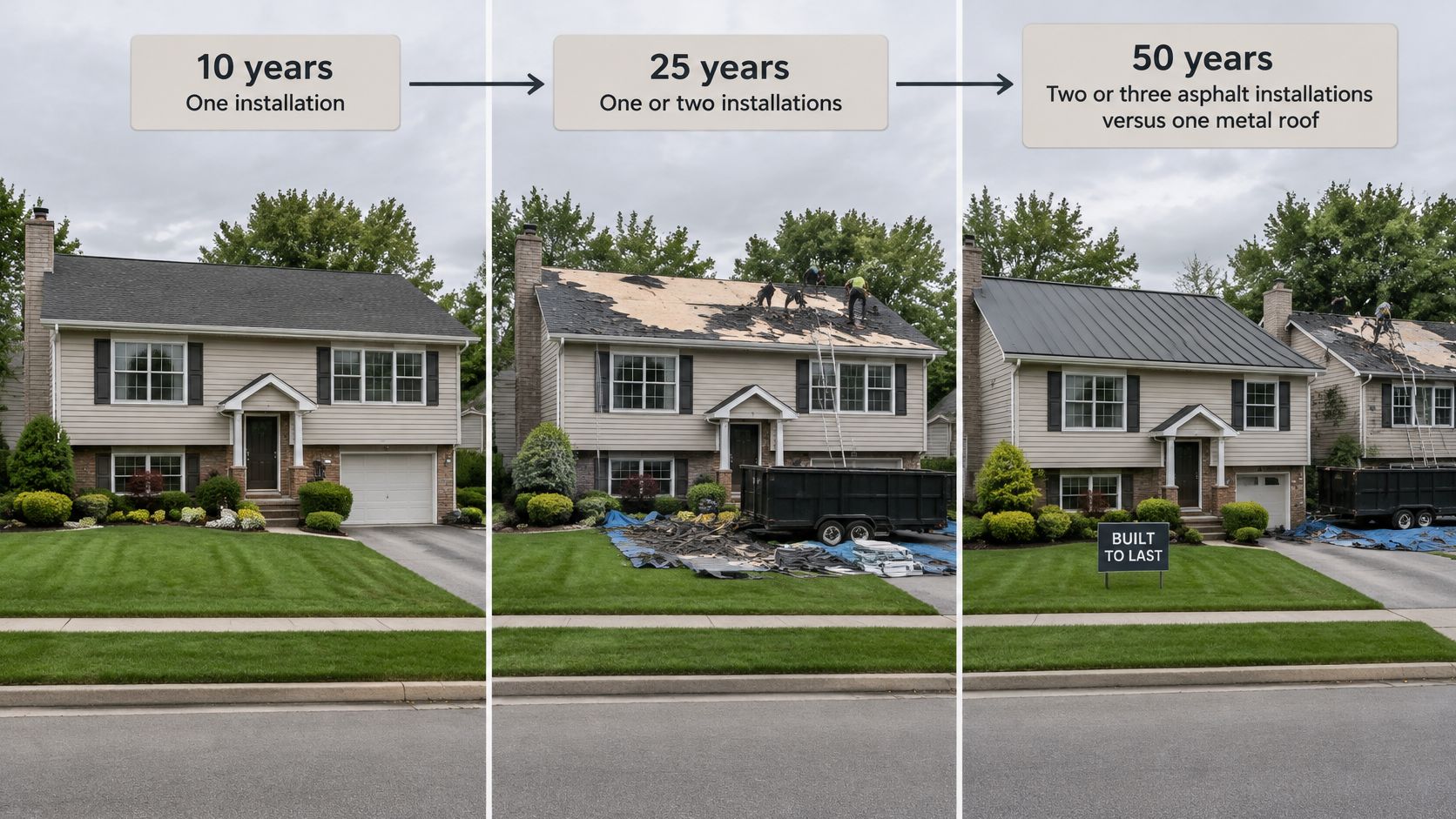
Count installations, not slogans. At a 10-year hold, both roofs are still the first roof, so asphalt's lower invoice wins. At 25 years, a 20-year shingle is due for a second install, while many architectural shingles are near the end and metal is mid-life. At 50 years, a 20-year asphalt system can mean the original roof plus two replacements. Architectural shingles often mean one replacement. A properly installed metal roof is still the first roof, with maintenance rather than a full tear-off.
Common U.S. reference ranges place three-tab asphalt shingles near 20 years, architectural asphalt around 30 years, and many metal systems between 40 and 70 years. Some metal products are reported at 40–80 years depending on material, coating, installation quality, climate, and maintenance. Over a 50-year horizon, a homeowner on a 20-year asphalt system may face the initial installation plus two additional replacement cycles, while a properly installed metal roof may need one installation and limited maintenance. That does not guarantee metal is cheaper. Future prices, corrosion, fastener or coating upkeep, roof complexity, and financing all sit in the total. The U.S. Department of Energy cool-roof guide reports that substituting a cool roof for a conventional roof can reduce annual air-conditioning energy use in a single-story building by up to 15%, and its consumer guidance reports potential cooling-cost reductions of at least 5% to 20% for cool-color roofs, with results varying by climate and building design.
What maintenance actually looks like
Asphalt in a high-wind, high-UV market needs periodic checks for lifted tabs, open nails, and granule loss in valleys and at drips. A storm can turn a small lift into a leak long before the shingle's rated life is over. Those visits are why cumulative upkeep is a large share of the asphalt bill, not a rounding error.
Metal needs a different checklist. Look at the coating for chalk or scratches, inspect exposed fasteners where the system uses them, clear debris at seams and valleys, and watch for corrosion where salt air meets cut edges or dissimilar metals. Coastal exposure is the reason a cheap coating can erase part of the lifespan advantage. We specialize in metal roofing that is hurricane-rated and heat-reflective, with a 50+ year lifespan and low maintenance. A properly installed metal roof from us can last 50 years or more, and with proper insulation it is no noisier than shingles.
Model energy savings on the low side. A reflective coating helps in July. It does not pay back a standing-seam premium by itself.
Annualized cost, not the opening invoice
A Ducker Worldwide analysis reported an expected service life of approximately 40 years for metal roofing versus 23 years for asphalt. Its lifecycle model put annualized cost at about $0.30 per square foot for metal and $0.37 per square foot for asphalt. Cumulative maintenance was about 3.5% of initial installation cost for metal, compared with 28.5% for asphalt over the expected service life.
That is why a higher metal bid can be the lower ownership cost when the house stays in service for several decades. You skip a second tear-off, disposal charge, permitting cycle, and the week of interior disruption. For a South Florida property, split the estimate into standing seam, exposed-fastener metal, architectural asphalt, underlayment, flashing, ventilation, deck repairs, and code-required wind-uplift attachments. A blended "metal versus shingle" average hides those lines.
How to run the holding-period math
Use lifecycle cost per year. Add installation cost, forecast maintenance, and each replacement, timed to the year it falls, then divide by the analysis period. A cheap asphalt roof that needs another capital project inside the metal roof's service life is not cheap on that math.
A break-even check is simpler. Take the metal premium over the asphalt bid on the same scope. Divide that premium by the yearly cost you avoid (the asphalt replacement spread across its life, plus a conservative cooling credit, not the top of the DOE range). Compare that year with how long you expect to keep the property. Our metal roofing uses reflective coatings that cut cooling costs in the hottest months. Treat that as a credit in the model, not as a guaranteed dollar amount on your bill.
Which roof usually costs less by holding period
| Holding period | Likely lower total cost | Deciding factor |
|---|---|---|
| Under 12 years (selling soon) | Asphalt | Metal premium may not be recovered at sale |
| 12–25 years | Either roof can win on a full-scope bid | Energy savings and an avoided tear-off can flip the result |
| 25–50 years | Metal | One or two asphalt replacements avoided |
If you are already inside a replacement decision, a roof replacement scoped to Florida wind-load code should show tear-off, disposal, and the attachment pattern, not a single square price. Financing changes the picture too. Interest on a larger metal loan can eat the annualized edge if you sell before the first avoided shingle replacement.
Say you keep a Hialeah house 30 years. Architectural asphalt may need one full replacement inside that window, with a new permit and a new tear-off at whatever labor costs then. Standing seam is still the original roof if the coating and fasteners were specified for salt air. The owner who lists in eight years paid the metal premium and may not get it back from a buyer who only sees a roof that "looks new" either way.
Permit and Wind-Code Costs Across South Florida Cities
Find the city before you compare materials. A Miami-Dade permitting procedures page states that each municipality has its own building official who issues permits inside that city's limits. County permit instructions apply to unincorporated Miami-Dade, identified by folios beginning with 30. An e-municipal route covers places such as the City of Miami and the Town of Miami Lakes. One countywide permit assumption will mis-price both metal and asphalt.
Permit authority and bid planning by service city
| City | Permit authority | Plan the bid for |
|---|---|---|
| Hialeah | Municipal building official | Municipal permit, plan review and inspection schedule |
| Doral | Municipal building official | Municipal permit, plan review and inspection schedule |
| Miami Lakes | Town of Miami Lakes (e-municipal process) | Online municipal permit submission and inspections |
| Coral Gables | Municipal building official | Municipal permit, plan review and inspection schedule |
| Pinecrest | Municipal building official | Municipal permit, plan review and inspection schedule |
| Palmetto Bay | Municipal building official | Municipal permit, plan review and inspection schedule |
| South Miami | Municipal building official | Municipal permit, plan review and inspection schedule |
| Kendale Lakes | Miami-Dade County (folios beginning with 30) | County permit instructions and county inspections |
| Pembroke Pines | Broward County municipality | Confirm the permit path with the city building department |
| Cooper City | Broward County municipality | Confirm the permit path with the city building department |
Pembroke Pines and Cooper City sit in Broward. This Miami-Dade permit map does not set their forms, fees, or inspection order. Call the city building department before you lock a number.
Documents that move scope more than the shingle or the panel
Miami-Dade treats roofing as work in the High-Velocity Hurricane Zone. The county's uniform roofing application calls for product-approval documents (front page, system description, limitations, and detail drawings). Depending on the job, you also need Chapter 16 wind-design calculations or calculations under RAS 127 or RAS 128, other component approvals, a municipal permit application, and the owner's reroofing-notification form. The form wants roof levels, drains, scuppers, overflow drainage, parapets, and high-pressure zones. Those details change labor on both asphalt and metal.
The county's hurricane mitigation rules are narrower than people assume. Retrofit and secondary-waterproofing requirements apply only to site-built single-family residences with sloped hip or gable roofs. Townhouses and duplexes are outside that definition. Apartment buildings, condominiums, commercial buildings, and new-construction roofs tied to a master building permit are exempt from those particular requirements. Where the rules apply, sheathing must meet the Florida Building Code, Florida Statute 553.844, and the county's Hurricane Mitigation Retrofit Manual. A roof-decking and secondary-water-barrier affidavit is due at the first inspection, and a roof-to-wall affidavit is due when that work applies. Some single-family reroofs are exempt from roof-to-wall strengthening when the structure's ad-valorem just value is below $300,000.
A quote that includes permit handling, product approvals, wind documentation, and inspection coordination covers work a material-only estimate leaves out.
We offer free on-site estimates for roof replacements, and permits are handled for the customer. Call Rooftop Solutions in Hialeah, or book an inspection, before you price a reroof from a per-square advertisement.
Which Roof Fits Your Property and Plans
Match the house and the calendar. There is no single winner.
- You expect to own for 25 years or more. Choose metal. You skip one or two asphalt replacement cycles, including tear-off, disposal, and another permit.
- You expect to sell within 12 years. Choose asphalt. The metal premium may not come back at closing, especially if buyers treat any new roof as "done."
- Cash or financing is the hard limit. Choose architectural asphalt. It is the lowest installed price among the options you would want to keep through a few hurricane seasons. Three-tab saves a bit more and usually needs replacing sooner.
- The roof covers a warehouse, or an HOA that hates repeat scaffolding. Choose metal when the horizon is long. Fewer projects means fewer disruptions for tenants and residents, and maintenance stays on coatings and fasteners rather than full replacements.
- The roof is dark and summer electric bills are already high. Choose metal with a reflective coating. A reflective surface cuts heat into the attic. Put a conservative cooling credit in the model, and do not let a salesperson treat the top of a national range as your bill.
- The damage is minor and cosmetic. Choose repair. We advise that minor, cosmetic repairs are often cheaper paid out of pocket than filed as an insurance claim, since a claim can raise your premium. A lifted shingle or a small flashing leak is not automatically a new roof.
HOA and condo boards should run the same holding-period test per unit, not per building slogan. A replacement hits every owner through reserves or a special assessment. Agree on how long the association expects to keep that roof before anyone votes on standing seam versus architectural shingles. Commercial managers can use the same split. A short lease term favors the lower asphalt invoice. A building you will still operate in 30 years favors metal.
No single answer fits every folio in Miami-Dade or Broward. The right choice is the situation you match. A site visit is what separates a sound deck and a repair from a full reroof.
Lock the Quote Before You Choose a Roof
National ranges go stale before the crew arrives. A 2025 industry report attributed metal-roofing price increases of as much as 60% between March and early June to steel and aluminum tariff changes. A market report indicated that the U.S. Producer Price Index for asphalt paving and roofing-material manufacturing rose from 365.240 in December 2025 to 377.951 in March 2026. Those figures do not prove one material always inflates faster. They do show why a quote without an expiration date is not a price.

After a storm, labor and material queues in South Florida tighten. The number that matters is the number someone will still honor on install day.
What has to be fixed on the page
- Itemized scope. Name the system tier, tear-off, underlayment, flashing, and wind-uplift attachment. A single "per square" line is not a scope.
- Expiration date. If the price dies in two weeks, say so.
- Escalation language. State what happens if steel, aluminum, or asphalt inputs move before delivery.
- Deposit and lead time. Know what is refundable and when panels or shingles arrive.
- Gauge or thickness and coating. Extra thickness and a premium finish you do not need are a real way to overpay for metal.
- Accessories and warranty. Vents, edge metal, and both manufacturer and workmanship terms should be written, not implied.
- Permits and inspections. Name who pulls the permit and who meets the inspector.
- Hidden deck, code upgrades, and disposal. Write the assumption. If sheathing is rotten, the quote should say how that change order is priced.
A cheaper asphalt estimate can be the riskier buy if it leaves out a future tear-off, a code upgrade, or a second replacement. A premium metal estimate can be poor value if it loads unnecessary thickness or finishes onto a house you will sell inside a decade. Owners who study home services lead generation tactics still need the same discipline on their own bid. The written assumptions are the product.
Two steps close the decision. Ask us for a free quote with no pressure and no obligation, and ask for two options priced on the same scope and the same holding period. You can sketch a range first with the roofing cost calculator, using size, pitch, and material, then confirm it on the roof. Every project is handled by our own trained crew, never subcontracted, so the people who inspect the roof are the people who install it. We say no to jobs we don't think you need, and we will not sell a replacement if a repair is enough. A repair-first recommendation is the correct quote when the deck, the flashing, and the remaining life still support it.
Rooftop Solutions prices metal and asphalt reroofs across Miami-Dade and Broward, with free on-site estimates, permit handling, and the same crew from inspection through install. If you are weighing a long-hold metal roof against a lower asphalt invoice, we will put both on one scope and say when a repair is the better spend. Visit Rooftop Solutions to book an inspection or request a no-pressure quote.
