
Roof Tiling Prices in 2026: Concrete vs Clay Costs
Concrete tile runs about $7 to $19 per square foot installed and clay tile about $11 to $25 per square foot installed, which puts a 2,000 square foot roof at roughly $14,000 to $38,000 for concrete and $22,000 to $50,000 for clay. Those are national ranges, and in Miami-Dade and Broward they're only your starting point. What moves you inside, or outside, that band is the complete tested roof system underneath the tile, plus Florida wind rules, permits, and the condition we find when the old roof comes off.
Table of Contents
- Tile Roof Prices at a Glance
- Why Concrete and Clay Tile Cost Different Amounts
- What Makes Up an Installed Tile Price
- How Florida Wind Rules Change the Quote
- Local Labor and Permits Across Hialeah and South Florida
- Worked Price Examples for Common Roof Sizes
- Get an Itemized Tile Quote Before You Commit
Tile Roof Prices at a Glance
For roof tiling prices, start with the installed rate, not the price of a pallet of tile. The 2026 national cost report from The Roofing Brief puts installed concrete tile at about $7 to $19 per square foot and installed clay tile at about $11 to $25 per square foot, which translates to roughly $14,000 to $38,000 and $22,000 to $50,000 on a 2,000 square foot roof. Florida is also named in that report as an important regional market for concrete tile, reflecting how well the material fits warm-climate construction.
| Material | Installed price per sq ft | Typical 2,000 sq ft roof | Where it fits |
|---|---|---|---|
| Concrete tile | $7 to $19 | $14,000 to $38,000 | Common in Florida and other warm-climate markets |
| Clay tile | $11 to $25 | $22,000 to $50,000 | Premium look with more labor-intensive installation |
How to Use These Numbers
- Measure the roof on the pitch. A sloped roof has more surface than the footprint you see on a plan, so don't multiply by your home's floor area.
- Multiply that pitched area by each rate. Run concrete and clay separately so you can see the gap between them on your roof.
- Treat the result as a base range. It's the tile and install band before project-specific extras are priced in.
Practical rule: If a quote gives you only a per-tile number, you don't have a roof price yet. Ask what pitched area the contractor measured.
That base range can't tell you where your house will land. Tear-off, structural repairs, permitting, unusually steep slopes, and complex detailing can all push a Miami-Dade or Broward job above the national band, especially when hurricane-wind requirements, coastal exposure, or limited access add scope. I would use the table to set expectations and spot an unrealistic bid, then let an on-site measurement and an itemized scope set the actual number.
Why Concrete and Clay Tile Cost Different Amounts
Concrete tile is like a well-built, mass-produced cabinet. It's consistent, made in high volume, and efficient for a crew to install. Clay is closer to a hand-finished piece, where the material itself, the finish, and careful handling on the roof drive what you pay.
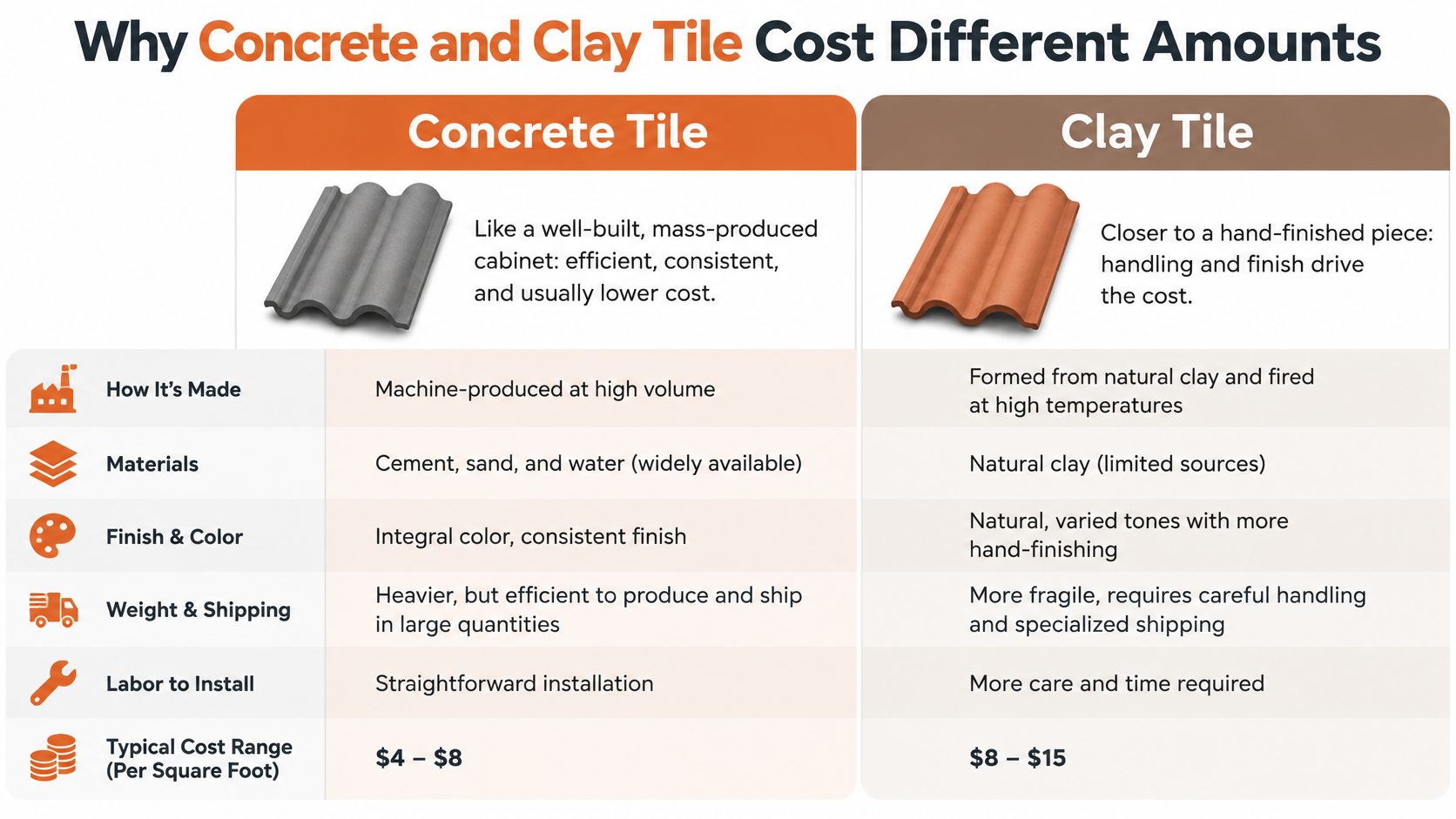
| Factor | Concrete tile | Clay tile |
|---|---|---|
| Material cost | Lower, made in high volume | Higher, more expensive tile |
| Handling and labor | Standard tile crew work | Specialized handling, more labor-intensive |
| Breakage risk during install | Lower | Higher, needs careful handling |
| Typical service life | 40 to 50 years (market estimate) | Confirm by specific product and approval |
| Florida profile | Widely used in warm-climate builds | Classic Florida look at a premium price |
Material and Labor
Clay costs more for three connected reasons. The tile itself is pricier, it needs more specialized handling getting it up the ladder, across battens, and into cuts without chipping, and that care takes more crew time. It's not just more material volume, it's slower, more deliberate work at hips, ridges, and valleys.
Concrete usually wins on entry price while still meeting the same wind and longevity goals for a South Florida home. A market report from Dataintelo estimates useful service lives of roughly 40 to 50 years for concrete tile. No verified clay figure is stated here, so I wouldn't compare service life from a brochure claim. Ask for the exact product and its approval instead.
Which One Fits Your House
The classic clay look is a valid premium choice when appearance matters to you and you accept the handling cost that comes with it. There's nothing wrong with paying for that profile in Coral Gables or Pinecrest if the architecture calls for it. We install tile roofing using classic Florida clay and concrete tile, built for exceptional longevity and wind resistance, so the choice doesn't have to be steered by what a contractor happens to stock.
Match concrete against concrete and clay against clay, on the same roof area and the same scope. A clay bid that includes tear-off will always look unfair next to a concrete bid that quietly excludes it.
What Makes Up an Installed Tile Price
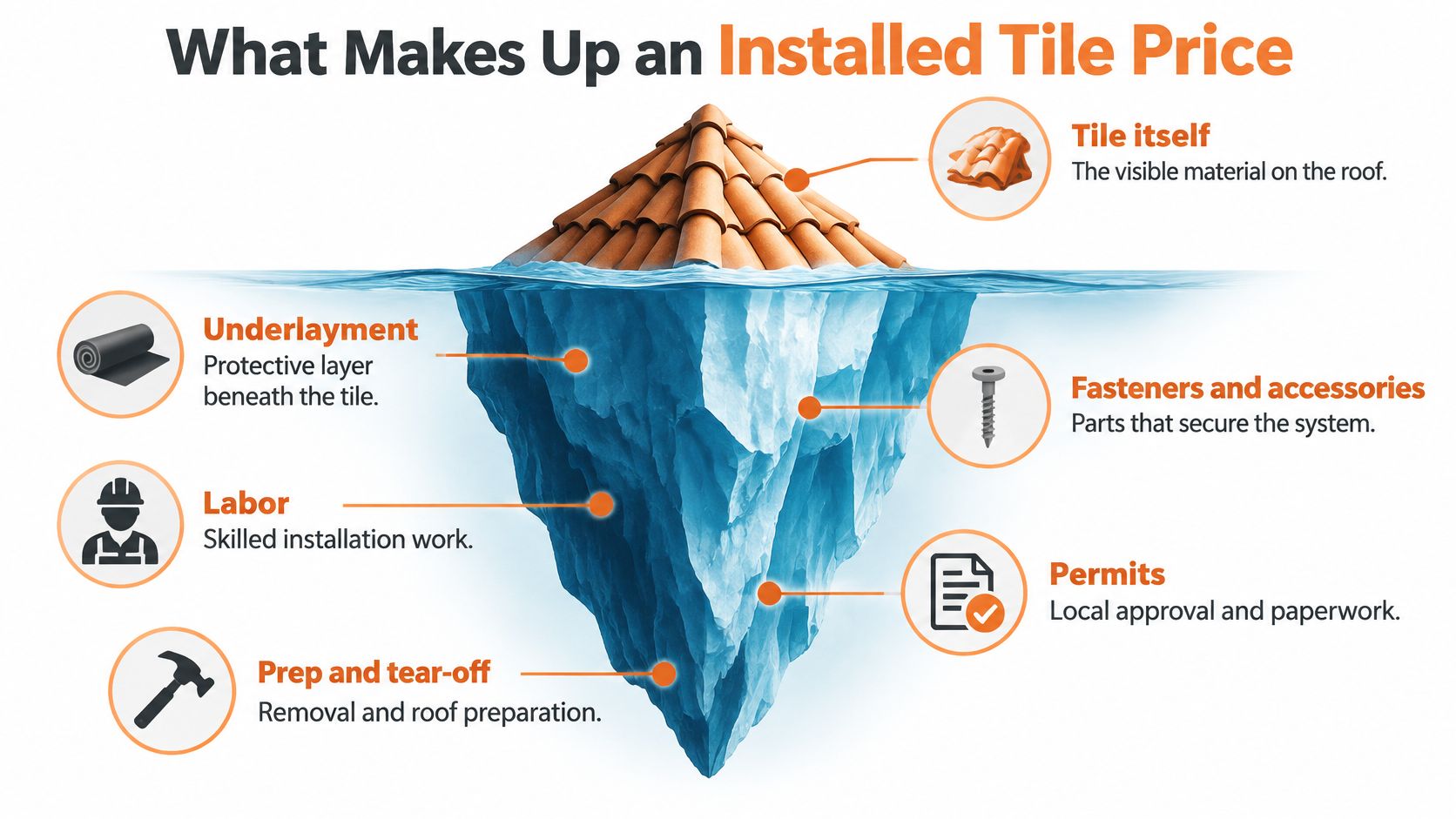
Think of the tile as the tip of an iceberg. It's what you see from the street, but most of the cost sits below the surface in layers, fastening, labor, and paperwork you won't see once the job is done.
The Components in a Complete Price
- Tile itself: The most visible cost, and the one that swings most between concrete and clay.
- Underlayment: Replaced when the old roof is removed, and it has to match the tested assembly, not just whatever roll is cheapest that week.
- Attachment method: Adhesive or mechanical fastening sets both material cost and crew time.
- Flashing and perimeter detailing: Edges, hips, ridges, and penetrations are hand work, and that's where labor adds up.
- Deck repairs: Rotten or damaged sheathing only shows itself after tear-off.
- Tear-off and disposal: Crew hours to strip the old system plus dump fees to haul it away.
- Permits and inspections: Required before work begins in Miami-Dade and Broward.
- Testing and approval paperwork: The documentation that ties your price to a verified assembly.
- Ventilation and access: Tight lots, narrow side yards, and limited staging slow a crew down.
In South Florida, the price is driven by the complete tested assembly, not the purchase price of the tile alone, and the Florida Building Code HVHZ test protocols require tile systems to demonstrate resistance to design uplift pressures, with adhered or mechanically attached underlayments tested under FM 4474 or UL 1897 criteria. Stronger fastening, enhanced perimeter work, approved components, and inspections all raise labor and material allowances, which is why coastal exposure shows up directly in your quote.
A low material-only quote that excludes tear-off, deck preparation, underlayment replacement, disposal, or permits will look cheaper on day one and usually produces change orders later. Every project we run is handled by our own trained crew, never subcontracted, so the same people who inspect your roof are the ones installing it and pricing those hidden layers.
How Florida Wind Rules Change the Quote
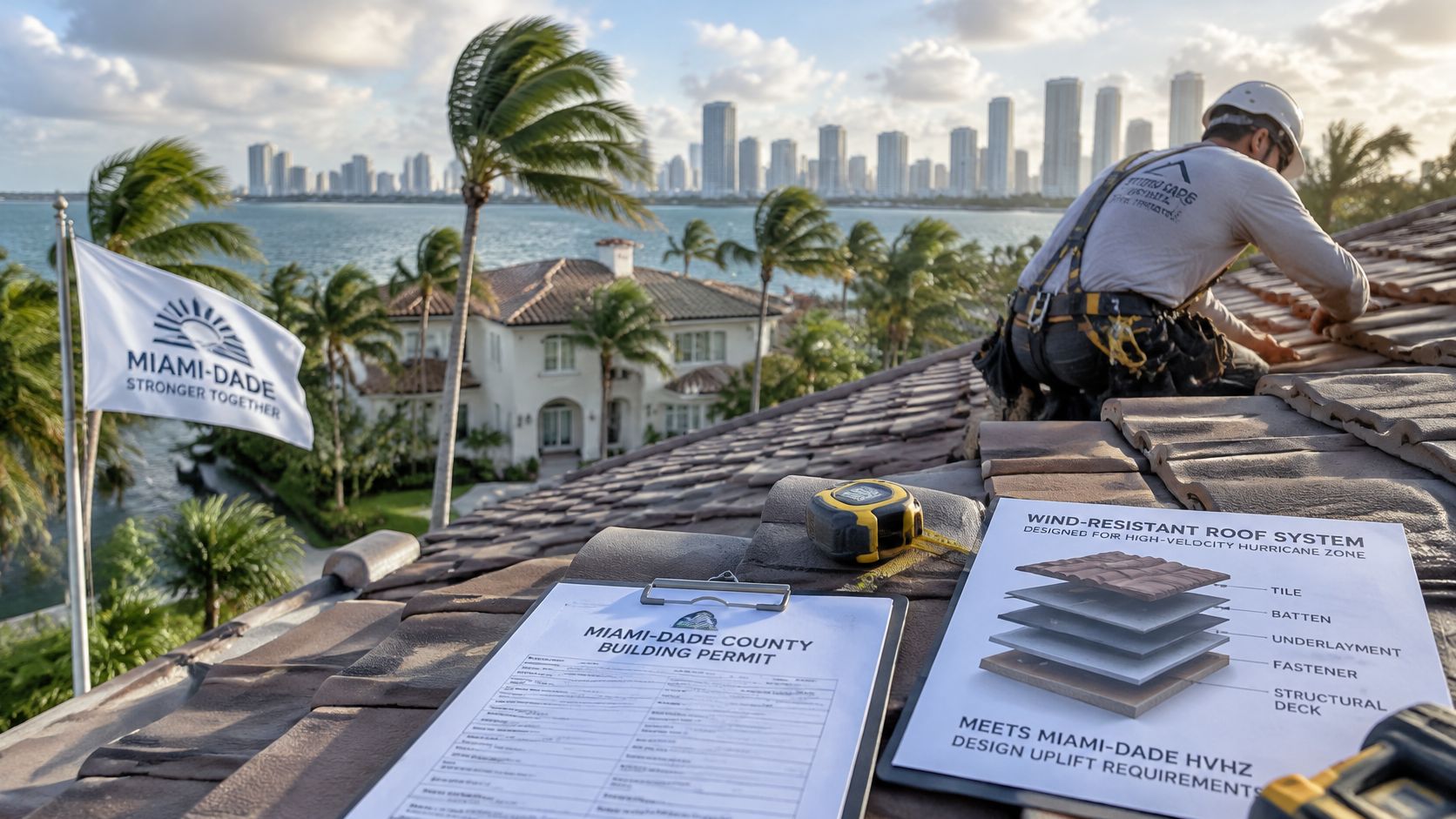
In Miami-Dade, the wind rules, not the tile, often decide the final price. Two neighbors can pick the identical tile and get noticeably different quotes because one roof needs more perimeter fastening, engineering review, or corrective work at edges and penetrations.
The crew below is installing to those wind requirements, not just laying tile in rows.
Testing You May Be Paying For
Florida provisions in the roof tile uplift test requirement require adhesive-set and mortar-set tile systems to undergo field verification or static uplift testing under TAS 106 before final approval, and some jurisdictions also require representative testing of field, perimeter, hip, and ridge areas. In plain terms, testing pulls an assembly to failure, applies a 2 to 1 safety margin to passing results, and one cited protocol specifies a 90 psf minimum passing uplift pressure for an approved assembly before that margin is applied. Tile failure is usually governed by uplift and attachment behavior, not by tile weight alone.
Watch how attachment and detailing come together on an actual install before you judge a line item for testing coordination.
Retrofit Work That Can Add Scope
Miami-Dade's hurricane mitigation requirements for retrofit and secondary waterproofing apply only to site-built single-family residences and only to sloped hipped or gable roofs, roof sheathing must comply with the Florida Building Code, Florida Statute 553.844, and the Hurricane Mitigation Retrofit Manual, and roof-to-wall connection retrofits may be installed only by a licensed general, building, or residential contractor. If your sheathing or connections trigger that work, it's real scope with real cost, not an upsell.
We offer roof replacement with full tear-off and replacement for tile, shingle, or metal roofs, built to Florida wind-load code and backed by manufacturer warranties. Before you sign, ask four wind-specific questions. Does the price include TAS-related testing coordination, approved underlayment, perimeter fastening or adhesive requirements, and an approval number that matches the installation method being proposed?
Local Labor and Permits Across Hialeah and South Florida
We're based in Hialeah, and that's where local pricing conversations should start. Hialeah had 223,109 residents in the 2020 Census, while Miami-Dade County had 2,701,767, according to U.S. Census Bureau QuickFacts for Hialeah and Miami-Dade County. It's a large, dense roofing market, not a suburb you price with a generic Miami number. Our Hialeah service area page covers how we work in the city directly.
Local work starts with knowing the neighborhoods and the permitting desk, as shown here.
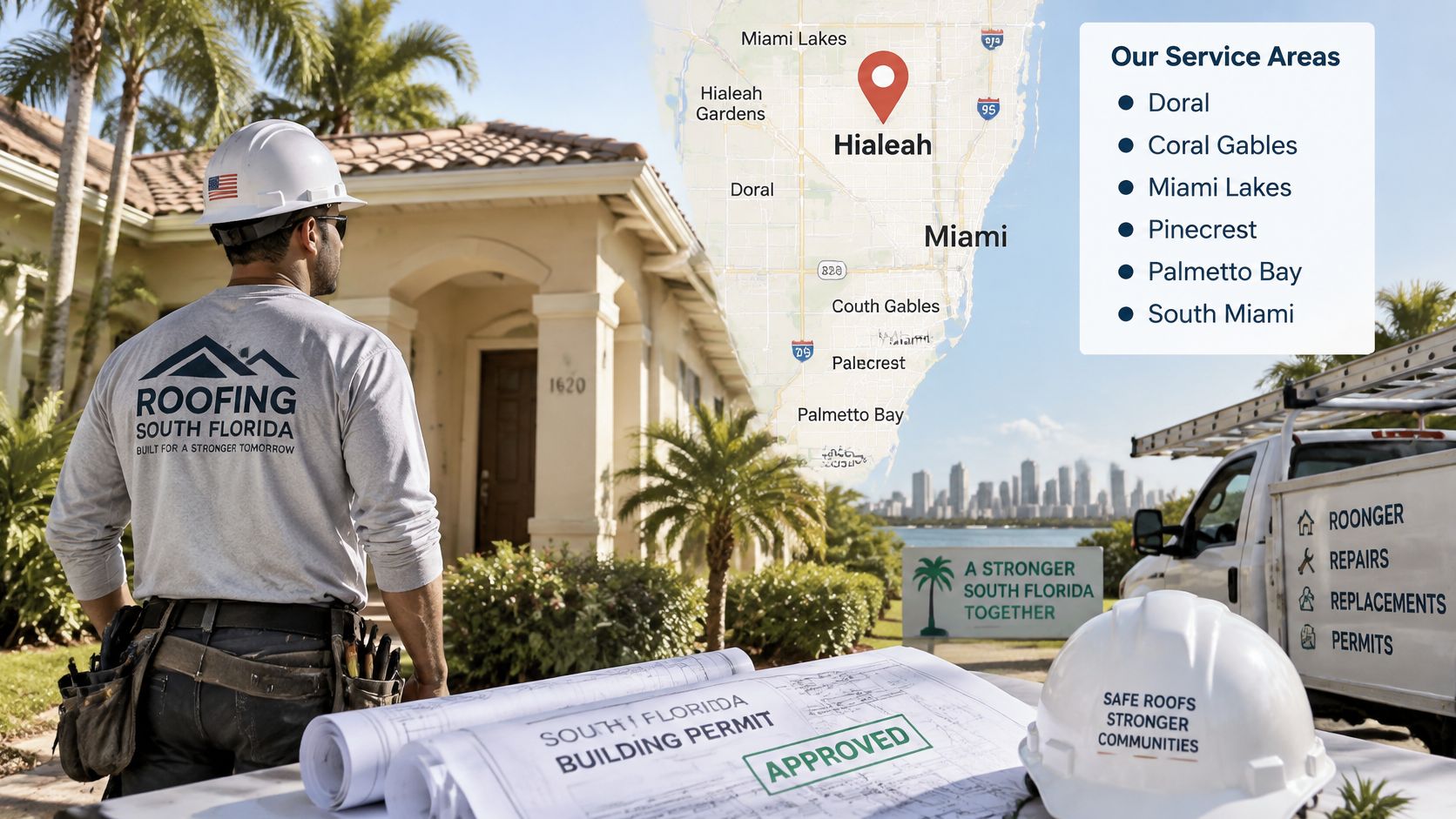
Cities We Serve Around Hialeah
- Miami-Dade: Doral, Coral Gables, Miami Lakes, Pinecrest, Palmetto Bay, South Miami, and Kendale Lakes
- Broward: Pembroke Pines and Cooper City
Permits Differ by County and City
Miami-Dade states in its building responsibly guidance that all construction in Miami-Dade County requires building permits before construction begins, and its Uniform Roofing Permit Application is based on the Florida Building Code's High-Velocity Hurricane Zone requirements, covering roof replacement, roof sheathing, secondary water barriers, and roof-to-wall connections. In Broward, the Broward County Building Code Division directly regulates unincorporated Broward and the cities it contracts with, handling permitting, code compliance, enforcement, and contractor licensing. That split means permit steps in Pembroke Pines or Cooper City can differ by municipality, so confirm the local process before you schedule tear-off.
Labor moves with practical conditions, tight lots and limited access for staging tile, crew scheduling, and higher demand after storms when every good crew in South Florida is booked out. No published local labor rate is included here, so your written quote is the only reliable local number.
Ask directly: Are permit fees and inspections inside the quoted price, or will they show up later as pass-through charges?
Every city we serve gets CertainTeed ShingleMaster and Polyglass certified installation, full local permitting, manufacturer-spec materials, and our own crew from estimate through final inspection, never a subcontractor. We handle the permitting for you, which removes one of the most common causes of delay.
Worked Price Examples for Common Roof Sizes
Use the national per-square-foot rates to build totals for the roof sizes we see most often, from a smaller starter home to a larger family home.
| Roof area | Concrete tile (installed) | Clay tile (installed) |
|---|---|---|
| 1,200 sq ft | $8,400 to $22,800 | $13,200 to $30,000 |
| 2,500 sq ft | $17,500 to $47,500 | $27,500 to $62,500 |
| 3,500 sq ft | $24,500 to $66,500 | $38,500 to $87,500 |
The arithmetic is simple enough to repeat yourself. Roof area times the low rate gives you the floor, and roof area times the high rate gives you the top. You can run your own pitched area through our roofing calculator to check a contractor's math before you talk scope.
One Illustrative Hialeah Example
Say you own a 2,500 square foot hip roof in Hialeah and choose concrete tile. Your base starts at $17,500 at the low rate. Then the quote adds tear-off and disposal of the old system, new underlayment matched to the approved assembly, perimeter work at hips and eaves, plus permits and inspections. Each addition moves you from that floor toward the upper half of the range, and none of them are optional if you want a permitted, inspectable roof.
Run the same scope in clay and the total climbs faster, because you're paying the higher tile cost on every square foot plus slower, more careful handling on every cut and ridge. A hip roof also needs attention to roof-to-wall connections under Miami-Dade mitigation rules, which can add scope a simple gable roof might not trigger in the same way.
Two Caveats Before You Trust the Table
First, roof area must include the pitch, not the footprint. Understating area understates every number that follows. Second, this table is built from national installed rates, so specialized wind testing and local permit administration can sit on top of it.
If a total falls below the floor for your size and material, ask what's missing. If it lands far above the top, ask which specific scope item drives it.
Either answer tells you something useful. A contractor who can point to deck repairs, perimeter detailing, or testing coordination is explaining a system. A contractor who can't explain the gap is asking you to trust a number with nothing under it.
Get an Itemized Tile Quote Before You Commit
A price range is a starting point. The right quote is the one you can compare line by line against another quote for the same roof.
Five Steps to a Comparable Quote
- Confirm roof area and shape. Get the pitch-adjusted area in writing and confirm whether you're looking at a hip or gable design.
- Request full itemization. Tile, underlayment, attachment method, flashing and perimeter work, deck repairs, tear-off and disposal, permits and inspections, each on its own line.
- Get the approval number. Ask for the Florida Product Approval or Notice of Acceptance number that matches the exact installation method proposed.
- Confirm permit responsibility. Who pulls the permit, who meets the inspector, and which closeout documents land in your hands at the end.
- Compare like against like. Same roof area, same tile, same scope. Anything else is guesswork.
Our roof replacement service follows that structure, so you're reading a scope, not decoding a lump sum.
We're a licensed roofing contractor based in Hialeah, serving Hialeah, Doral, Miami Lakes, Coral Gables, Pinecrest, Palmetto Bay, South Miami, Kendale Lakes, Pembroke Pines, and Cooper City. We offer free on-site estimates for roof replacements, permits are handled for you, and your free quote comes with no pressure and no obligation. You can reach us by calling or texting (305) 615-5060.
At the visit, expect an itemized written scope tied to your roof's condition and your city's code requirements. That's the point where roof tiling prices stop being a national range and become a number you can act on.
If your tile roof is leaking, aging out, or coming up for insurance renewal, get a real local number based on your pitched area, tile choice, and wind requirements. Visit Rooftop Solutions to book your free on-site inspection and itemized quote, and we'll price the complete permitted system for your Hialeah or South Florida home with no pressure and no obligation.
