
Asphalt vs Metal Roof Prices: Real Costs in South Florida
A $19,994 upfront premium changes the roofing decision. A 2025 national benchmark reported by Smart American Living priced replacement of a 3,000-square-foot roof at $31,871 for asphalt shingles versus $51,865 for standing-seam metal, approximately 62.7% more for metal. For a South Florida homeowner, the question isn't whether metal lasts longer. It's whether you'll own the property long enough to recover that premium after permitting, financing, maintenance and any documented insurance benefits.
Table of Contents
- Asphalt and Metal Roof Prices at a Glance
- Scope and Permit Rules That Set Your Price
- Lifetime Cost Break-Even by Ownership Length
- Insurance Discounts and the Paperwork That Protects Them
- Choosing Asphalt or Metal for Your Property
- Request a Line-Item Quote Before You Sign
Asphalt and Metal Roof Prices at a Glance
Benchmark installed prices for asphalt and metal roofs
| Benchmark | Asphalt shingle | Metal roof | Metal premium |
|---|---|---|---|
| 2025 national benchmark, 3,000 sq ft roof, standing-seam metal | $31,871 | $51,865 | $19,994, about 62.7% |
| 2024 national average replacement, Cost vs. Value figures cited by The Roofing Brief | $30,680 | $49,928 | $19,248, about 62.7% |
| Published comparison, 1,800 sq ft roof, from Constructly Tools | $7,071 | $13,879 | $6,808, about 96.3% |
| 2024 typical project ranges reported by Fixr | $5,400 to $9,800 | $6,700 to $12,200 | Corresponding endpoints are $1,300 to $2,400 higher, about 24% |
These comparisons don't describe identical roofs or specifications. Fixr's overlapping project ranges, for example, don't establish what the premium would be on your property. Compare within each benchmark, not across unrelated rows.
The installed-price bands in Constructly Tools' comparison are roughly $4 to $8 per square foot for architectural asphalt shingles and $8 to $16 for metal roofing. Those broad bands help explain why two reasonable estimates can differ substantially before either contractor has made a pricing mistake.
What the premium actually buys
Metal pricing includes more than panels. Specialized fastening, flashing, underlayment, installation labor and detailed work around roof transitions contribute to the difference. Standing-seam construction shouldn't be treated as interchangeable with a lower-priced exposed-fastener system.
Roof pitch, geometry, access, tear-off requirements and local labor also affect either option. In Hialeah, Doral and Miami Lakes, wind-rated assemblies, corrosion-resistant components and permit work can push both installed prices above a national comparison.
For a hypothetical 1,800-square-foot South Florida roof, applying those published bands produces $7,200 to $14,400 for architectural asphalt and $14,400 to $28,800 for metal. Treat that calculation as a screening exercise before separately identified Miami-Dade engineering, permitting and mitigation work, not as a local bid. Don't add an allowance twice if the contractor already included it.
A quote outside a national price band is a reason to examine its scope, not proof of an overcharge.
Commercial owners should also avoid forcing every roof into this comparison. Airtight Spray Foam Insulation's resource on seamless foam roofing for commercial buildings provides context for a different system category, rather than a direct substitute for a pitched residential roofing estimate.
Write down your own complete asphalt and metal prices. Calculate (metal price minus asphalt price) ÷ asphalt price × 100 to establish the premium you'll test against your ownership plans.
Scope and Permit Rules That Set Your Price
A low roofing quote can reflect an efficient installation, a simpler product or an incomplete scope. You can't tell which by looking at the total alone. When comparing asphalt vs metal roof prices, require the contractor to identify what's included, what's excluded and what gets priced only after tear-off.
The most useful comparison is an assembly-to-assembly estimate. Both proposals should cover the same roof area and address the same existing conditions, even when the installation methods differ.
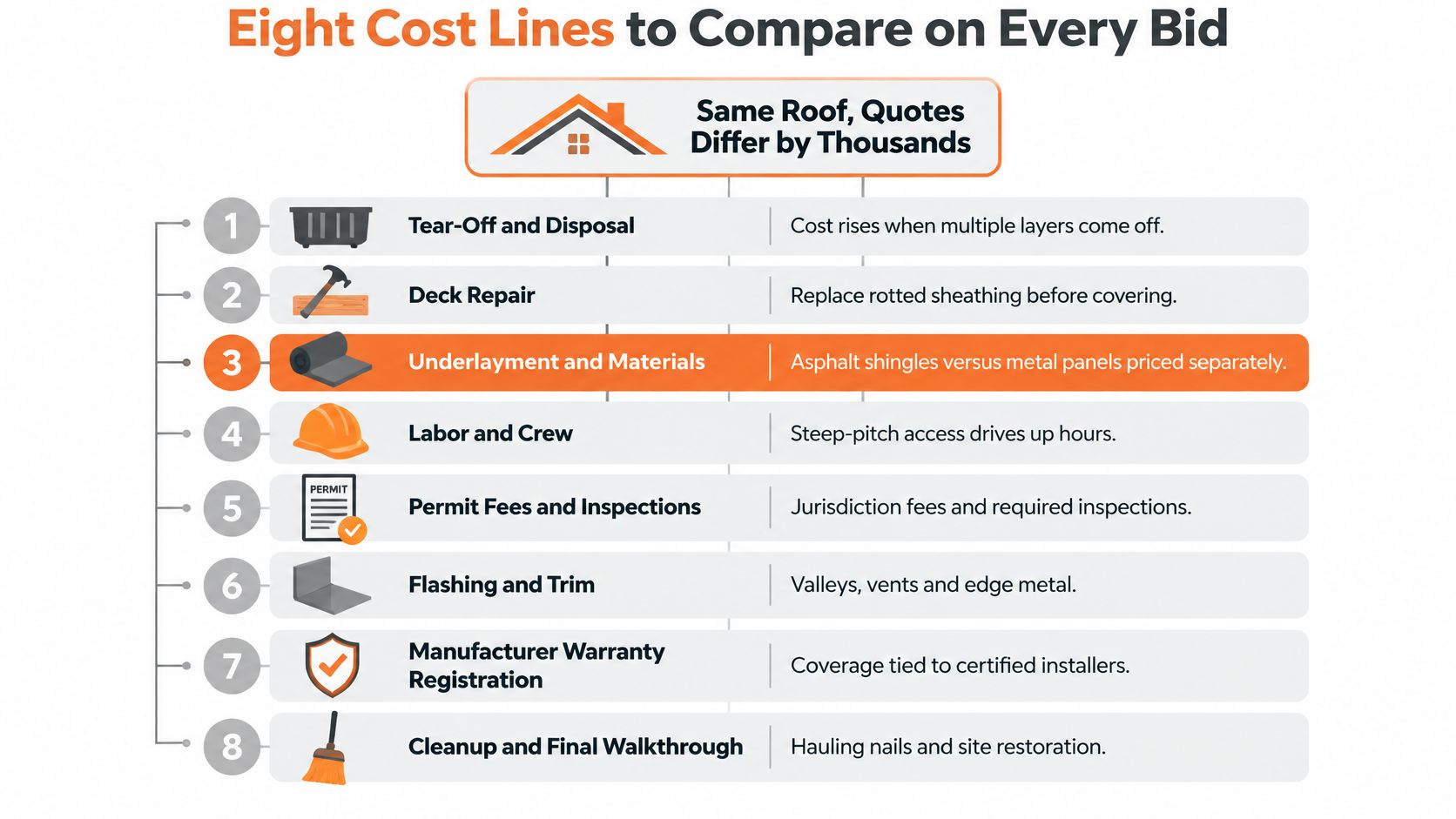
Compare these eight cost lines
Tear-off and disposal. Identify the existing covering and whether the price includes removing all layers. Multiple layers mean more removal and hauling work, so a quote that assumes a simpler tear-off can look cheaper until work begins. Include disposal and final cleanup rather than treating them as informal promises.
Deck repair and damaged sheathing. Ask how concealed damage will be documented and priced. The estimate should explain the repair allowance or pricing method, who authorizes extra work and whether photographs accompany a change order. Neither covering should be used to hide an unsound substrate.
High-wind-rated underlayment and secondary waterproofing. Identify the proposed product and assembly, not simply an underlayment allowance. Secondary water-barrier requirements can change the preparation and materials needed. A higher price may represent a materially different waterproofing scope.
Corrosion-resistant and enhanced uplift fasteners. Confirm which fastening system belongs to the approved assembly. Metal panels, deck attachment and shingles don't all use the same fastening approach. The contractor should distinguish standard installation labor from any additional attachment work required for the property.
Edge metal, flashing and penetrations. Request clear treatment of valleys, walls, plumbing vents and other roof openings. Reusing existing flashing and installing new flashing aren't equivalent scopes. Complex transitions can add considerable detail work even when the roof's measured area hasn't changed.
Ventilation. Identify existing ventilation and the proposed changes. Don't assume a roof replacement automatically includes correcting every attic ventilation issue. The estimate should explain which components remain, which are replaced and how the installation accommodates them.
Permits, inspections and engineering. Make responsibility explicit. A price that excludes engineering, approval documents or inspection-related work isn't directly comparable with a complete permitted replacement. The written scope should also identify who responds if the building department requires revisions.
Wind-mitigation documentation. Specify the records you'll receive at completion. Installation photographs and fastening information are easier to collect while the work is exposed than after the covering is installed. Documentation should be a planned deliverable, not something you try to reconstruct later.
Use this visual checklist alongside the written scope, while keeping warranty registration and cleanup responsibilities in the contract too.
Miami-Dade permitting changes the comparison
Miami-Dade County's permitting guidance requires the Uniform Roofing Permit Application, based on the Florida Building Code, for roofing permits and addresses High-Velocity Hurricane Zone requirements involving sheathing, roof-to-wall connections, secondary waterproofing and other mitigation measures.
That framework matters in Hialeah, Doral, Miami Lakes, Coral Gables, Pinecrest, Palmetto Bay, South Miami and Kendale Lakes. Engineering, applicable product approvals, hurricane-rated details, permit fees and inspection work belong in the estimate when the property requires them. They aren't optional upgrades just because a national price calculator doesn't show separate lines for them.
Code framework and permit path by service area
| Service area | Code framework | Permit path | Effect on price |
|---|---|---|---|
| Hialeah, Doral, Miami Lakes, Coral Gables, Pinecrest, Palmetto Bay, South Miami | Miami-Dade High-Velocity Hurricane Zone rules | Uniform Roofing Permit Application through the applicable authority | Engineering, product approvals, hurricane-rated details and permit fees |
| Kendale Lakes, unincorporated Miami-Dade | Miami-Dade High-Velocity Hurricane Zone rules | Uniform Roofing Permit Application | Miami-Dade assembly requirements, plus a mitigation-eligibility check |
| Pembroke Pines, Cooper City, Broward | Florida Building Code wind-load rules with Broward amendments | Local building department permit | Wind-uplift fastening and permit fees; confirm current local amendments |
| Older Miami-Dade homes with sloped hip or gable roofs | Applicable retrofit and secondary water-barrier rules | Permit scope expands when mitigation is triggered | Roof-deck attachment and roof-to-wall work can add cost |
Why neighboring homes can receive different scopes
Miami-Dade's hurricane-mitigation guidance identifies requirements for site-built single-family residences with sloped hip or gable roofs, including deck attachment, secondary waterproofing and roof-to-wall connections; it also identifies exemptions from roof-to-wall strengthening for some homes built under the Florida Building Code or the 1994 South Florida Building Code.
The important conclusion is that a countywide price multiplier won't capture an individual home's obligations. Construction date, roof shape, existing attachments and exemption eligibility can change the permit scope before you choose shingles or metal.
For Pembroke Pines and Cooper City, confirm the current amendments and permit requirements with the local building department. Don't transfer a Miami-Dade approval package to a Broward project without checking the actual jurisdiction.
Our Hialeah base anchors service across these markets. For scale, Florida's official 2010 Census municipal table recorded 224,669 residents in Hialeah, 154,750 in Pembroke Pines and 45,704 in Doral. Those are historical population counts, not indicators of roof price.
Every city we serve receives CertainTeed ShingleMaster and Polyglass certified installation, full local permitting, manufacturer-spec materials and our own crew from estimate through final inspection, never a subcontractor.
Use the installed premium divided by the expected service interval as an initial affordability measure, not a complete lifetime-cost answer. Before signing, resolve three questions: Who pulls the permit? Is engineering included? Which code edition does the quote follow?
Lifetime Cost Break-Even by Ownership Length
Roofs needed and likely cheaper path by ownership length
| Ownership length | Asphalt roofs needed | Metal roofs needed | Likely cheaper path |
|---|---|---|---|
| Sell within 10 years | 1 | 1 | Asphalt, lowest upfront cost |
| Own 20 to 30 years | 1 to 2 | 1 | Compare the installed premium with probable replacement timing |
| Own 40 years or more | 2 in a simplified 40-year model | 1 if its service life covers the period | Metal may close the gap if the premium stays near the benchmark |
These are planning scenarios based on the commonly stated 20-to-30-year asphalt life and 40-to-60-year metal life summarized by EcoFlow's metal-versus-shingles comparison. They aren't service-life guarantees, and an open-ended ownership period can require more replacements than the simplified table shows.
The short-term conclusion is straightforward: an owner who sells before the next replacement generally keeps asphalt's upfront saving without paying for another roof. The long-term conclusion is conditional. Metal becomes financially attractive when the owner avoids a replacement that would otherwise occur during ownership.
Calculate the cost you might avoid
Start with the complete installed premium, not the material-price difference. Then compare it with the future asphalt replacement expense you expect to avoid.
Include tear-off, disposal and renewed underlayment in that avoided expense. Add financing interest and each option's expected maintenance to its own side of the comparison. Separate standing-seam metal from exposed-fastener panels because their initial prices, maintenance obligations and warranty terms aren't interchangeable.
Longevity has financial value only when you retain the property long enough to use it, or recover that value when you sell.
A future replacement expense also isn't equivalent to cash spent today. If metal requires financing that strains your budget, a nominal lifetime saving may not justify the immediate obligation.
Our metal roofing has reflective coatings that cut cooling costs during the hottest months. A properly installed metal roof from Rooftop Solutions can last 50 years or more, and with proper insulation it's no noisier than shingles. Keep cooling savings separate from the construction quote, and don't assign them a dollar value without a property-specific basis.
A worked example you can copy
Enter these values in a spreadsheet:
- Asphalt installed price: Your complete written estimate.
- Metal installed price: The same scope using the specified metal system.
- Ownership period: Your expected remaining time in the home.
- Next asphalt replacement: A planning year supported by the product and property assessment.
- Additional costs: Financing, maintenance and any documented operating savings.
For illustration, suppose you expect to remain through the next asphalt replacement. Subtract the asphalt estimate from the metal estimate, then compare that premium with the avoided replacement's estimated cost in today's dollars. If the avoided expense doesn't exceed the premium and additional ownership costs, metal hasn't reached financial break-even under your assumptions.
Run the calculation again with an earlier sale date. If the result reverses, ownership length, not the roofing material alone, controls your decision.
Insurance Discounts and the Paperwork That Protects Them
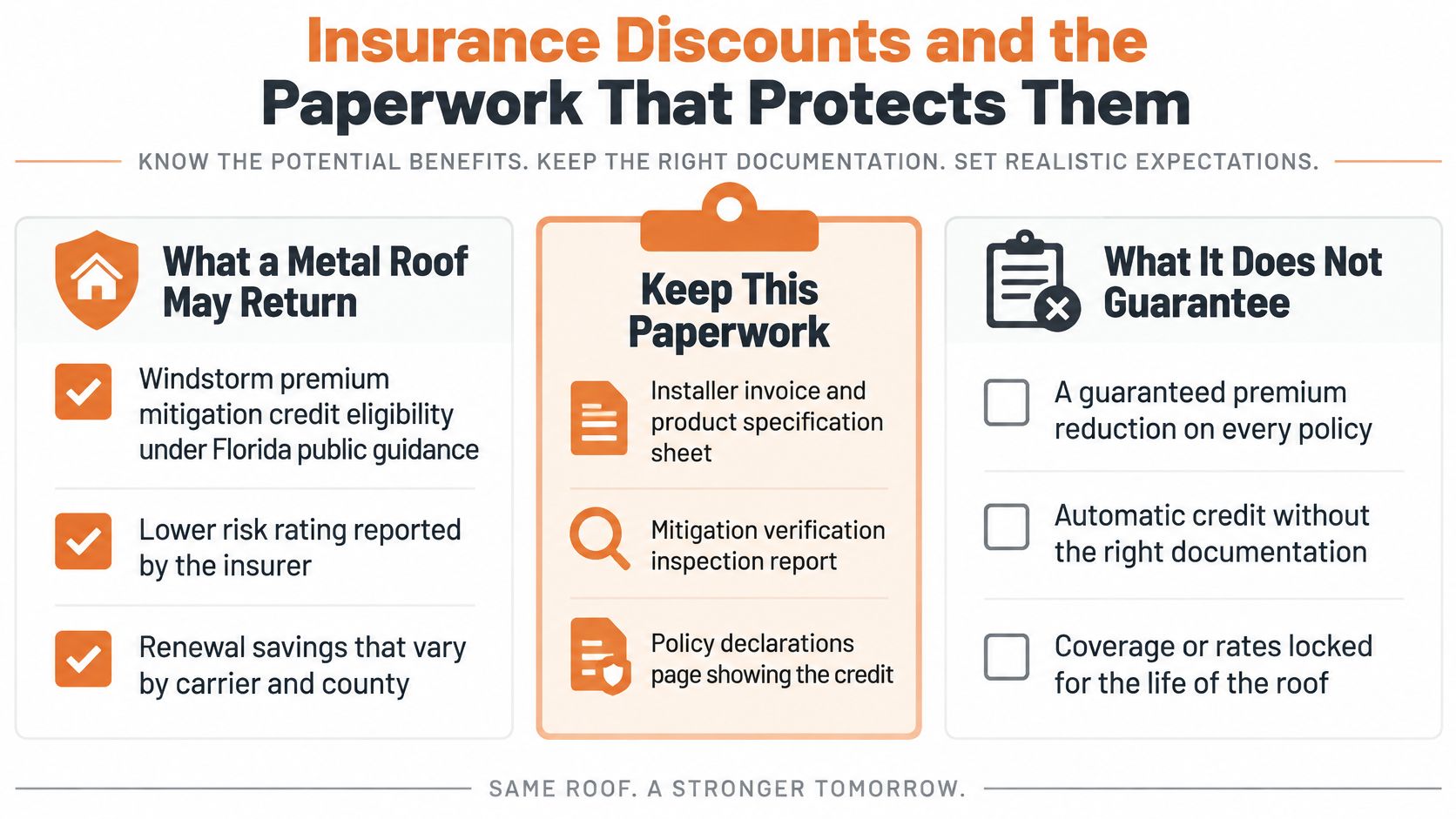
A metal roof doesn't automatically produce a standard Florida insurance discount. The Florida Office of Insurance Regulation's wind-mitigation resources explain that mitigation improvements can qualify homeowners for windstorm-premium discounts, but eligibility depends on the complete assembly and insurer criteria; the revised wind-mitigation inspection form became effective April 1, 2026.
The relevant features include approved materials, attachment methods, roof-to-wall connections, opening protection, roof age and a completed inspection. A panel's material name doesn't establish the performance of the entire building envelope.
Compare metal with an appropriately approved, impact-rated asphalt system rather than assuming every shingle product is weak. Both systems can have tested approvals, and installation determines whether the specified assembly is delivered.
Build the insurance file before construction
Ask your insurer for its written eligibility requirements before you include any premium reduction in your budget. Then retain the records that show what was installed:
- Applicable product approvals: Match the proposed products and assembly to the property.
- Installation and fastening records: Keep specifications and records of the attachment work.
- Concealed-work photographs: Capture relevant details before later roofing layers hide them.
- Permit and inspection records: Retain the permit documents and completed inspection records.
- Insurer confirmation: Keep the mitigation report, written eligibility decision and policy documents showing any applied credit.
Don't assume a contractor's estimate of insurance savings is binding on your carrier. Ask the insurer to distinguish the effect of the proposed mitigation from other changes affecting your renewal.
Keep claims decisions separate from material selection
A storm-damage claim and a mitigation discount answer different questions. One concerns a covered loss under the policy; the other concerns how the insurer recognizes qualifying property features.
We advise that minor cosmetic repairs are often cheaper paid out of pocket than filed as an insurance claim, since a claim can raise your premium. Check the deductible and policy terms before deciding, and distinguish cosmetic damage from damage that affects watertightness or function.
Our insurance claims assistance includes damage-documentation support, working directly with the insurer and guidance on repair versus replacement. We can help coordinate the information used by the insurer and adjuster without treating claim approval as guaranteed.
Budget for the roof without an assumed discount. Treat any confirmed insurance reduction as additional value, not guaranteed repayment of the metal premium.
Choosing Asphalt or Metal for Your Property
Choose based on the decision you're making: managing cash, avoiding another replacement, improving storm readiness or addressing a limited defect. The lowest quote and the lowest lifetime expense aren't always the same answer.
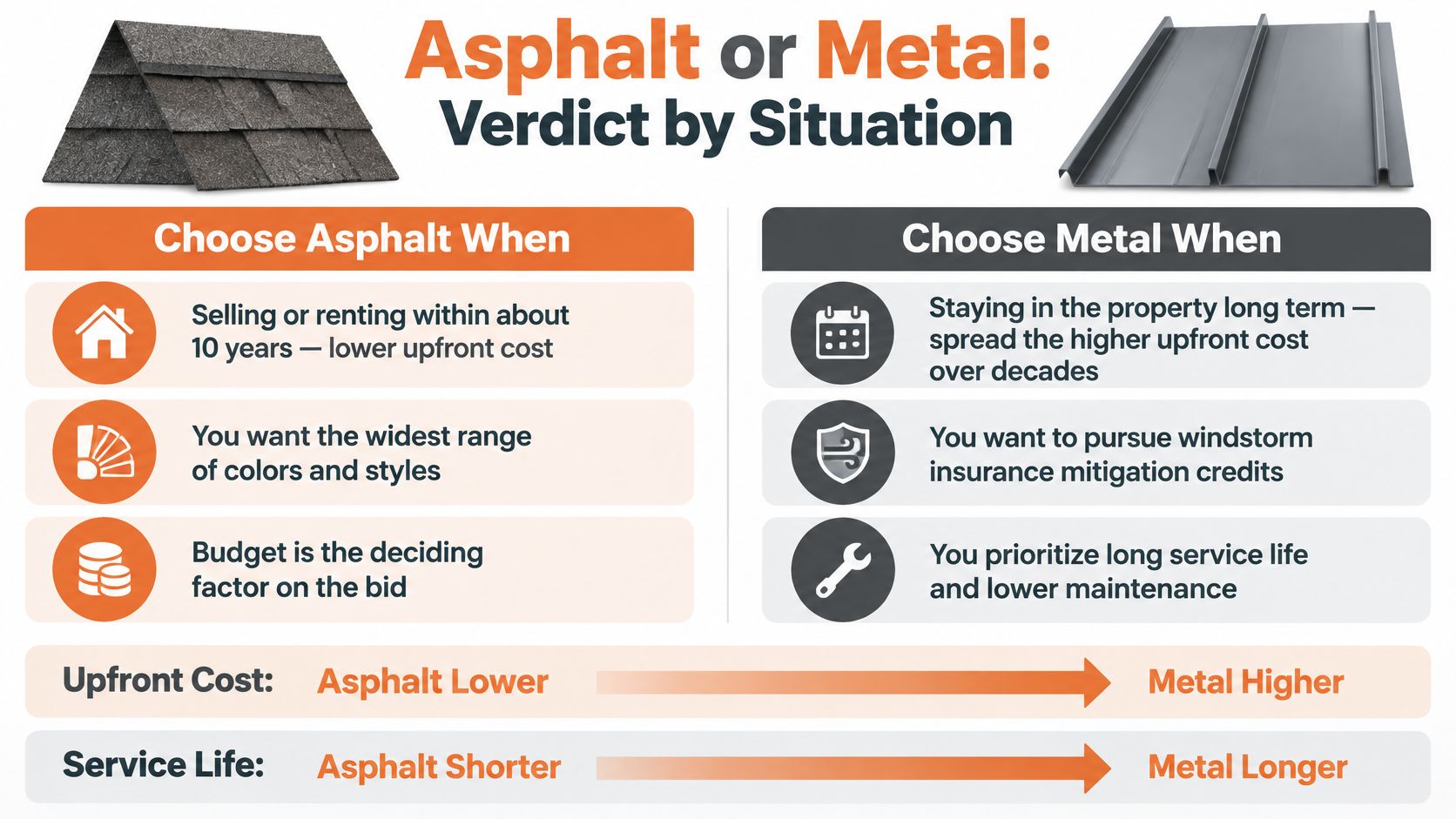
Match the material to the ownership plan
Selling soon or preparing a rental: Asphalt is generally the practical starting point when the upfront budget controls. We install budget-friendly asphalt shingles in a wide range of colors and styles. The number that changes the verdict is the net premium you can realistically recover, not an assumed resale bonus.
Staying through a substantial ownership period on a tight budget: A properly scoped asphalt proposal can be the better financial choice when metal requires expensive borrowing. The deciding number is the financed premium, including interest, rather than the difference between cash prices.
Keeping the home for the long term or passing it on: Metal deserves closer analysis when avoiding another replacement is a realistic benefit. Our specialty is hurricane-rated, heat-reflective metal roofing with a 50-plus-year lifespan and low maintenance. The number that changes the verdict is the cost of the replacement you expect to avoid.
For a more product-specific comparison, use our standing-seam metal roof cost guide rather than treating all metal systems as one category.
Account for exposure, building use and roof condition
- Coastal Miami-Dade or Broward property: Give greater weight to the approved assembly, corrosion-resistant details and documented installation. The critical number is the complete compliant-system price, not the panel allowance.
- Commercial property, HOA or condo association: Budget for the full replacement cycle, maintenance access and warranty obligations before setting reserves. The number that changes the recommendation is the funded lifecycle cost, not the initial contract amount.
- Sound roof with an isolated leak or missing shingles: Investigate a targeted repair before comparing replacement materials. We say no to work we don't think the customer needs and won't sell a replacement when a repair is enough. The deciding number is the repair cost relative to the roof's remaining useful service, supported by an inspection.
The strongest recommendation isn't always metal. It's the option that fits the property, the owner's finances and a credible timeline.
Request a Line-Item Quote Before You Sign
A useful estimate should let you trace the total back to measurable work. Software can help organize quantities, but it can't replace checking the deck, verifying the jurisdiction or documenting existing conditions. For readers interested in how contractors structure takeoffs, Exayard roofing estimating software is a relevant workflow resource, not evidence of what your particular roof should cost.
Turn the comparison into a written request
Request both options on the same scope. Include tear-off, deck-repair pricing, underlayment, fasteners, flashing, ventilation, permitting and documentation. Identify allowances and exclusions so a low starting number doesn't hide unfinished decisions.
Assign permit responsibility. Confirm who submits the application and whether engineering, applicable product approvals and inspection-related work are included. We handle permits for our replacement customers.
Test your ownership assumptions. Compare the installed premium with the replacement expense you might avoid, then account for financing and maintenance. Our roofing calculator can be a starting point, but the measured estimate should control your decision.
Book the inspection before choosing the material. Establish whether you need replacement at all. We offer a free roof inspection with no obligation and a response in minutes, plus free on-site replacement estimates and a no-pressure quote.
Get a property-specific answer
Rooftop Solutions is a licensed and insured roofing contractor based in Hialeah, with more than 5,000 roofs completed and a 4.8-star Google rating. We serve Hialeah, Doral, Miami Lakes, Coral Gables, Pinecrest, Palmetto Bay, South Miami, Kendale Lakes, Pembroke Pines and Cooper City.
Bring your competing proposals, expected ownership period and any insurer requirements to the inspection. We'll help distinguish a material premium from a scope difference, and we won't recommend a replacement when a repair is enough.
Get a free, no-obligation inspection and a line-item asphalt-versus-metal replacement quote, with permitting handled for you. Visit Rooftop Solutions to call or book an inspection, and compare both options using your roof's condition, local requirements and ownership plans.
