
Standing Seam Metal Roof Cost in South Florida
A standing seam metal roof in the United States typically costs about $8–$14 per square foot installed, or roughly $16,000–$28,000 for 2,000 square feet of roof surface. In South Florida, wind engineering, tear-off, and metal choice can move a real bid well outside that baseline.
That range is useful for early budgeting, not for choosing a contractor from a headline price. In Hialeah, Miami-Dade, and Broward, you need to compare the actual roof assembly, its wind approval, and what the quote includes. A lower price can leave out the clips, deck work, permitting, or inspections that make the system appropriate for the property.
Table of Contents
- What Standing Seam Metal Roof Cost Really Covers
- How Panels Labor and Accessories Build the Price
- Metal Type and Coating Prices Compared
- Tear-Off Overlay and Miami-Dade Wind Ratings
- Sample Standing Seam Estimates for Local Cities
- How to Compare Quotes and Choose a Contractor
- When the Higher Upfront Cost Makes Sense
What Standing Seam Metal Roof Cost Really Covers
One roofing square equals 100 square feet, and that unit matters more than your floor plan. Two Hialeah houses with similar living area can have different roof surfaces once slope, overhangs, valleys, and garage tie-ins are measured, so the national range is a budgeting marker rather than a South Florida bid.
A real Miami-Dade or Broward price covers an engineered assembly: panel metal and thickness, coating, profile, clip spacing, fasteners, underlayment, edge metal, flashing, and the exact tear-off and deck repair scope. If the proposal does not name the wind-rated system and the approval path for your jurisdiction, the number is incomplete.
What the baseline can and can't tell you
Geometry drives labor. Steeper slopes slow staging and seam closure; cut-up roofs add layout time, trim, and waste. Permit fees, inspections, disposal, plywood or deck correction, ventilation changes, and sales tax can sit outside the metal line, and they differ enough between Miami-Dade and Broward jobs to make a square-foot average weak for contractor selection.
Specialty metals change the bracket quickly, while mainstream steel and aluminum usually anchor the lower discussion. The bigger pricing risk is ambiguity: “standing seam” can describe several assemblies, and only the written spec tells you whether the attachment, clips, and edge details suit hurricane exposure.
Before you compare prices: get the metal, thickness, coating, seam height, clip spacing, deck work, removal, permits, inspections, warranty, and exclusions in writing.
For Hialeah and the surrounding Miami-Dade and Broward market, treat any estimate without those lines as preliminary. Ask what is included, what is excluded, and which approval the roof is being installed under.
How Panels Labor and Accessories Build the Price
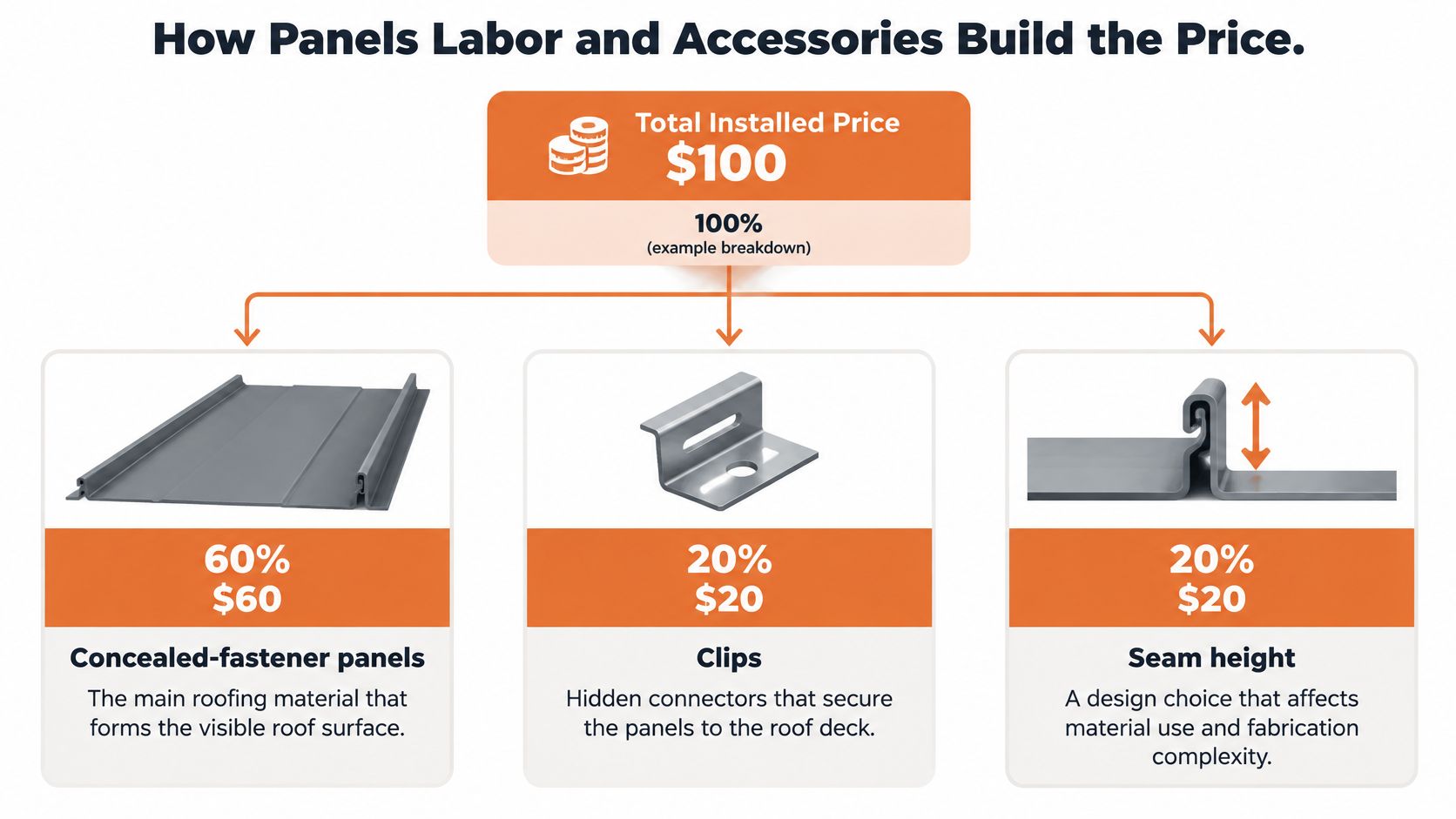
A standing seam roof is a system, not a stack of metal panels. Think of the panel as the roof's skin and the clips and seams as its skeleton. In hurricane conditions, that skeleton has to hold the panels in place as part of a specified assembly.
Read the material and attachment lines first
A proposal should identify whether it uses mainstream steel or aluminum, or a specialty metal such as copper or zinc. It should also spell out the panel profile, thickness, coating, and seam height. The seam isn't just a visual choice: it affects fabrication and how the system fits together.
Clips secure concealed-fastener panels to the roof deck. Ask what clip and fastener system is specified and how it will be attached. A quote that says only “standing seam metal” doesn't tell you whether the attachment matches the roof's required wind design.
Look for labor and finishing scope
Installation labor covers more than placing panels. The crew needs to lay out the roof, handle and position the panels, close the seams, and complete the edge metal and transitions. Walls, chimneys, and skylights need properly detailed flashing, with more intricate conditions typically requiring more labor and material.
Underlayment, ventilation, and accessories should appear as defined scope items instead of disappearing into a vague “metal” line. The same goes for manufacturer and workmanship warranties. Don't assume a warranty is included, or that a brand name alone explains what's covered. Ask the contractor to state the available coverage and the conditions in writing.
Use this mental invoice when you review a Hialeah or Broward proposal: panels, clips and fasteners, fabrication, labor, flashing and edge metal, underlayment, ventilation, accessories, permits, and warranty terms. If one bid includes an item and the other excludes it, the totals don't represent the same job.
Metal Type and Coating Prices Compared
Metal and finish can change the installed average even when the roof size stays fixed. The examples below show why a proposal that says only “metal roofing” leaves out a major cost decision.
| Metal and finish | Per square foot | 1,700 sq ft total |
|---|---|---|
| Basic-coated steel | $12.75 | $21,675 |
| PVDF/Kynar-coated steel | $15.90 | $27,090 |
| Basic-coated aluminum | $17.00 | $28,900 |
| PVDF/Kynar-coated aluminum | $21.25 | $36,125 |
| Zinc | $23.00 | $39,100 |
| Stainless steel | $24.00 | $40,800 |
| Copper | $34.00 | $57,800 |
These are average installed estimates, not guaranteed local bids. In this comparison, the difference between the lowest and highest example is $36,125, and copper is about 2.7 times the price of basic-coated steel. Those averages come from a cost guide's metal-and-finish estimates; actual totals still depend on the roof and installation scope. (Standing seam metal roof cost guide and material estimates)
Choose a specification, not a label
Steel can offer a stronger cost position, while aluminum or a PVDF/Kynar finish may be worth considering when coastal exposure, corrosion concerns, or color retention matter to the property owner. There isn't one right choice for every roof. The useful question is whether the material, coating, and attachment are appropriate for the property and the wind-rated assembly being proposed.
A roof with complicated flashing, difficult access, substrate repairs, insulation work, or permitting needs can land far from the material average. Storm-wind engineering may also change the clips, fasteners, and edge details. Get every proposal to identify the same material and finish before comparing totals.
A complete specification beats a low headline price. Compare the metal, coating, profile, attachment, labor, and included work line by line.
Tear-Off Overlay and Miami-Dade Wind Ratings
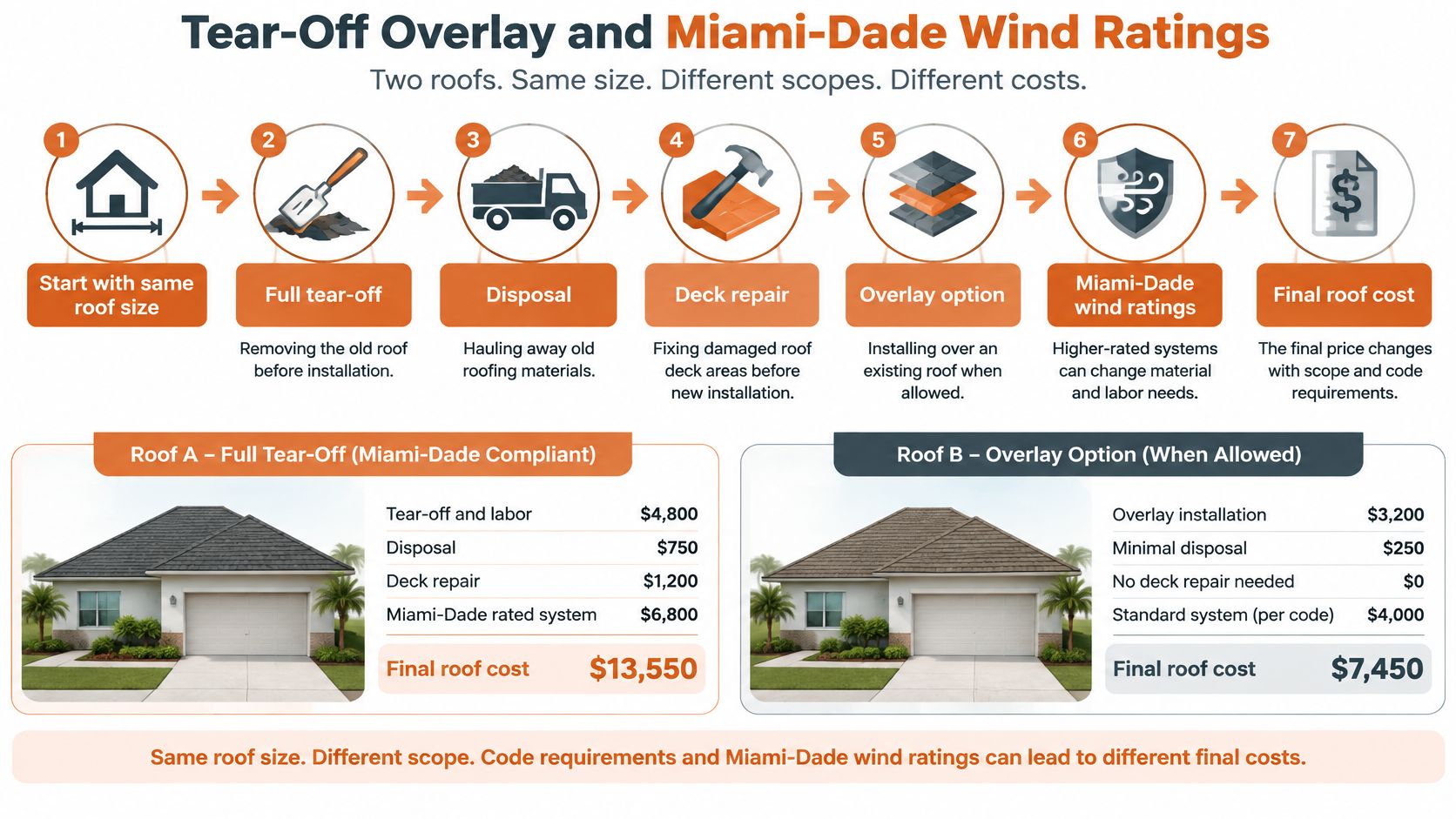
Two bids on the same measured roof can land far apart, and the gap often starts with one line: whether the old roof comes off. A tear-off adds removal and disposal labor, yet it also exposes the deck so the contractor can verify fastening, replace damaged sheathing, and build the new assembly on a known surface. An overlay skips that work, and it only qualifies when the existing roof and structure allow it.
Deck repairs, ventilation, insulation, and code upgrades can move the total further than panel selection does. For a broader look at replacement scope, see roof replacement planning and services.
Wind rating changes the assembly
Miami-Dade wind design is an engineering problem, and the panel is only one input. Under the Florida Building Code and ASCE 7, design uplift pressure depends on building height, exposure category, roof geometry, and location. A product-approval report shows what attachment does to the number: a certified 26-gauge concealed-fastener system over 15/32-inch plywood reached a maximum design uplift of -56 psf with anchors 24 inches on center, and -86 psf when spacing tightened to 12 inches on center. (Florida product approval report for a concealed-fastener roof system)
That is over 50 percent more uplift resistance from one spacing change, and it carries a price. Tighter spacing means more clips, more fasteners, more layout labor, and more inspection time. Perimeter and corner zones carry the worst pressures, so engineered edge metal and reinforced attachment there add cost that a per-square-foot average never captures. Two quotes for identical roof area describe different products when one specifies a tested assembly and the other leaves attachment vague.
Treat permits and mitigation as project scope
Miami-Dade issues roofing permits through a Uniform Roofing Permit Application, and a submission can require product approvals, system descriptions, limitations, detail drawings, and design calculations. On covered site-built single-family replacements, mitigation work can include compliant sheathing attachment, a secondary water barrier, and roof-to-wall connections, and the permit holder must provide an affidavit of compliance for deck attachment and the secondary water barrier at the first inspection. (Miami-Dade roofing permit requirements; Miami-Dade hurricane-mitigation requirements)
Those are labor and documentation line items, and they belong in the bid.
Before signing, ask which product approval applies, what clip spacing the number assumes, and whether tear-off, deck repairs, permitting, engineering, and disposal sit inside the price or outside it. A low quote that skips those answers prices a different job.
Sample Standing Seam Estimates for Local Cities
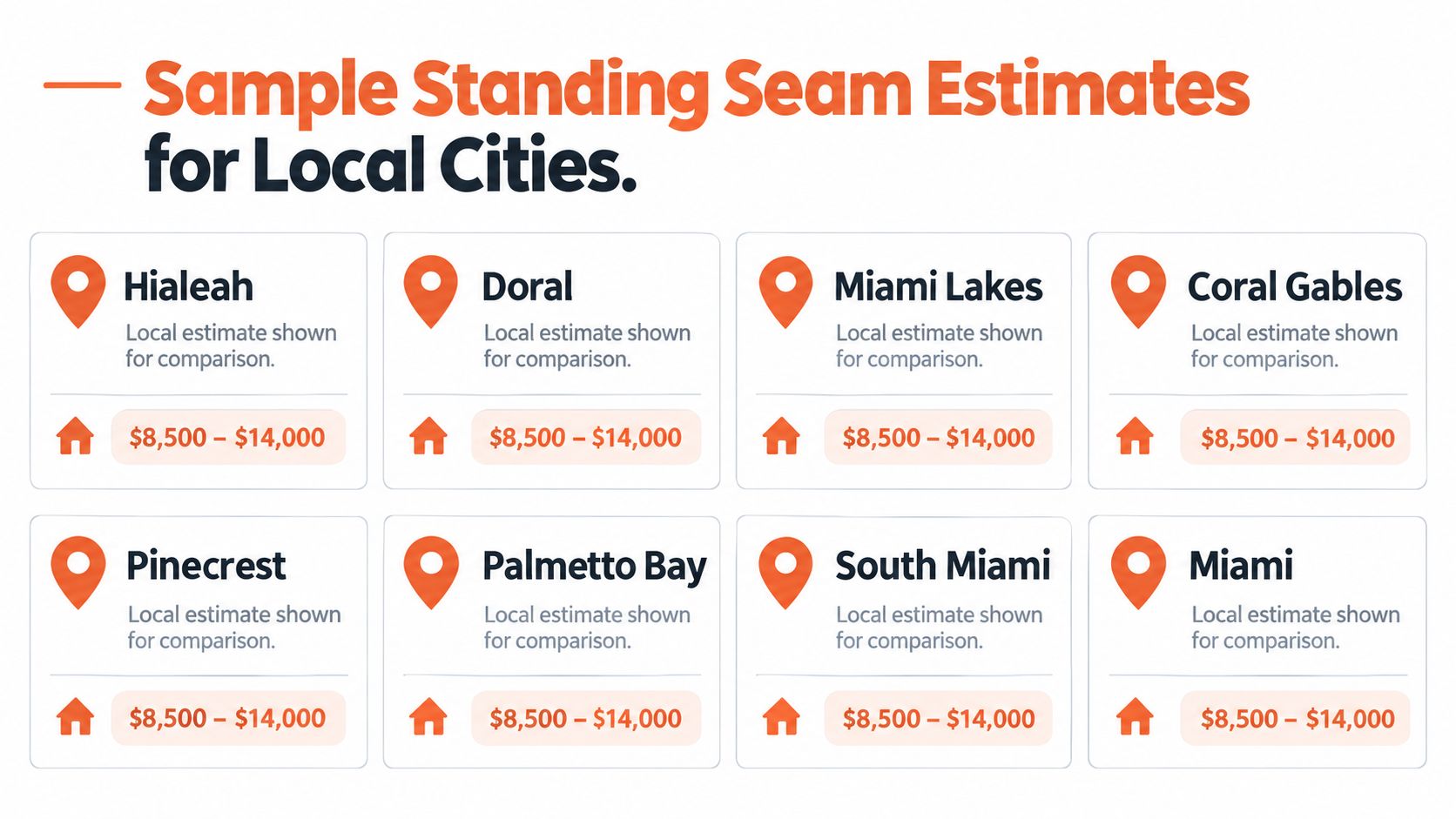
Start with the math, then name the city. The national baseline cited earlier, $8–$14 per square foot, scales by roof size before any scope differences enter the picture. A compact single-story home with roughly 1,000 square feet of roof surface plans at about $8,500–$14,000. A 1,500-square-foot roof runs $12,000–$21,000, and the 2,000-square-foot example reaches $16,000–$28,000. Every figure below is an example calculation at that baseline, the kind of rough check you run before anyone measures the roof.
Example scenarios by city
| Area | Example scenario | Planning range at baseline |
|---|---|---|
| Hialeah, Miami Lakes | Smaller single-story roof, ~1,000 sq ft | ~$8,500–$14,000 |
| Doral, South Miami, Kendale Lakes | Mid-size roof, ~1,500 sq ft, moderate pitch | ~$12,000–$21,000 |
| Coral Gables, Pinecrest, Palmetto Bay | 2,000 sq ft or more, valleys and skylights | $16,000–$28,000 and up |
| Pembroke Pines, Cooper City (Broward) | ~1,500–2,000 sq ft | ~$12,000–$28,000 |
These bands assume the baseline holds. They move the moment scope does.
A tile tear-off on a Coral Gables or Pinecrest home adds removal, disposal, and possible deck repair before the first panel goes down. Valleys, skylights, and complicated flashing push a cut-up roof toward the top of its band even at the same nominal size. Rooftop Solutions is based in Hialeah and sees this pattern across Miami-Dade: two homes a mile apart can land thousands of dollars apart because one needs a full tear-off and the other does not.
Jurisdiction matters too. Doral, Miami Lakes, Coral Gables, Pinecrest, Palmetto Bay, South Miami, and Kendale Lakes each run their own permitting and inspection schedules inside Miami-Dade County, while Pembroke Pines and Cooper City answer to Broward. (Miami-Dade municipality directory; Broward municipal listings) For commercial buildings and HOA projects, ask how mobilization and access change the estimate, since a familiar panel spec can still mean a different work plan.
Check the Miami-Dade and Broward service areas, then request a local inspection with the property's real roof measurements and scope. That is how a planning band becomes a number you can sign against.
How to Compare Quotes and Choose a Contractor
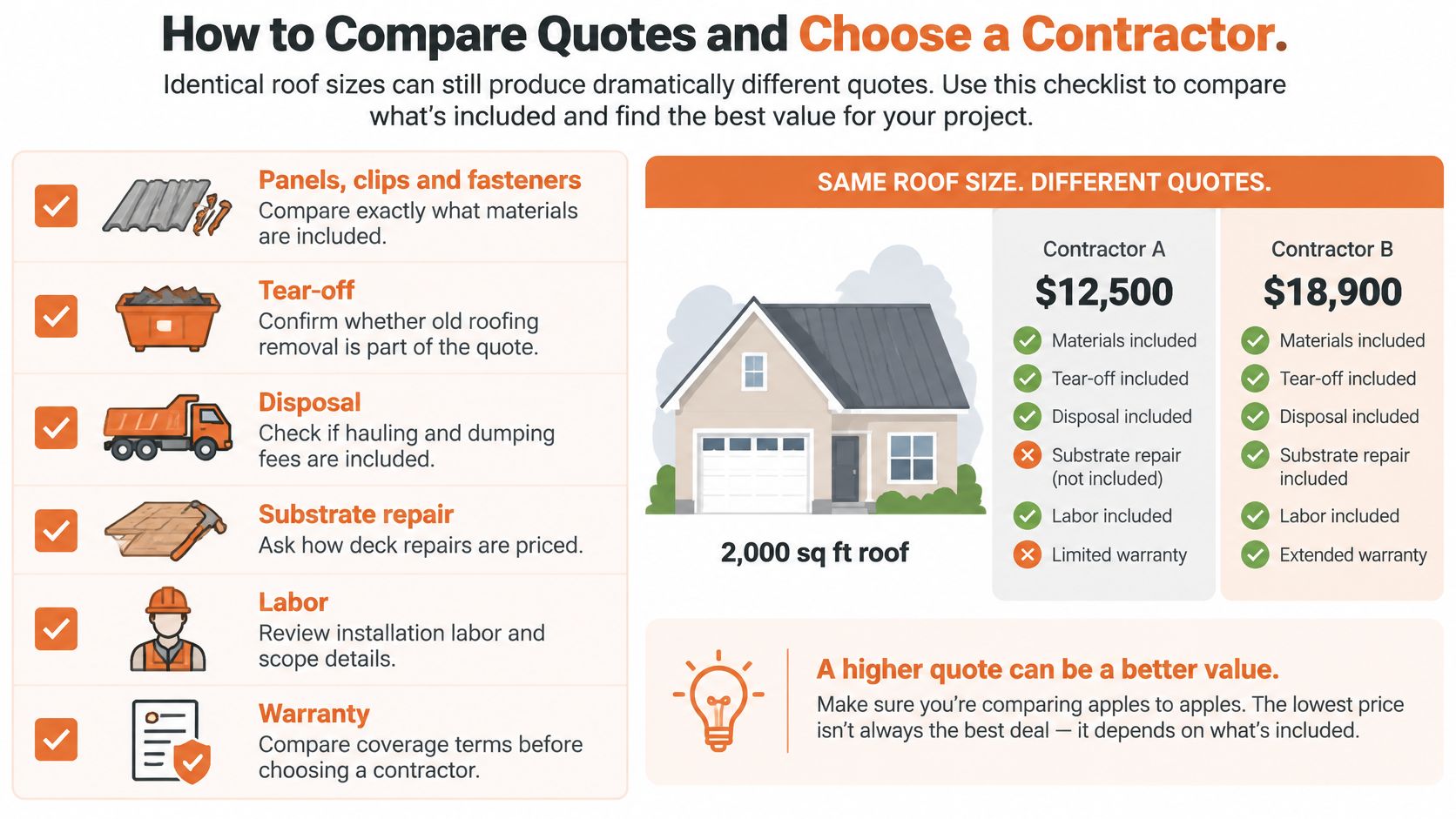
A low number means nothing until you know what it covers. Break every proposal into line items: panels, clips and fasteners, tear-off, disposal, deck repair, insulation, flashing, permits, engineering, mobilization, and warranty terms. If a contractor leaves one of those vague, get a written inclusion or exclusion before you compare totals.
Check material pricing and quote terms
Metal pricing can move while your project sits in permitting. Industry reporting cited metal-roofing cost increases of up to 60% between March and early June 2025, domestic hot-rolled coil projected to reach about $890 per short ton by late 2025, immediate panel-price effects of roughly 5–10%, a 46% increase in roofing-material costs since 2020, and 2025 steel tariffs expected to push coil prices about 15% higher year over year. (Industry reporting on metal and roofing-material price changes)
Ask how long the quote stays valid and whether it carries an escalation clause. On a Miami-Dade or Broward job, the written proposal should also name the high-wind product approval, clip spacing and attachment details, permit and inspection handling, and the metal specified for the property's exposure. A headline price missing those items is not a comparable quote.
Compare the contractor's actual scope
Rooftop Solutions is a licensed, insured Hialeah roofing contractor serving residential and commercial properties across Miami-Dade and Broward. Its stated services include standing seam metal installation, in-house crews, permit handling, photo and video inspections, insurance-claims documentation, and manufacturer and workmanship warranty options. The company also cites a strong Google rating from local customers.
Hold every bidder to that level of detail. Line the proposals up and confirm whether crew, materials, approvals, removal, deck repairs, and warranty terms match. Choose the contractor who documents the complete wind-rated assembly. The lowest page total usually belongs to the scope that left something out.
When the Higher Upfront Cost Makes Sense
Pay more when the higher number buys a stronger assembly. A bid that prices in a Miami-Dade approved panel system, tighter clip spacing in edge and corner zones, full tear-off, and permit handling is money spent on the parts that decide whether the roof survives hurricane season. A bid that runs higher for vague reasons is just a bigger number.
Market research puts steel at about 65.83% of metal-roofing market share in 2025, with aluminum forecast to grow roughly 5.43% a year through 2031. The same research flags raw-material pricing and installer availability as cost constraints. (Metal roofing market research and projections) For your budget, that means material choice and timing both move the final number, so treat neither as fixed.
Spend the premium where it does the work
Steel usually wins on cost position. Aluminum earns its premium near the coast, where salt exposure punishes coated steel over time, or where deck loading limits your options. Neither metal fixes a weak attachment schedule or a thin scope of work, which is why panel price alone should never close the deal.
Run the full ownership math before you commit: expected service life, maintenance, recoating, fastener and flashing replacement, cooling-energy effects, insurance treatment where it applies, and what a premature failure or storm repair would cost you. Then confirm whether the job is a full replacement or a retrofit, because deck condition, ventilation, insulation, and code upgrades often swing the economics harder than the panels do.
One more test before you sign. Compare each quote's exclusions before you compare totals. The lower number often leaves out tear-off disposal, deck repairs, or permit fees, which puts it right back at the higher bid once work starts.
For owners in Hialeah, Doral, Miami Lakes, Coral Gables, Pinecrest, Palmetto Bay, South Miami, Kendale Lakes, Pembroke Pines, and Cooper City, the next step is an inspection and a written assembly matched to roof condition, wind approval, and warranty. Review standing seam and other metal roofing options before you commit funds.
Call Rooftop Solutions to discuss standing seam installation, roof condition, wind-rated assemblies, and written scope options for your South Florida property.
