
Asphalt Roof vs Metal Roof Cost in South Florida (2026)
The most popular advice about roofing costs, pay more for metal because it lasts longer, skips the question that matters: Will you own the property long enough to recover the premium? A longer service life doesn't automatically mean a lower bill during your ownership.
For homeowners in Hialeah and across Miami-Dade and Broward, the useful asphalt roof vs metal roof cost comparison starts with permitted, code-compliant quotes. Then it accounts for financing, replacement timing, maintenance, and only those energy or insurance savings that can be documented. That approach can favor asphalt even when metal has the longer lifespan.
Table of Contents
- Installed Cost of Asphalt and Metal Roofs at a Glance
- What Each Roof Costs Over Your Ownership Horizon
- Cool Roof Ratings and Verified Energy and Insurance Savings
- Hurricane Code and Permit Costs in Miami-Dade and Broward
- Which Roof Fits Your Property and Plans
- Get a Compliant Roof Quote Before You Commit
Installed Cost of Asphalt and Metal Roofs at a Glance
Installed cost and lifespan by roof system
| Roof system | Installed cost per sq ft | Typical 2,000 sq ft roof | Expected lifespan |
|---|---|---|---|
| Architectural asphalt shingles | $5–$8 | $10,000–$16,000 | 15–30 years |
| Standing-seam metal | $10–$18 | $20,000–$36,000 | 40–70 years |
The installed-price planning ranges above come from The Roofing Brief's asphalt roofing cost guide: approximately $10,000–$16,000 for architectural asphalt and $20,000–$36,000 for standing-seam metal on a typical 2,000-square-foot roof. Its comparison places standing-seam metal at about 2 to 2.5 times the upfront cost in major U.S. markets, not necessarily on every South Florida property.
The lifespan reference ranges are 15–30 years for conventional asphalt systems and 40–70 years for metal roofing, alongside a government-published questionnaire reporting a shorter asphalt average, as summarized in the government roofing questionnaire. Treat those ranges as service-life assumptions, not warranties or promises about your roof.
Measure the roof, not the living space
Roof surface area isn't house floor area. Pitch, overhangs, valleys, garages, porches, and attached structures affect how much roof must be covered. An estimate based only on the property listing's interior square footage can leave you comparing the wrong quantities.
Use our roofing calculator to organize an initial budget, then have the roof measured before making a financing or material decision. A calculator can support planning; it can't inspect concealed decking, confirm the approved assembly, or establish the final permit scope.
Standing-seam metal is also a specific system, not a price label for every metal product. A proposal for a different panel profile or attachment method shouldn't be treated as an equivalent substitute without checking the installation details.
Compare complete installation scopes
Ask for these costs to be identified rather than hidden inside a material-only allowance:
- Roof covering and labor: Exact shingle or metal product, finish, and installation scope.
- Removal and disposal: Existing roofing layers, hauling, and cleanup.
- Waterproofing details: Underlayment, flashing, penetrations, and edge metal.
- Permits and inspections: Documentation, processing, and required approvals.
- Deck repairs and warranties: Repair pricing, exclusions, and written coverage.
At Rooftop Solutions, we install budget-friendly asphalt shingles in a wide range of colors and styles. Asphalt's lower entry price can preserve funds for other necessary work; metal's longer service potential can improve annualized value. Neither advantage establishes the lowest total cost without your actual quotes and ownership horizon.
What Each Roof Costs Over Your Ownership Horizon
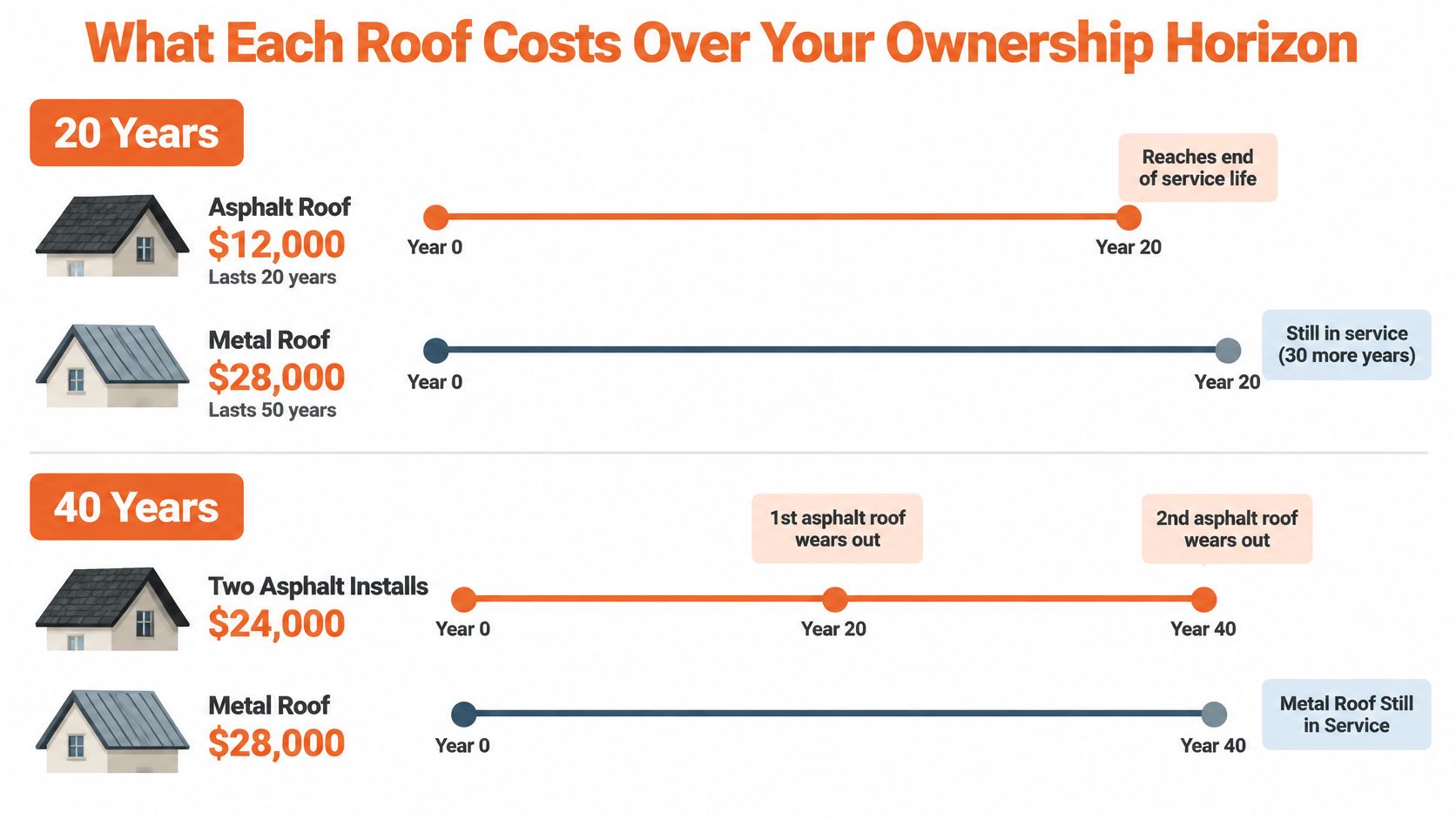
Consider an illustrative asphalt installation costing $12,000 and lasting 20 years, compared with a $28,000 metal installation lasting 50 years. If the asphalt replacement costs the same amount, two installations serving a 40-year period total $24,000, before inflation, repairs, financing, or additional disposal costs. Metal still costs more in that simplified cash comparison.
Those are scenario assumptions, not local bids. The ownership-based approach in The Roofing Brief's metal-versus-asphalt comparison distinguishes selling within 5–10 years, owning for 20 years, and owning for 40 or more years, rather than assuming longevity automatically repays the premium.
Illustrative cost by ownership horizon
| Ownership horizon | Asphalt path (illustrative) | Metal path (illustrative) | Likely lower-cost option |
|---|---|---|---|
| Sell within 5–10 years | One asphalt install, about $12,000 | One metal install, about $28,000 | Asphalt unless documented resale proceeds recover the premium |
| Own about 20 years | One asphalt install reaching end of life | One metal install, mid-life | Asphalt on cash outlay |
| Own 40 years or more | Two asphalt installs, about $24,000 before inflation | One metal install, about $28,000 | Asphalt in this nominal example; future costs can change the result |
| Annualized install cost | $600 per year ($12,000 ÷ 20 years) | $560 per year ($28,000 ÷ 50 years) | Metal over assumed full service life, before other costs |
| Break-even year | Track installation, financing, repairs, and replacements | Track premium, financing, maintenance, and verified savings | First year metal's cumulative adjusted cost falls below asphalt's |
Why annualized cost isn't your break-even year
The annualized figures divide installation price by assumed service life. They don't show when your bank account recovers the higher initial payment, and they give you credit for useful roof life you may leave to the next owner.
Selling soon: Don't assume a buyer will reimburse the metal premium. Count additional resale proceeds only when a property-specific valuation supports them.
Keeping the property through the asphalt roof's service life: Asphalt retains the lower cash requirement in the illustration. Metal may provide remaining service life at sale, but that's different from cash savings already received.
Holding for several decades: Price the replacement event explicitly. Inflation, tear-off, disposal, and deck repairs can raise asphalt's future cost, while borrowing costs and coating renewal can increase metal's total.
Calculate both cash cost and present value
A nominal total adds payments without adjusting for timing. Present value discounts future payments, recognizing that a replacement paid later isn't financially equivalent to spending the same amount today. For a useful explanation of the broader framework, the Facility Management Insights TCO guide introduces total-cost-of-ownership analysis.
We specialize in hurricane-rated, heat-reflective metal roofing with low maintenance and service potential of 50 years or more when properly installed. With proper insulation, it's no noisier than shingles. Those benefits support the comparison, but they don't replace it.
Decision rule: Run short, medium, and long ownership scenarios using your quotes. Record the break-even year, or record that no break-even occurs within your planned ownership.
Cool Roof Ratings and Verified Energy and Insurance Savings
Two claims deserve scrutiny before they enter your budget: large energy savings and automatic insurance discounts. Home Run Improvement's roofing comparison discusses online estimates of 10%–40% energy savings, an Oak Ridge-related finding of approximately 45% lower heat flow and 25% lower cooling costs, and why a hypothetical 10% insurance discount isn't a guaranteed Florida premium reduction.
Those figures describe different measures and circumstances. Heat passing through a roof isn't the same as household electricity consumption, and a reduction in cooling costs isn't a reduction in every charge on your utility bill. None should become a promised return for a home in Doral or Pembroke Pines.
Specify the coating, not just the material
The U.S. Department of Energy's cool-roof guide identifies cool-roof options in both asphalt-shingle and metal systems; it describes standard cool asphalt shingles with solar reflectance of 0.30 or less and improved products studied with a target of approximately 0.40 at comparable cost. DOE also explains that unpainted metal can have high solar reflectance but low thermal emittance, limiting cool-roof qualification in some low-slope applications.
Solar reflectance by roof type
| Roof type | Solar reflectance | What it means for cooling |
|---|---|---|
| Standard cool asphalt shingles | 0.30 or less | Cool products exist, but baseline reflectance is limited |
| Improved asphalt shingles studied by DOE | About 0.40 target | Improved reflectance was targeted at comparable cost |
| Coated metal roofing | Verify reflectance and documented solar reflectance index | Can achieve cool-roof performance; request aged values |
| Unpainted metal on low slope | High reflectance, low thermal emittance | May not qualify as a cool roof; specify an appropriate coating |
Solar reflectance describes how much sunlight the surface reflects. Thermal emittance concerns how effectively it releases heat. The solar reflectance index, or SRI, combines these characteristics into a performance indicator; it isn't interchangeable with a reflectance measurement.
Our metal roofing uses reflective coatings that cut cooling costs during the hottest months. The amount saved depends on the property, including attic insulation, ventilation, HVAC performance, roof orientation, and the roof being replaced. A reflective finish alone doesn't establish a household payback period.
Build a property-specific savings file
- Collect the last twelve months of bills. Identify cooling consumption as closely as your utility records or energy model allow. Don't apply a cooling-savings assumption to the entire household bill.
- Record the building assumptions. Note insulation, attic ventilation, HVAC equipment, and any planned upgrades. Otherwise, you may credit the roofing material for savings produced by separate improvements.
- Request product documentation. Keep aged reflectance or SRI information, the exact coating specification, and its warranty with the estimate. Include any expected coating inspection or renewal needs in the ownership model.
- Obtain a written insurance quote. Give the insurer the proposed assembly, product approvals, roof age information, fastening details, and required wind-mitigation documentation. Count only the credit the carrier confirms for your policy.
An insurer's acceptance of a roof and its offer of a premium credit are separate questions. Ask whether the proposal changes eligibility, deductibles, exclusions, or required inspections, not whether metal receives a discount.
We also advise that minor cosmetic repairs are often cheaper paid out of pocket than submitted as an insurance claim, since a claim can raise your premium. That decision should reflect the repair scope and policy terms rather than a blanket rule to file every incident.
Include the costs that savings claims omit
Metal coatings may need renewal, and either roof can require storm repairs. Keep those allowances separate from energy savings so an optimistic utility estimate doesn't conceal a maintenance obligation.
We back every job with workmanship warranty coverage. Compare the written terms, exclusions, and claim procedure alongside the manufacturer's coverage, because workmanship protection and coating protection address different risks.
Savings belong in the payback calculation only when a written quote, documented model, or measured baseline supports them. Unverified savings should remain outside the base case.
Hurricane Code and Permit Costs in Miami-Dade and Broward
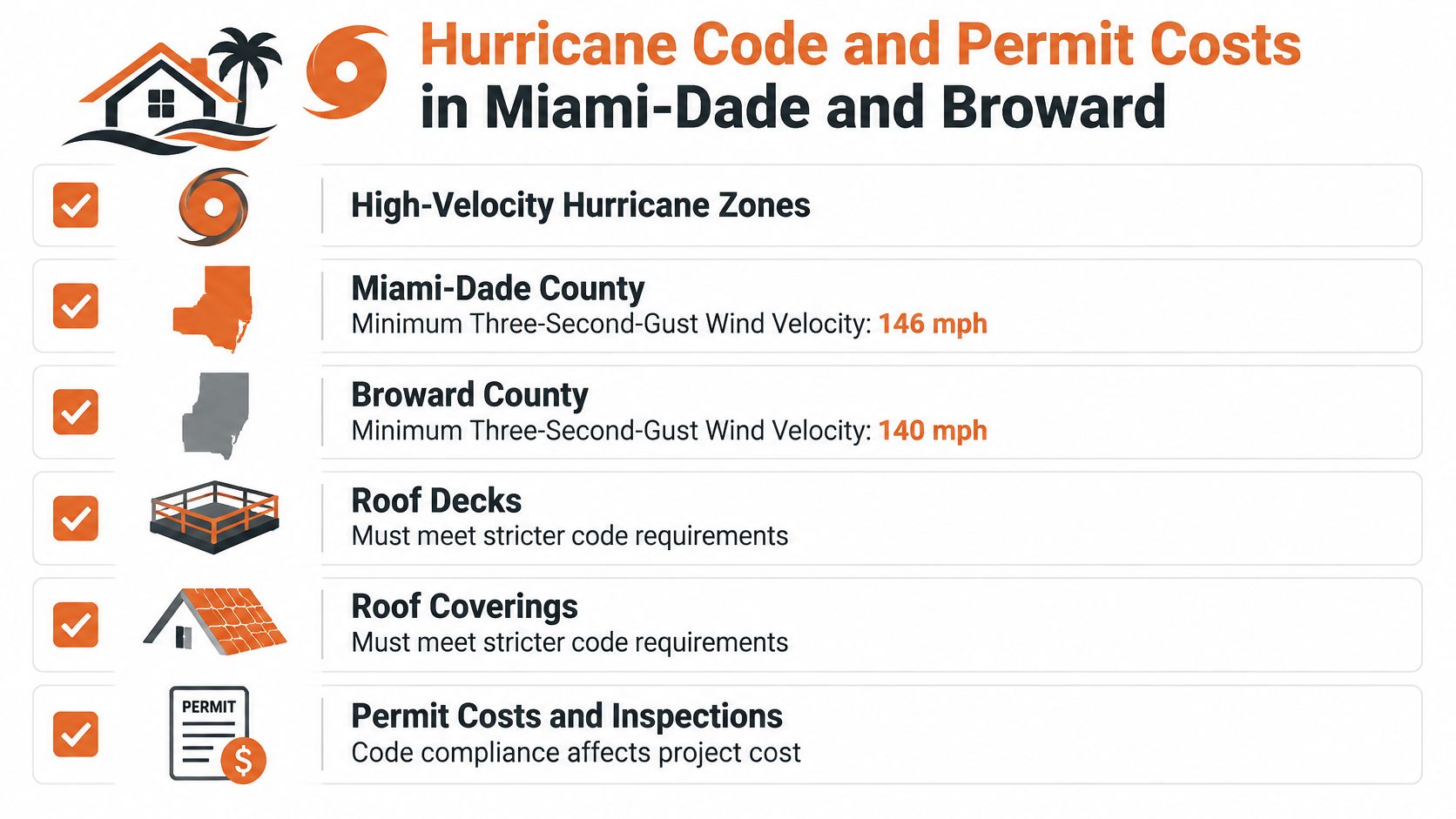
The Florida Building Code materials identify Miami-Dade and Broward as High-Velocity Hurricane Zones, with minimum three-second-gust wind velocities of 146 mph in Miami-Dade and 140 mph in Broward; they also require roof decks and coverings to meet applicable structural wind loads. These published values aren't a substitute for confirming the governing code edition and project-specific design requirements.
The same materials specify approved fastening provisions for asphalt shingles in wind zones above 110 mph, including an ASTM D3161 test modified to 110 mph or the Miami-Dade PA 107-95 test. A shingle's marketing label doesn't establish that the proposed installation meets the required assembly details.
Compare tested assemblies
For metal, compare deck attachment, clips or fasteners, underlayment, edge metal, penetrations, and attachment spacing. FEMA's wind-vulnerability guidance documents the importance of construction and installation quality, including failures that can undermine metal roofing's storm-performance advantages.
Permitting creates another scope distinction. Miami-Dade County's roofing permit guidance calls for product-approval documentation, system descriptions, limitations, and applicable details, with design calculations where required. The City of Miami's roofing permit guidance requires building permits for residential and commercial roofing work.
Confirm the responsible permitting authority for Hialeah, Doral, Miami Lakes, Coral Gables, Pinecrest, Palmetto Bay, South Miami, Kendale Lakes, Pembroke Pines, or Cooper City. Don't assume a neighboring property used the same approval path.
The 2025 Florida windstorm-loss-mitigation statute also requires additional specified mitigation for qualifying replacements in the wind-borne-debris region where insured value is $300,000 or more, with a corresponding taxable-just-value provision when the building is uninsured or valuation documentation is unavailable. Its application depends on the building and required mitigation scope, not the roofing material.
Hand every bidder the same checklist
- Design basis: Same project-specific wind design pressure and substrate assumptions.
- Approved system: Product approval, system limitations, and fastening schedule.
- Waterproofing: Matching flashing, edge, penetration, and underlayment scope.
- Administration: Permits, inspections, and required mitigation work included.
We're fully licensed and insured. Every city we serve receives CertainTeed ShingleMaster and Polyglass certified installation, manufacturer-spec materials, and full local permitting, with our own trained crew from estimate through final inspection, never subcontractors.
If storm damage prompted the comparison, our storm-damage roof repair guidance can help you separate immediate protection needs from the replacement decision. Stabilizing a leak and selecting a long-term roof are related tasks, but they shouldn't be confused in the budget.
Which Roof Fits Your Property and Plans
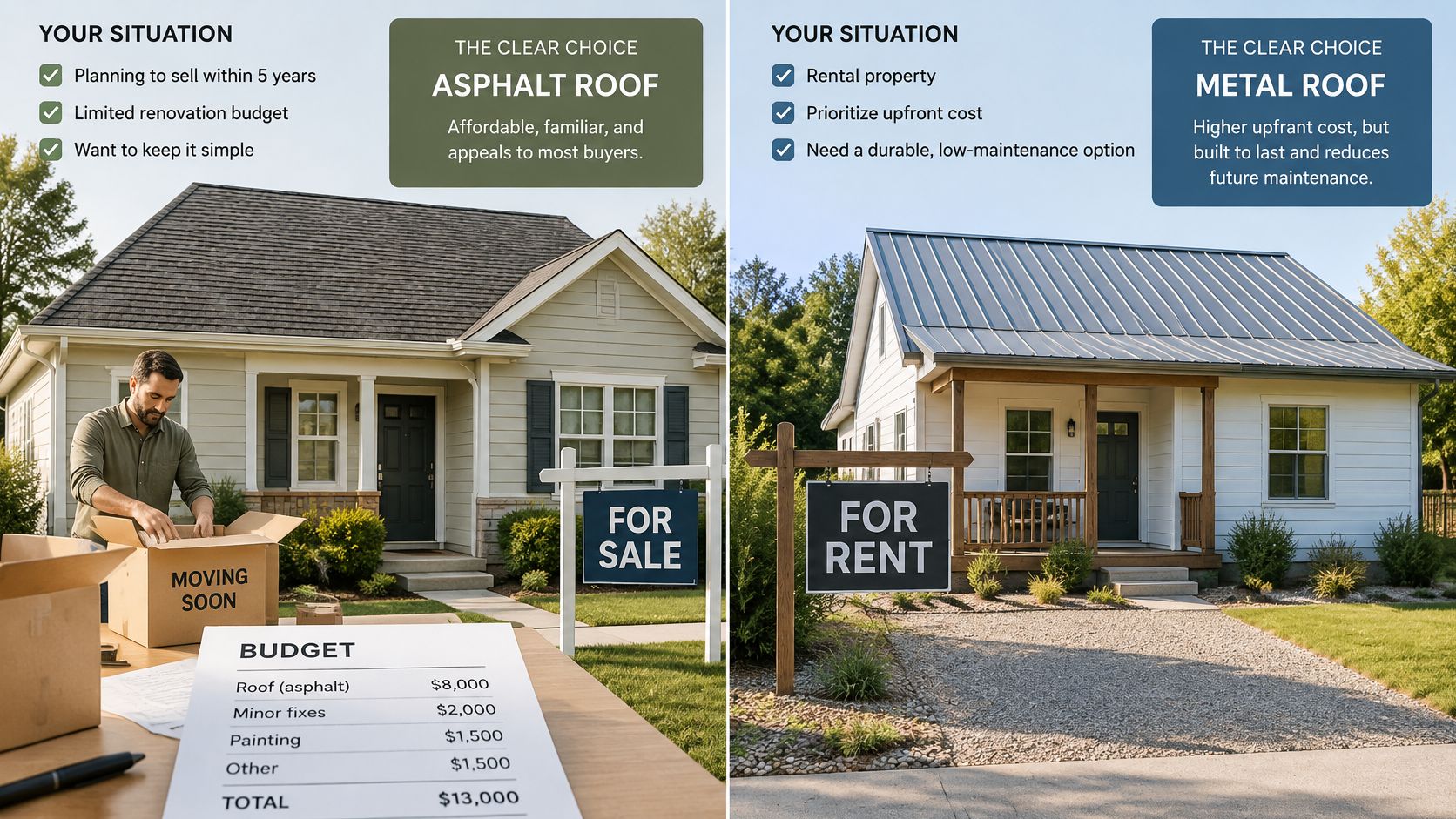
Choose asphalt when preserving cash is the priority. That includes a seller approaching listing, an owner balancing several necessary renovations, or a rental-property owner who needs a compliant replacement without committing extra capital to unused service life. The decision should reflect the property's needs, not the assumption that a lower-priced system is automatically inferior.
Consider metal when you expect to keep the property long term. The strongest case combines affordable financing, a suitable approved assembly, and enough ownership time to benefit from avoided replacement work. Treat durability as a reason to investigate metal, not proof that it must be cheaper.
Match the choice to the building
For a home with high cooling bills, compare documented assemblies. A specified reflective metal coating deserves consideration, but so does the condition of the attic and HVAC system. Don't borrow more for a roof based on an energy estimate that ignores the building underneath it.
For an HOA, condominium association, or commercial owner, consider replacement disruption. Access coordination, resident communication, and scheduling belong in the decision alongside installation invoices. Evaluate remaining service life consistently across buildings rather than choosing a material solely because another community installed it.
For low-slope additions and commercial roofs, use a separate comparison. We install TPO and modified bitumen systems for those applications. A steep-slope asphalt-versus-standing-seam table isn't a substitute for selecting the right system for the roof's geometry.
Decide whether replacement is necessary first
A sound roof with localized damage may need a targeted repair rather than either replacement option. We won't sell a replacement when a repair is enough, and we decline work we don't believe the customer needs.
Before choosing a material, document:
- Ownership horizon: Expected sale, refinance, or long-term hold.
- Financing: Cash contribution, borrowing terms, and payment timing.
- Cooling and insurance: Supported savings, not general marketing estimates.
- Roof condition: Repairable defects versus assembly-wide deterioration.
- Permit scope: Required approvals, inspections, and mitigation work.
A simple roof shape can make scope comparison easier, but ordinary-looking coastal exposure doesn't justify relaxing wind requirements. Let the inspection and approved design establish what the property needs.
The cheapest compliant roof is the one whose total cost is documented for your holding period, not the one with the lowest material price or longest advertised lifespan.
Get a Compliant Roof Quote Before You Commit
A useful estimate should let you compare roofing systems without reconstructing missing costs yourself. We offer a free roof inspection with no obligation, a response in minutes, and a free on-site replacement estimate, with permits handled for you.
For a roof replacement, request a written scope that includes:
- Wind-rated assembly suitable for the local zone and project design.
- Product-approval documentation identifying the proposed installation system.
- Fastening schedule for the covering and relevant attachment details.
- Flashing and edge scope, including penetrations and transitions.
- Permit and inspection line items, with responsibilities clearly assigned.
- Tear-off and disposal, plus the method for pricing concealed deck repairs.
- Manufacturer and workmanship warranty terms, including exclusions and maintenance obligations.
Keep the decision and communication documented
Keep the estimate, inspection photographs, product approvals, and ownership-cost worksheet together. If a contractor proposes an alternative product, ask for the revised approval and scope before treating the prices as comparable.
For property managers coordinating several stakeholders, reliable intake also matters. Mercateer's resource on 24/7 call answering for roofing contractors explains a communication option for roofing businesses; an answered call, however, isn't confirmation of an inspection appointment or installation date. Get those arrangements directly from the contractor.
Rooftop Solutions is licensed and based in Hialeah, serving Hialeah, Doral, Miami Lakes, Coral Gables, Pinecrest, Palmetto Bay, South Miami, Kendale Lakes, Pembroke Pines, and Cooper City. Our own crews handle the work from estimate through final inspection.
Bring your short, medium, and long ownership scenarios to the appointment. The estimate should show not just what you'll pay to install the roof, but which assumptions would have to change before the other system becomes the better financial choice.
Rooftop Solutions offers a free, no-obligation roof inspection and free on-site replacement estimates, with permitting handled for you. Visit Rooftop Solutions to book your inspection or call our Hialeah office, and bring your ownership scenarios so we can compare asphalt and metal against the time you expect to keep the property.
