
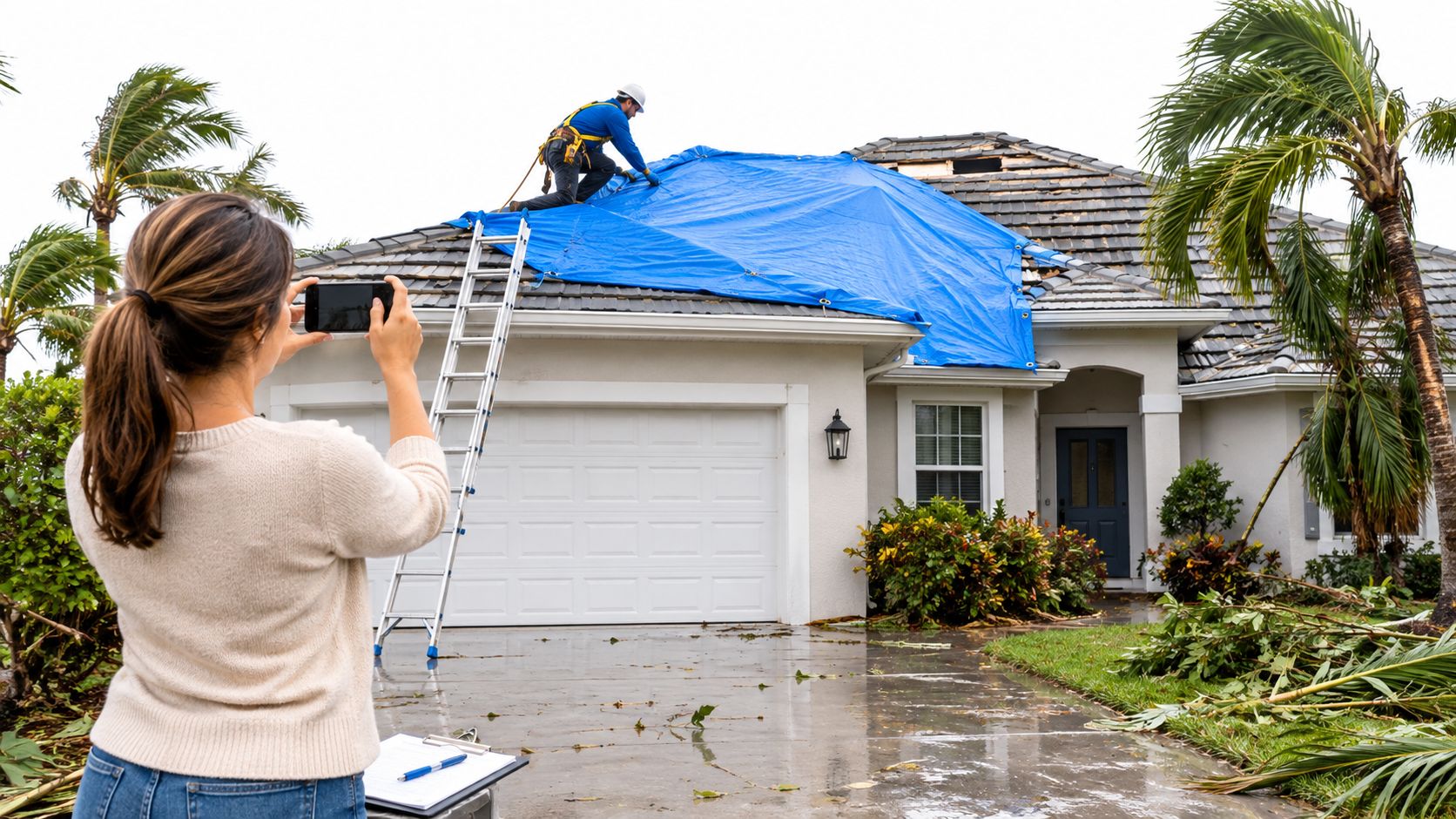
Storm Damage Roof Repair in South Florida
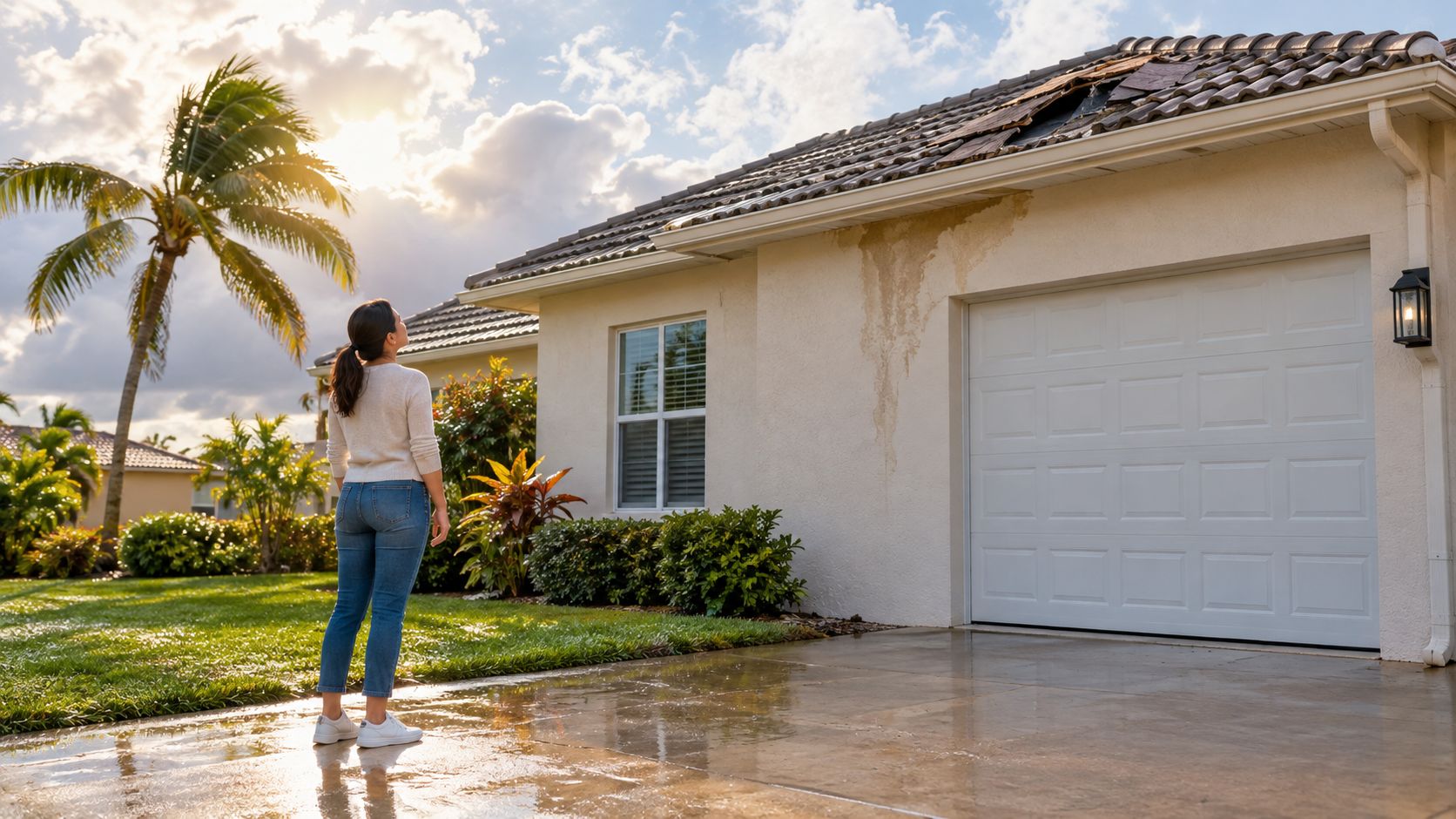
You step into the bedroom after a night of hard rain and find a brown stain spreading around the ceiling vent. Outside, pieces of roofing sit in the driveway, but from the sidewalk, most of the roof looks fine. The immediate question is how to stop the leak. The harder question is whether a patch will restore the roof, satisfy local code, and make financial sense under your insurance policy.
Table of Contents
- The Morning After the Storm in South Florida
- Emergency Steps in the First 24 Hours
- Documenting Damage So the Claim Holds Up
- Repair or Full Replacement Under Florida Code
- Working With Insurance in a High-Deductible State
- Sequencing Temporary and Permanent Repairs
- A Realistic Timeline and Your Next Move
The Morning After the Storm in South Florida
For a homeowner in Hialeah, Doral, or Pembroke Pines, the morning after a storm can turn into competing phone calls: the roofer, the insurance company, the electrician, and family members asking whether it's safe to stay inside. Start with the building's condition, not somebody's promise of a new roof.
A ceiling stain tells you where water became visible. It doesn't establish where water entered, how far it traveled, or whether the surrounding assembly remains sound. Treat the stain as a reason to investigate, not as a repair map.
Visible damage is only part of the picture.
Separate the emergency from the permanent solution
The emergency job is to protect people and limit additional exposure. The permanent job is to identify the failed components and restore a continuous, code-compliant roofing system. Those jobs belong in the same recovery plan, but they aren't interchangeable.
Ask the contractor to distinguish between what the crew can observe immediately and what requires closer access or opening the assembly. A responsible initial assessment should acknowledge uncertainty instead of treating every wet ceiling as proof of total roof failure.
- Active exposure: Identify rooms receiving water and areas that occupants should avoid.
- Roof condition: Record displaced coverings, damaged edges, and suspected entry points without assuming the visible breach is the only problem.
- Decision boundaries: Separate emergency authorization from approval for permanent construction.
Why a ground-level check isn't enough
In a post-hurricane investigation of 933 single-family homes, researchers found roof-cover damage on 602 homes, or 65%; affected roof area averaged 7.7% across all homes and 11.9% among damaged homes, according to IBHS post-hurricane investigations. Those findings support a practical distinction: limited-looking damage deserves inspection, but it doesn't automatically justify replacement.
From our Hialeah base, the approach to storm damage roof repair should be straightforward: protect the home, establish the facts, then settle the scope. Don't let an emergency tarp agreement become an unexplained commitment to a much larger project.
Emergency Steps in the First 24 Hours
Stay off the roof. A wet surface, loose covering, and uncertain deck condition aren't problems a homeowner should investigate from a ladder. Start from a safe interior location and the ground.
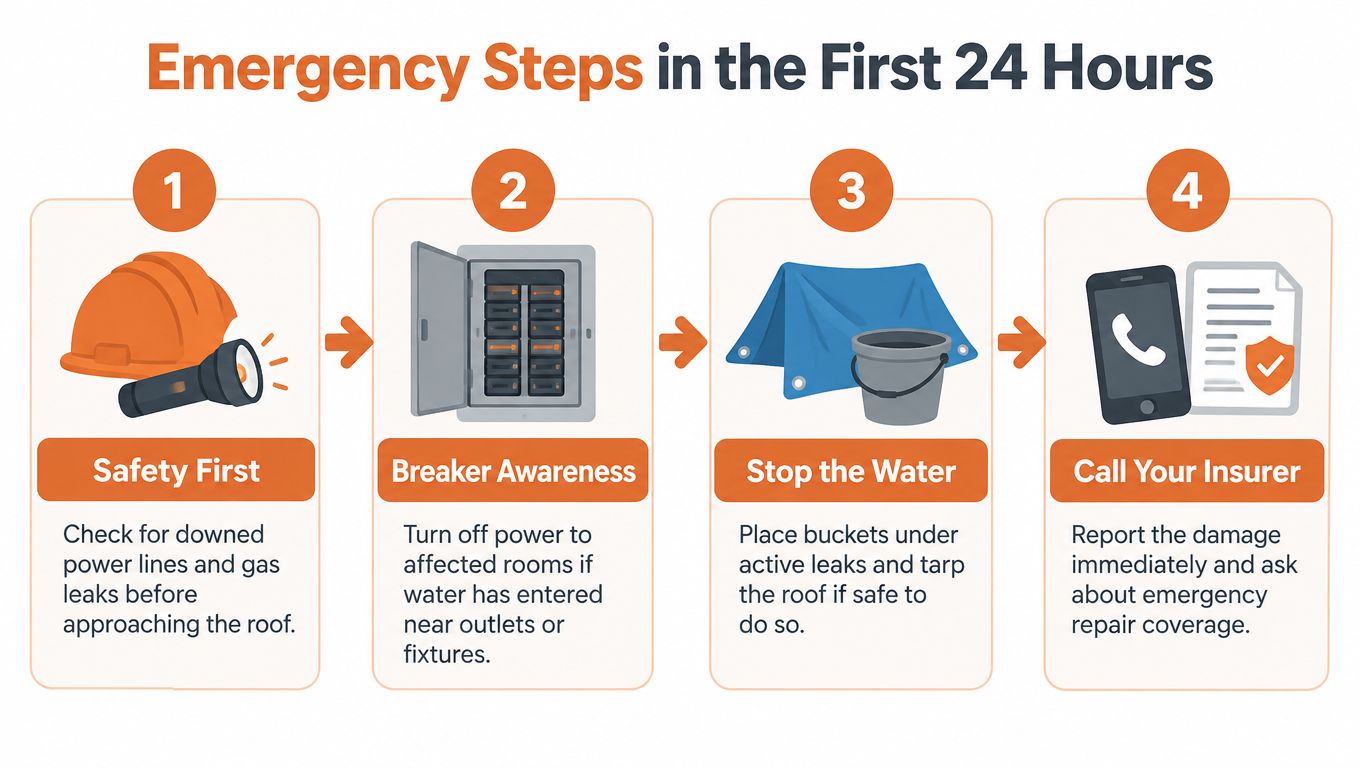
Use this emergency sequence as a reminder, with roof access and tarping reserved for trained crews.
Make the occupied space safe
Keep people away from sagging or bulging ceilings. Don't stand beneath them to move furniture, and don't puncture them yourself. If you see downed electrical lines, smell gas, or suspect structural instability, withdraw and contact the appropriate emergency service or utility.
Water around lights, outlets, or electrical equipment requires particular caution. Shut off the affected circuit only if you can reach a dry, safe panel without crossing water or approaching damaged equipment. Otherwise, leave it alone and call an electrician or emergency service.
Where conditions are safe, place containers beneath drips, move belongings, and remove wet rugs from unaffected flooring. Photograph conditions before moving items when doing so won't delay necessary protection.
Practical rule: Protect people first. A photograph or a piece of furniture isn't worth entering an unsafe room.
Give the tarp crew useful information
Tell the dispatcher your city, roof material, whether water is actively entering, and whether trees, wires, or blocked access complicate the job. If storms remain nearby, ask what weather conditions must improve before the crew can work safely. Don't pressure anyone to climb during unsafe conditions.
Ask how the temporary covering will be secured and how the crew will avoid unnecessary damage. Tile, shingles, and metal require different attachment decisions; the crew should explain its method rather than promise to nail plastic over everything.
- Material suitability: Ask what covering and fastening method the crew proposes. If someone advertises an “HVHZ-rated tarp,” request the supporting documentation rather than accepting the phrase as proof.
- Written limits: Clarify what the temporary work covers, what it excludes, and what follow-up checks may be needed.
- Evidence preservation: Request photographs before covering the damaged area and an itemized mitigation invoice.
Contact your insurer promptly about notice requirements and emergency mitigation. Ask whether authorization is required for particular expenses, but don't postpone necessary safety measures while waiting for a routine callback.
For an additional visual overview of the storm-response process:
Save evidence of storm timing alongside your mitigation records. A National Weather Service report, a dated radar screenshot, or a utility outage record can help establish the event chronology, though none independently proves what damaged your roof.
Documenting Damage So the Claim Holds Up
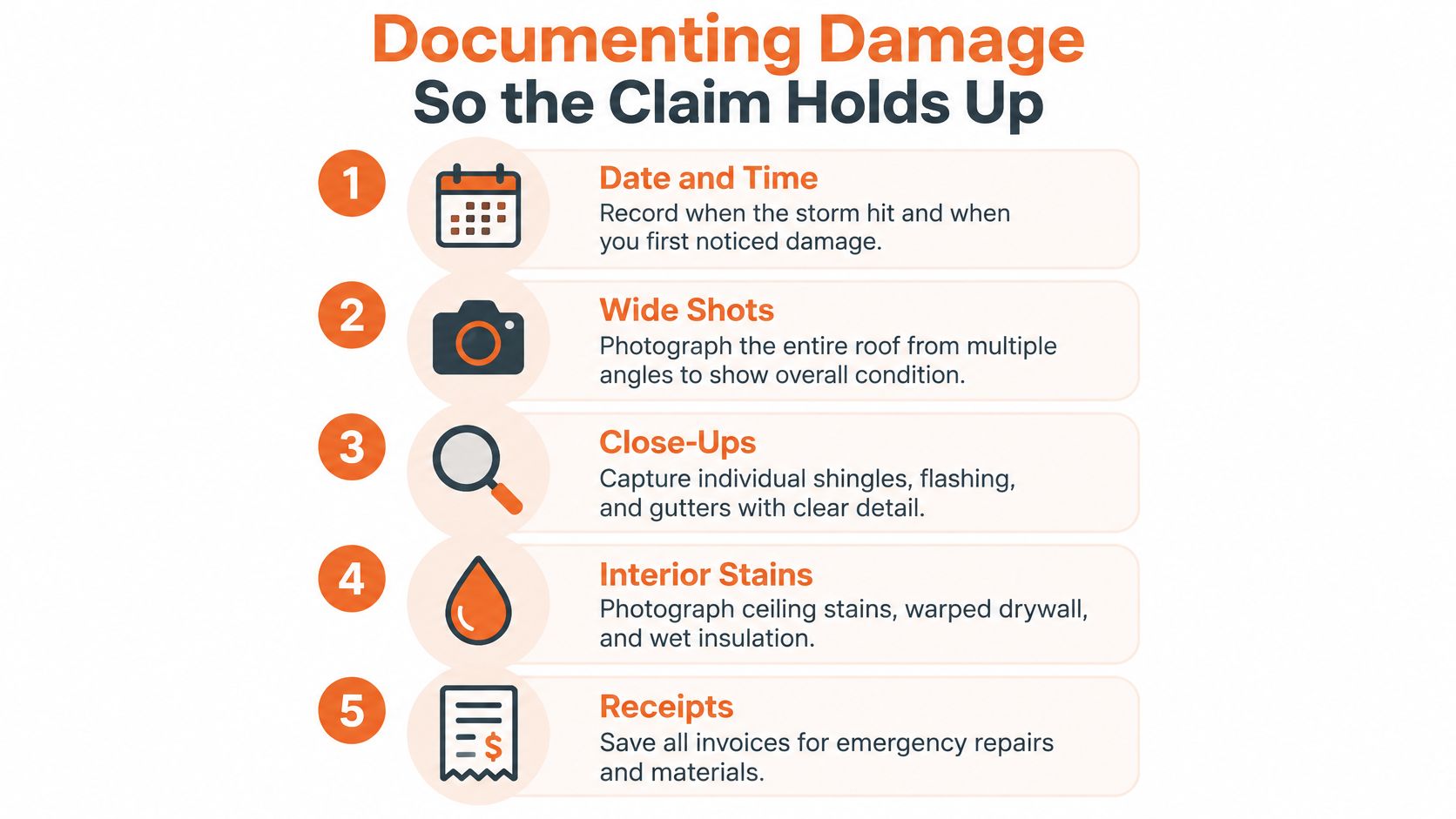
A useful damage file lets someone who wasn't at the property understand what happened, where it happened, and what work followed. Hundreds of unlabeled photographs make that harder, not easier. Organize evidence by location and date.
Start with a written incident summary: when you noticed the problem, which rooms were affected, what emergency actions you took, and who performed them. Describe observations without guessing at concealed conditions or declaring an insurance cause.
Build a record someone else can follow
Photograph each accessible exterior elevation from consistent ground-level positions. Take wide views for context, then closer views using your camera's zoom. Leave rooftop close-ups to the inspection crew.
Inside, identify rooms by name and location. Record the dimensions of stained or wet areas where safe, distinguish estimates from measurements, and narrate a dated video walkthrough. Have the inspector document attic conditions when access is safe, including the underside of decking, insulation, and framing.
Use this checklist to keep the visual record organized.
A written report should connect photographs to findings. For example, label a ceiling photograph with the room and wall orientation, then identify the roof area requiring investigation above or adjacent to it. Don't label a suspected entry point as confirmed unless the inspection supports that conclusion.
Ask for documented post-storm roof inspections that distinguish roof-cover breaches, flashing defects, exposed decking, suspected water pathways, and affected contents.
Separate observations from conclusions
FEMA's wind-retrofit guidance recommends evaluating the whole building, including apparently undamaged elements, before repair or retrofit. That's why the inspection shouldn't stop at the roof area directly above a stain.
Keep these records together:
- Pre-storm evidence: Prior inspection reports, maintenance invoices, and older photographs help distinguish existing wear from new damage.
- Mitigation records: Preserve contracts, receipts, payment records, and photographs taken before temporary coverings concealed the opening.
- Condition findings: Ask the inspector to separate cosmetic issues, repairable defects, structural concerns, and replacement recommendations.
Send the carrier the incident summary, relevant photographs, inspection findings, and emergency invoices through its requested channel. Retain original files and have the complete record available for the adjuster. Don't withhold relevant evidence; distinguish a concise initial submission from the complete supporting archive.
Repair or Full Replacement Under Florida Code
Repairability is a condition question and a code question. A patch can look acceptable from the street yet leave failed flashing, unsuitable fastening, or damaged substrate untreated. Conversely, roof age alone doesn't prove that replacement is legally required.
The Florida Commission on Hurricane Loss Projection Methodology report describes a general 25% roof-cover damage threshold associated with replacement of the entire covering. Treat that as a trigger for a code review, not a universal shortcut: the applicable code provisions, existing roof compliance, project circumstances, and permitting authority must determine the actual requirement.
Measure the affected assembly
Ask the contractor for a roof sketch showing measured areas, damaged locations, and the basis for the proposed scope. The calculation should identify what area is being evaluated and why. Counting loose shingles in the yard isn't an adequate substitute.
Keep roof-cover damage separate from decking and structural damage. These findings can expand the necessary work, but they shouldn't be casually combined into an unsupported percentage. The estimate should explain each layer requiring removal or restoration.
The comparison below is a starting point, not a substitute for a project-specific code determination.
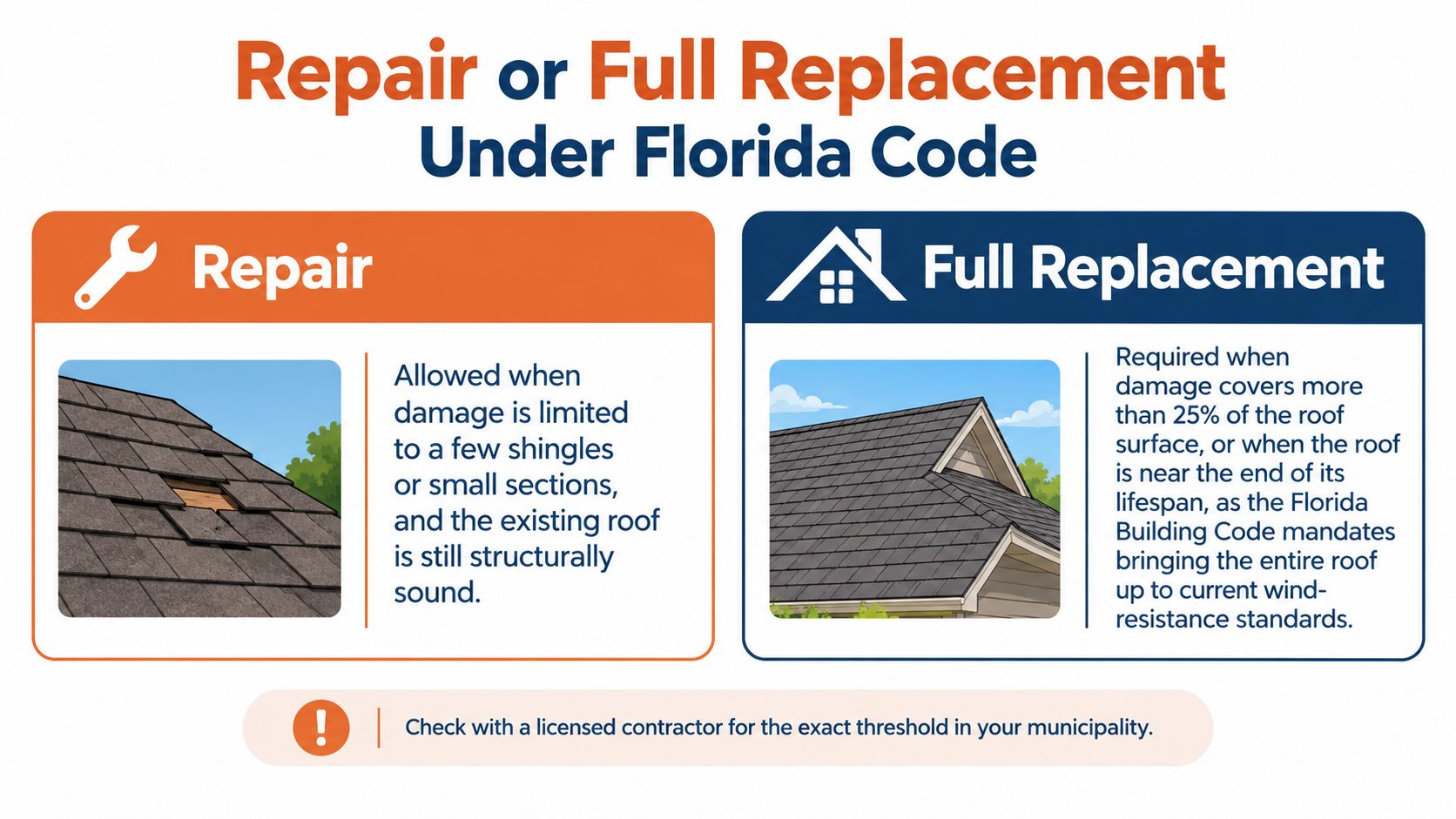
An aging roof may make replacement sensible without making it legally mandatory. Likewise, a small visible opening doesn't establish that the surrounding assembly can accept a durable repair.
Resolve the permit and coverage gaps
In Miami-Dade's High-Velocity Hurricane Zone, ask which approved assembly and component documents support the proposed installation. Product selection, fastening, underlayment, and substrate condition must work together; a contractor estimate alone doesn't establish compliance.
For applicable single-family work, Miami-Dade's hurricane-mitigation requirements address sheathing attachment, the owner's notification form, and an Affidavit of Compliance for roof-deck attachment and a secondary water barrier at the first inspection. These are construction obligations, not optional insurance upgrades.
A carrier's repair estimate and the building department's permitted scope answer different questions. Don't assume approval from one resolves the other.
Before authorizing roof replacement, ask:
- Affected area: What measurements and findings support the repair-versus-replacement recommendation?
- Permit scope: Which current requirements apply, and which upgrades are included?
- Wind resistance: How will the completed assembly satisfy the applicable installation and wind-load requirements?
If the carrier allows a localized repair while the permitted work requires more, request a written explanation of the difference. Review ordinance-or-law coverage and applicable limits with the insurer rather than assuming every code-related expense will be reimbursed.
Working With Insurance in a High-Deductible State
A roof can need repair without producing an insurance payment. The financial question is whether the covered scope, after applicable policy deductions and limitations, supports a claim payment. That's different from asking whether the contractor found damage.
Read the declarations page and relevant endorsements before signing a permanent-work contract. Confirm which deductible applies to the event, what settlement basis covers the roof, and what notice and inspection obligations the policy imposes.
Florida Storm Claim Decision Snapshot
| Metric | Value | Why It Matters |
|---|---|---|
| Illustrative hurricane deductible | 2% of a $400,000 dwelling limit equals $8,000, using the example in this storm-claim financial assessment | The percentage applies to the insured dwelling limit in this example, not to the contractor's repair estimate. |
| Roof settlement basis | Replacement cost or actual cash value, as stated in the policy | Depreciation and payment conditions can change the amount available initially. |
| Code-related scope | Subject to policy terms and ordinance-or-law provisions | A required construction expense isn't automatically a covered expense. |
| Cash-repair decision | Compare the documented covered loss with the applicable deductible | A small payable amount may not justify assumptions based on the full construction price. |
Understand the check before spending it
Under an actual-cash-value settlement, depreciation reduces the valuation of the covered property. A replacement-cost policy may also issue an initial payment reflecting depreciation, with additional recovery subject to policy conditions and completion documentation. Ask the adjuster to identify recoverable and nonrecoverable depreciation in writing.
Don't budget from the gross estimate alone. Request a payment breakdown that identifies the deductible, depreciation, exclusions, limits, and any disputed items. A contractor can explain construction costs; the insurer must explain its coverage determination.
Storm-damage insurance-claims assistance can help organize inspection evidence and coordinate construction questions with the adjuster. It shouldn't be presented as a guarantee of coverage or a substitute for licensed insurance or legal advice.
- Notice versus claim registration: Ask how the carrier handles a coverage inquiry or loss notice. Don't assume a conversation can't become a registered claim.
- Mitigation funding: Ask whether an advance is available and what invoices or photographs the carrier needs.
- Scope disagreements: Compare quantities, materials, removal work, substrate repairs, and required upgrades rather than arguing only about the total.
Prompt notice and mitigation remain important even when the likely payment is uncertain. If the scope appears below the deductible, obtain a defensible written estimate and confirm policy obligations before deciding to pay cash. “File immediately” and “never file a small claim” are both too simplistic.
Sequencing Temporary and Permanent Repairs
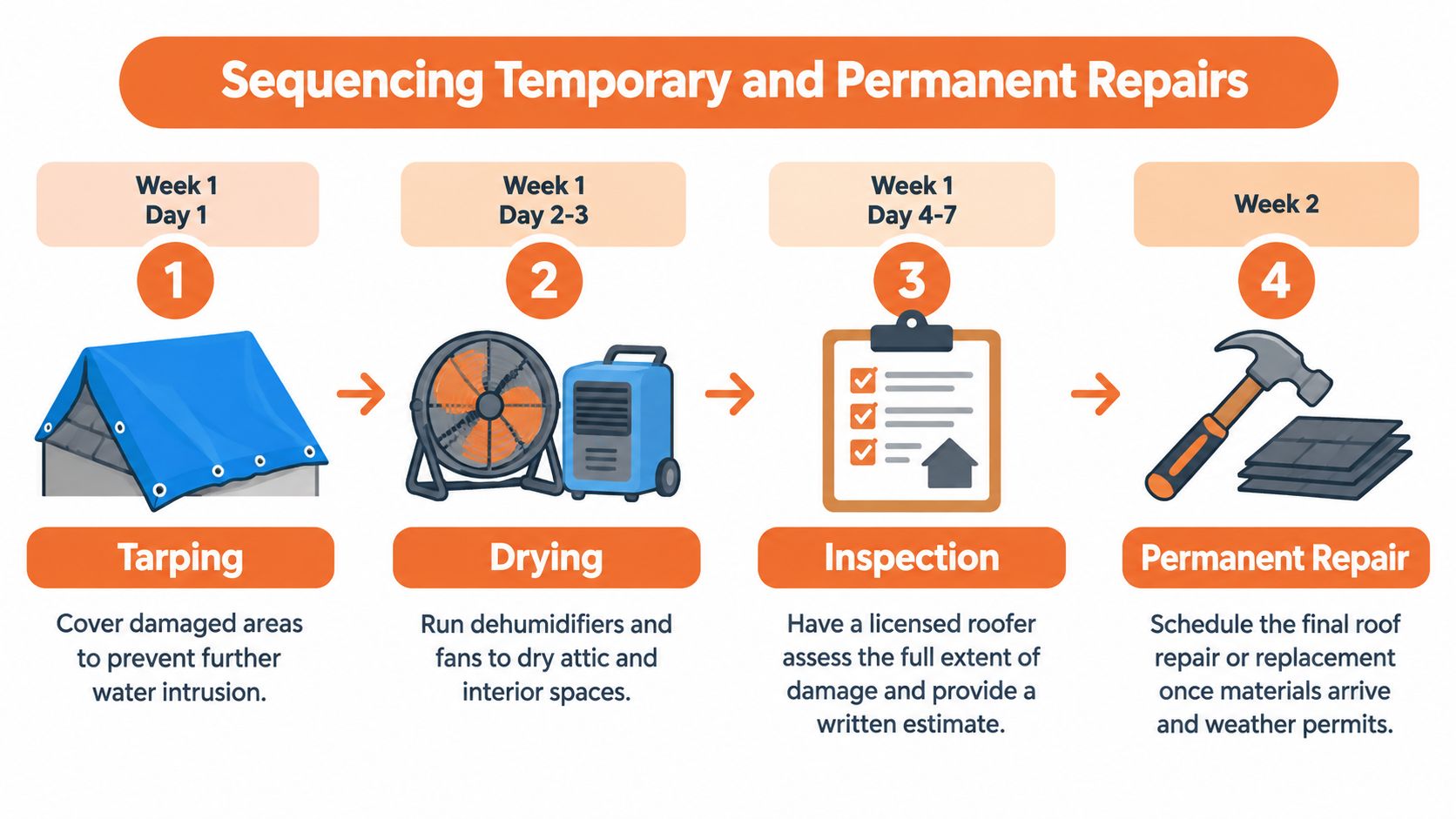
The correct sequence depends on exposure, findings, approvals, and safe working conditions. Don't treat a temporary covering as a permanent repair, and don't assume an emergency makes every later construction step exempt from permitting.
Use the sequence below as a planning illustration, not a promised schedule. Inspection should happen as soon as safe access permits, and drying work shouldn't wait for an arbitrary calendar milestone.
Match the intervention to its purpose
| Option | Appropriate purpose | Required handoff |
|---|---|---|
| Temporary covering | Limit immediate weather exposure | Reinspection, monitoring, and a permanent scope |
| Spot repair | Restore an isolated failure where surrounding materials remain serviceable | Verification of substrate condition and compatible detailing |
| Partial re-roof | Replace a defined area when technically and legally appropriate | Approved transitions, permit review, and inspection coordination |
| Full replacement | Restore a system that can't reasonably be repaired or requires broader work | Complete assembly documentation and required inspections |
A repair is a false economy when the contractor must disturb deteriorated surrounding materials but can't restore them reliably. Ask how the proposed repair will terminate into the existing roof and what warranty applies to that connection. A low price without a workable transition detail isn't a complete scope.
Clear the paperwork before construction
The Miami-Dade Uniform Roofing Application establishes documentation requirements for roofing permits, including applicable product approvals, system limitations, and supporting calculations. For metal systems, confirm that the contractor has selected the actual permitted assembly rather than merely naming a panel profile.
Broward projects may require roof-to-wall connection evaluation and mitigation documentation under the applicable Broward hurricane-mitigation affidavit. Ask the local permitting office which valuation documentation, forms, connection verification, and inspection deadlines apply to your property.
That jurisdiction-specific check matters in Pembroke Pines and Cooper City just as it does when coordinating work elsewhere in Broward. Don't assume a checklist used on another city's project is sufficient.
Before mobilization: Confirm that the permit scope, ordered materials, inspection sequence, and written contract describe the same roof assembly.
Coordinate permanent work with the insurer's inspection requirements, but document urgent protective work rather than leaving the building exposed. Avoid ordering nonreturnable materials before assembly approval, concealing deck work before inspection, or calling for an inspection without the supporting documents on site.
A Realistic Timeline and Your Next Move
Plan recovery around decision points, not a promised completion date. Weather, concealed conditions, material availability, permitting, and insurer access can change the schedule. Ask for a written sequence with responsibilities and dependencies.
A Category 3 hurricane brings sustained winds of 111–129 mph, equivalent to 96–112 knots or 178–208 km/h, according to Broward County's hurricane guidance. After that exposure, don't use an intact-looking roofline as your only reason to skip assessment of coverings, fasteners, sheathing, flashing, and water-entry defenses.
Keep the recovery moving
- Immediate phase: Establish safety, arrange necessary protection, preserve evidence, and meet policy notice requirements.
- Assessment phase: Obtain a written condition report, coordinate adjuster access, and resolve differences between observed damage and proposed work.
- Construction phase: Confirm approvals, materials, inspection hold points, and the final closeout package before the crew starts.
Verify the contractor's license and insurance, then ask who will physically perform the work. Clarify whether the crew is employed directly or subcontracted, who supervises installation, and who handles a later warranty call. If a coverage dispute remains unresolved, consider advice from an appropriately licensed public adjuster or attorney before accepting a settlement.
Homeowners in Hialeah, Doral, Miami Lakes, Coral Gables, Pinecrest, Palmetto Bay, South Miami, and Kendale Lakes, along with property owners in Pembroke Pines and Cooper City, should request the same outcome: a documented path from temporary protection to a permitted, durable roof, with costs and responsibilities explained before authorization.
Rooftop Solutions offers emergency tarping, documented storm inspections, targeted repairs, and roof replacement through its in-house crews serving Miami-Dade and Broward. Call or book an inspection to get a written scope that addresses the storm damage, applicable code requirements, and the next steps from temporary protection to permanent repair.
