
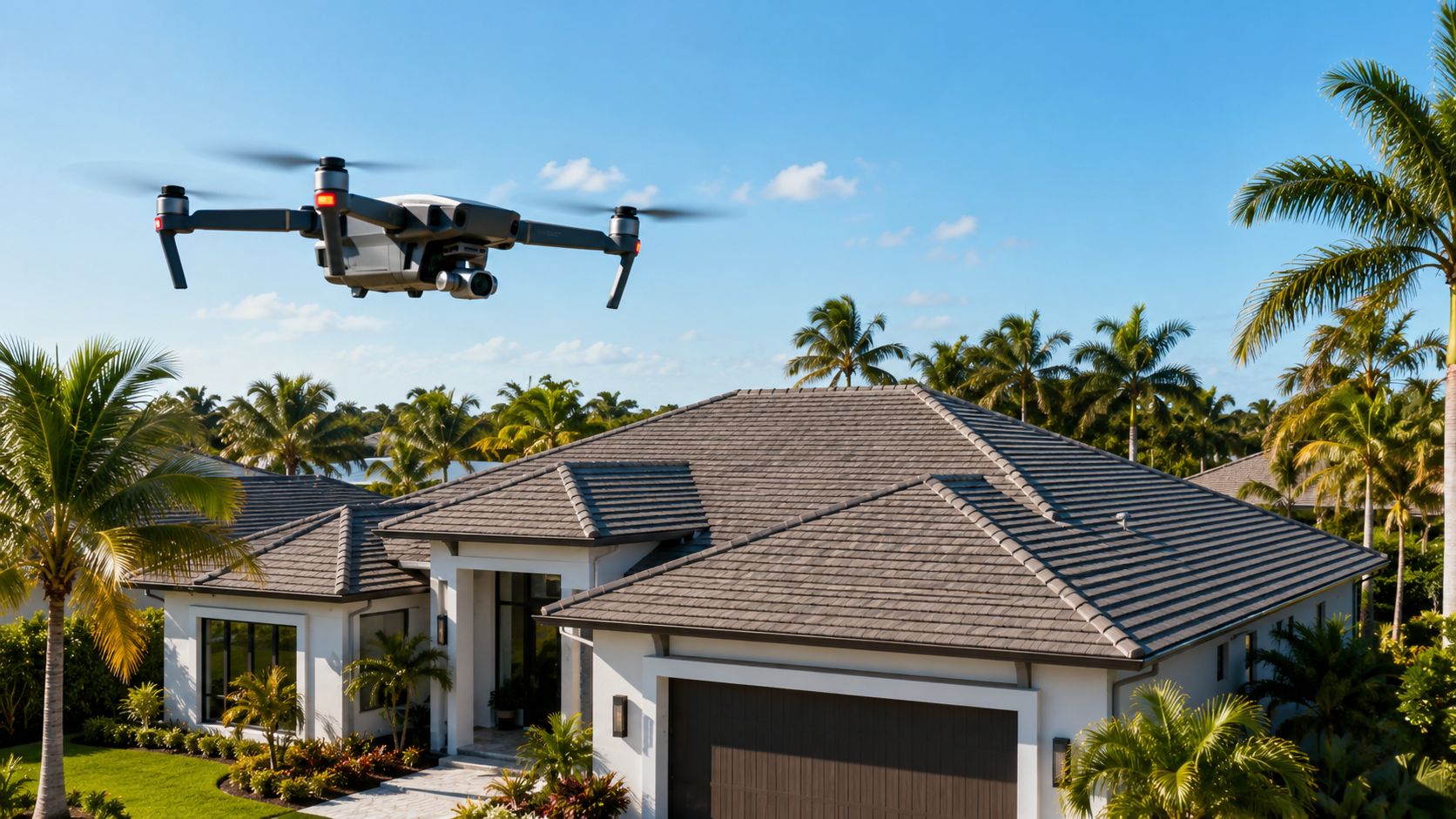
Drone Roof Inspection Guide for Miami-Dade & Broward
A storm has just moved through Hialeah, and water is showing up near a bedroom window. Your insurance carrier wants documentation, the roof is still slick, and climbing up with a ladder feels like a poor decision. You need to know whether the problem is a few displaced shingles, damaged flashing, a failing membrane, or something deeper that photographs alone can't prove.
A drone roof inspection can give you a fast, safer view of difficult areas and create a dated record before repairs change the evidence. It isn't a replacement for a qualified roofing professional. Used correctly, it helps sort urgent from non-urgent conditions, supports insurance communication, and tells the contractor where hands-on verification matters across Hialeah, Doral, Miami Lakes, Coral Gables, Pinecrest, Palmetto Bay, South Miami, Kendale Lakes, Pembroke Pines, and Cooper City.
Table of Contents
- Why Drone Roof Inspections Matter in South Florida
- How Drone Roof Inspections Work Step by Step
- What Drone Roof Inspection Reports Actually Show
- Safety and Documentation Benefits for Homeowners
- When Drone Data Is Not Enough
- Miami-Dade and Broward Permitting and Inspection Rules
- How to Choose a Qualified Drone Roof Inspection Provider
Why Drone Roof Inspections Matter in South Florida
After a hurricane or hard rain, the first question usually isn't, “Can someone fly a drone?” It's, “Is the roof damaged enough to cause the leak, and can we document it before the next weather system arrives?” A steep tile roof, a wet metal roof, or a commercial roof with unsafe access points can make a ladder-first response unnecessarily hazardous.
Aerial imagery lets an operator review roof planes, valleys, penetrations, drainage areas, and visible storm patterns while the operator remains on the ground. That matters when walking the surface could disturb loose materials or expose a worker to a fall. It also gives homeowners and property managers a consistent visual record that can be shared with a roofer, adjuster, or building owner.
The first response after a storm
The strongest use case is documentation and triage. A drone can identify missing or displaced shingles, broad areas of damage, debris, visible membrane irregularities, and apparent flashing problems. It can also show whether the concern is isolated or spread across several roof sections.
A 2022 peer-reviewed study tested a UAV and deep-learning system for missing-shingle detection. The system reached 72% accuracy on training data and 81% on imagery from a second house, while missing 19% of defects, mainly where image quality was poor or defects were too small to resolve. The Frontiers in Built Environment study makes the practical limit clear: automated screening can help locate visible issues, but it can't independently establish leakage, structural condition, fastener integrity, or whether replacement is justified.
Practical rule: Use the flight to reduce uncertainty and unnecessary roof access. Don't use it to pretend concealed damage is visible.
That distinction protects the homeowner. A responsible report identifies what the imagery supports, what remains uncertain, and what should happen next. For residents and managers in Miami-Dade and Broward, the best inspection is the one that produces useful evidence without overselling what a camera can prove.
How Drone Roof Inspections Work Step by Step
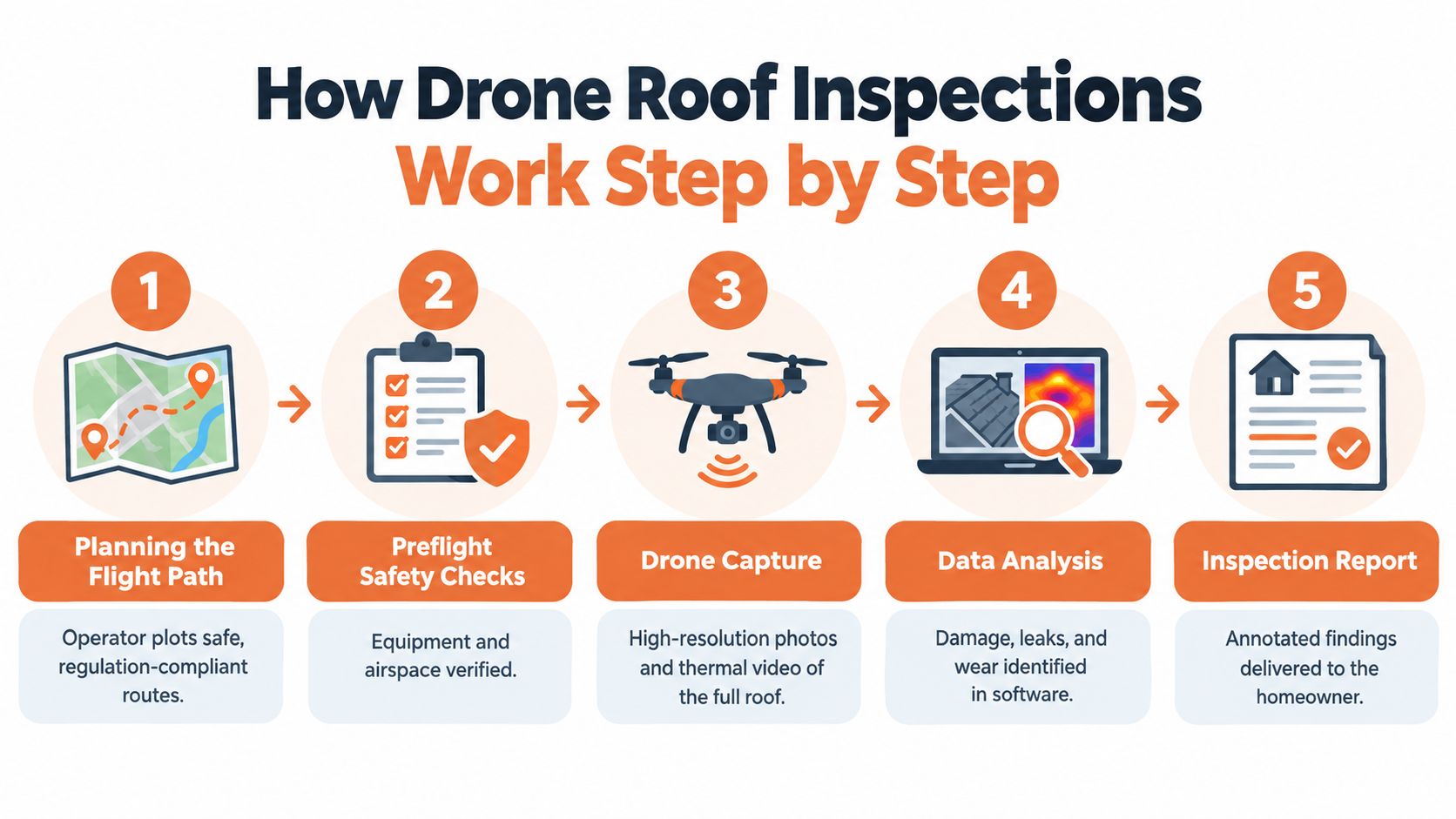
A professional inspection isn't random video from above. The operator defines the roof area, checks the surroundings, plans safe flight lines, captures repeatable imagery, processes the files, and reviews the results before issuing a report.
1. Plan the flight
The operator first identifies roof boundaries, nearby structures, trees, power lines, access restrictions, and areas that need oblique views. A flat commercial roof may need broad nadir coverage, while a tile or metal roof benefits from angled passes that reveal lifted components, seams, and flashing.
Flight planning controls the quality of the final model more than owning expensive hardware. The operator should define whether the goal is visual documentation, approximate measurement, storm comparison, or a more detailed three-dimensional record.
2. Complete safety checks
Before launch, the pilot verifies equipment, weather, airspace, property boundaries, and permissions. Dense neighborhoods require particular care because a camera can capture adjacent properties or unrelated people. Privacy isn't a marketing footnote. It belongs in the operator's planning and file-handling process.
3. Capture overlapping imagery
Photogrammetry software needs repeated views of the same features to align photographs and build a reliable model. A field study found that approximately 0.75 to 1.26 centimeters of ground-sample distance with 85% image overlap produced highly accurate rooftop models while limiting unnecessary images and flight time, as reported in this UAV reconstruction research.
Ground-sample distance means the actual area represented by each pixel. Smaller values generally preserve more detail. Consistent overlap also reduces gaps and warped edges, especially on repetitive metal panels and low-texture membranes.
4. Process and review the files
The output may include an orthomosaic, three-dimensional model, annotated photographs, or thermal imagery when conditions are suitable. The inspector reviews software findings instead of forwarding raw images without interpretation.
A useful roof inspection workflow should preserve original, geotagged files and distinguish raw imagery from automated annotations.
5. Deliver a decision-ready report
The homeowner should receive dated imagery, marked defect locations, drainage observations, approximate measurements where appropriate, and a clear list of areas needing closer review. Critical dimensions should be checked against site conditions, particularly when estimating materials, documenting storm damage, or communicating with an insurer.
What Drone Roof Inspection Reports Actually Show
A good report answers a narrow question: What visible roof conditions can be documented from the air, and which findings require another type of inspection? It shouldn't turn every color variation or software flag into a confirmed defect.
Visible imagery can usually support documentation of missing or displaced shingles, damaged sections, debris accumulation, apparent flashing irregularities, exposed components, ponding indicators, and broader storm-impact patterns. Orthomosaics and three-dimensional models can also support roof-area estimates, drainage observations, ridge-line review, and location references when the imagery is properly captured.
Evidence has boundaries
Computer vision can help screen large roof areas, but performance changes with lighting, weather, camera angle, image resolution, defect size, and the balance of examples used to train the system. The 2022 research linked above is valuable because it reports both the 81% validation benchmark and the defects the model missed. That is more useful than a claim that artificial intelligence “finds everything.”
Thermal imagery adds another layer, but it doesn't prove a leak by itself. A 2024 building-energy study found that an indoor-to-outdoor temperature difference greater than 8°C is needed to reliably reveal potential thermal anomalies. It also recommends thermal GSD of 5 millimeters or finer and an oblique viewing angle within 30° to improve contrast. The thermal inspection research supports a disciplined workflow, not casual interpretation of isolated colors.
| Category | Typical Drone Evidence | Common Ground Verification Need |
|---|---|---|
| Surface damage | Missing materials, displaced components, debris, visible impact areas | Material adhesion, fracture depth, concealed damage |
| Flashing and penetrations | Apparent damage, open-looking seams, disturbed metal | Fasteners, laps, sealant condition, installation details |
| Thermal patterns | Suspicious heat-retention or cooling areas | Moisture readings, interior evidence, membrane review |
| Roof geometry | Orthomosaic locations, approximate areas, drainage patterns | Critical dimensions, code tolerances, site measurements |
| Interior consequences | No direct proof of an interior leak | Attic inspection, ceiling review, moisture testing |
| Replacement decision | Condition clues across visible roof surfaces | Substrate, ventilation, structural condition, code requirements |
A contractor should combine the aerial record with attic checks, moisture testing, and targeted physical review when leakage, soft decking, or replacement is under consideration. The report becomes useful because it directs that follow-up, not because it eliminates the need for it.
Safety and Documentation Benefits for Homeowners
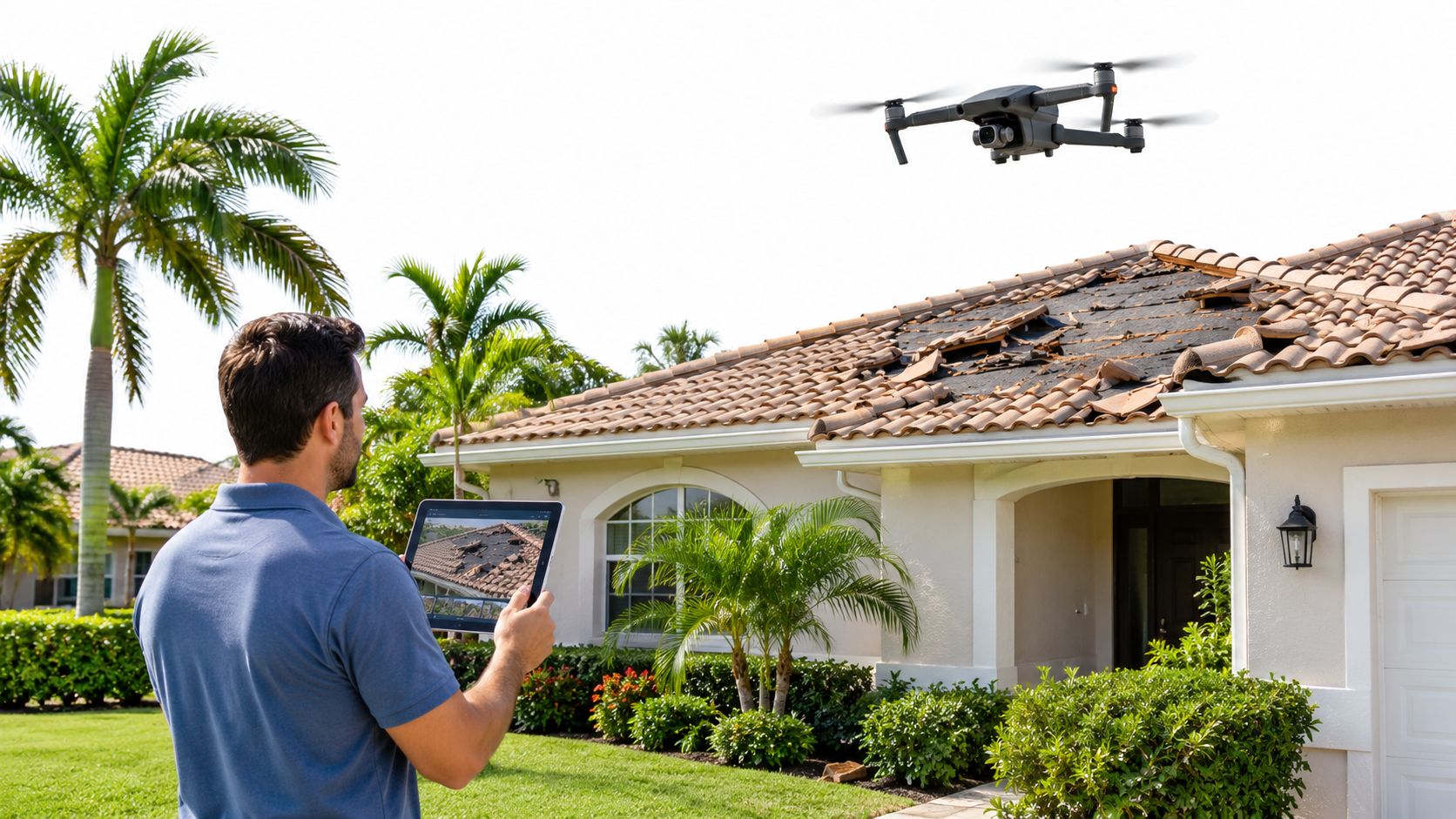
The safety advantage is straightforward. A drone keeps the first inspection pass on the ground when the roof is wet, steep, damaged, or difficult to access. That can be especially valuable after a South Florida storm, when loose tiles, slick surfaces, and unstable materials make an immediate climb a poor choice.
The documentation advantage is just as important. Consistent images can show the condition before repairs begin, identify the location of visible storm effects, and help different parties discuss the same roof area instead of relying on vague descriptions.
Drone screening compared with verification
For a homeowner with a difficult roof, drone-only screening makes sense as an initial step when the immediate need is to locate visible damage without creating unnecessary access risk. For a commercial property manager, a repeatable flight record can help compare multiple roof sections and prioritize maintenance.
Ground-level and attic verification remains the better choice when occupants report active leaks, when water has entered the building, or when the report shows a suspicious area that could involve concealed moisture. On a flat TPO or modified-bitumen roof, wet insulation may sit beneath an apparently intact membrane. Thermal imagery can identify a suspicious pattern, but moisture readings and physical investigation determine what it means.
A detailed insurance-claims documentation process should preserve the original files, inspection date, weather conditions, flight boundary, and follow-up observations. Speed helps after a storm, but operator discipline and verification determine whether the record is useful.
A clear photograph can document a condition. It can't establish causation, hidden damage, or code compliance by itself.
When Drone Data Is Not Enough
A drone inspection reaches its limit when the decision depends on something a camera cannot directly observe or physically test. Suspected interior leaks, soft decking, wet insulation, aging fasteners, underlayment condition, structural movement, and ventilation problems require a broader evaluation.
Flat TPO and modified-bitumen roofs need particular caution. An intact-looking surface can conceal moisture below the membrane or within the insulation assembly. As covered above, thermal patterns on these roofs require moisture-reading correlation before anyone draws a conclusion.
Escalation triggers
A responsible report should recommend hands-on follow-up when it identifies:
- Active leak evidence: Interior staining, dripping, or damp materials call for attic or interior review.
- Suspected concealed moisture: Thermal anomalies require moisture testing and physical correlation.
- Soft or unstable areas: A photograph cannot clear a structural concern.
- Fastener or flashing questions: Installation condition often requires close inspection.
- Replacement decisions: Age, substrate, ventilation, code requirements, and wind-uplift performance must be considered together.
- Unusual defects: Less-common defects may be missed when training data is imbalanced or camera angles are limited.
Computer-vision research shows why operators should state uncertainty. One study reported 90% defect-detection accuracy, but its dataset contained only 167 buildings, omitted defects such as cracks and blisters, and used limited camera angles. Another study used 7,937 drone images and found poorer results for less-common defects when training data was imbalanced, as summarized in the Scielo research report.
A concrete South Florida example is a suspected roof failure after a storm. A Broward or Miami-Dade contractor may use aerial images to mark displaced materials, damaged flashing, or ponding areas, then send a technician to verify attachment, substrate condition, and interior impact before recommending repairs. A replacement decision also requires review of the roof assembly, ventilation, and applicable requirements.
Aerial inspection remains valuable because a responsible operator states uncertainty instead of guessing. For insurance, safety, and replacement decisions, unresolved questions should lead to targeted verification.
Miami-Dade and Broward Permitting and Inspection Rules
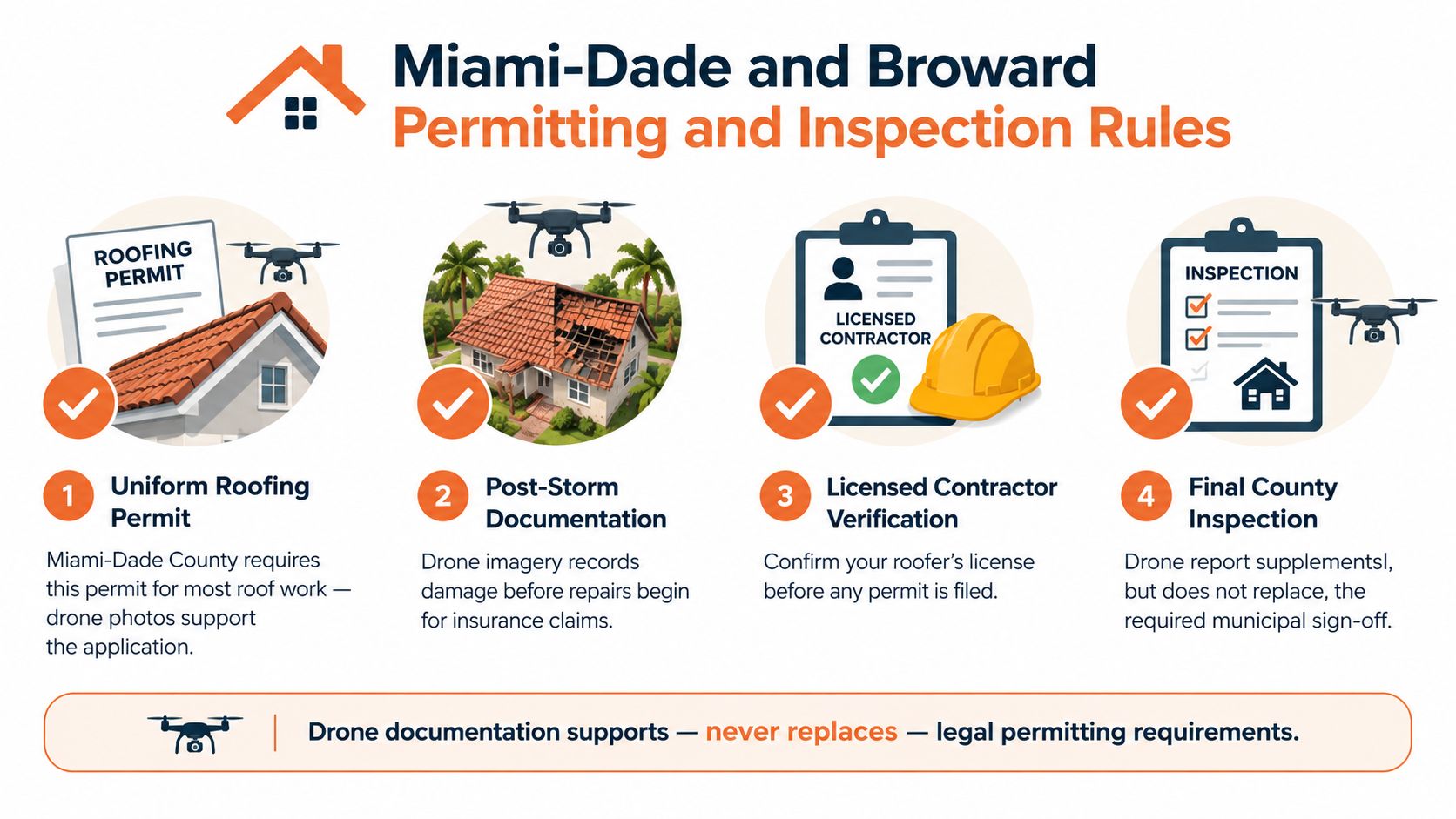
Drone documentation fits into local permitting as supporting evidence, not as legal approval. In Miami-Dade County, roofing permits use a Uniform Roofing Permit Application, and the county's e-permitting system allows qualified contractors to submit applications, pay fees, and print permit cards online for stand-alone and subsidiary roofing permits. The county roofing permit guidance also states that inspections are requested with a permit number and a three-digit inspection code.
Use the report inside the proper workflow
A documented flight can help identify roof areas, penetrations, drainage components, and apparent installation deficiencies before a formal inspection. It can also preserve a record of conditions before permitted work begins or after storm damage occurs. It cannot replace the permit, approved plans, jurisdictional review, or the required final inspection.
Miami-Dade's official roofing inspection checklist states that roofing work must comply with permit plans and the applicable Florida Building Code or South Florida Building Code. The permit holder, normally the contractor or owner-builder, remains responsible for verifying compliance before requesting inspection, and a final inspection is required after the roofing work is complete.
Miami-Dade identifies both virtual and onsite inspections as available options. Its inspection guidance says approved, stamped plans and the permit card must be present at the site, with the address posted and visible from the street. A drone survey should therefore be coordinated with the permitted project schedule, not presented as a substitute for municipal sign-off.
Local coverage requires local judgment
Those rules matter in Hialeah, Doral, Miami Lakes, Coral Gables, Pinecrest, Palmetto Bay, South Miami, Kendale Lakes, Pembroke Pines, and Cooper City. Municipal procedures can differ, and Broward projects may involve their own jurisdictional requirements. A contractor who understands local permitting should explain which evidence supports the project and which decisions belong to the building department.
Privacy deserves the same practical treatment. In a dense neighborhood, the operator should define the flight boundary, avoid unnecessary capture of neighboring property, secure original files, and document permissions. Strong evidence comes from controlled collection, transparent processing, and a clear follow-up plan.
How to Choose a Qualified Drone Roof Inspection Provider
Start with the roofing contractor, not the aircraft. Verify Florida licensing, insurance coverage, local experience, and whether the inspection is performed through an accountable in-house process. A polished aerial video means little if nobody can interpret flashing, fasteners, underlayment, storm patterns, or the requirements of a permitted repair.
Ask for a report that includes dated imagery, marked locations, original-file retention, measurement limitations, and explicit escalation triggers. The provider should tell you when the next step is an attic review, moisture testing, physical access, or a formal code inspection. They should also explain how they coordinate documentation with an insurer without claiming that imagery proves causation.
Hurricane-rated roofing, metal systems, tile, flat TPO, and modified bitumen behave differently. Choose a team that understands those assemblies and can complete the repair or replacement after identifying the problem. Experience across the Miami-Dade and Broward service area also helps when permitting, inspection scheduling, storm response, and insurance communication need to work together.
Before booking, confirm:
- Credentials: Florida license and appropriate insurance.
- Workflow: Planned flight, controlled image capture, and preserved originals.
- Reporting: Clear annotations, limitations, and next-step recommendations.
- Follow-up: Access to qualified roofing personnel when concealed conditions are suspected.
- Local knowledge: Familiarity with Miami-Dade, Broward, wind-load requirements, and jurisdictional inspection practices.
- Scope clarity: A written explanation of whether the visit is screening, repair diagnosis, claim documentation, or replacement planning.
If your property is in Hialeah, Doral, Miami Lakes, Coral Gables, Pinecrest, Palmetto Bay, South Miami, Kendale Lakes, Pembroke Pines, Cooper City, or a nearby Miami-Dade or Broward community, schedule a documented inspection that separates visible evidence from conditions requiring hands-on verification.
Rooftop Solutions provides documented drone-assisted roof inspections, storm assessments, repairs, replacements, permitting support, and insurance-claims assistance for residential and commercial properties across Miami-Dade and Broward. Visit Rooftop Solutions to request an inspection that clearly identifies what aerial imagery shows and what your roof needs next.
